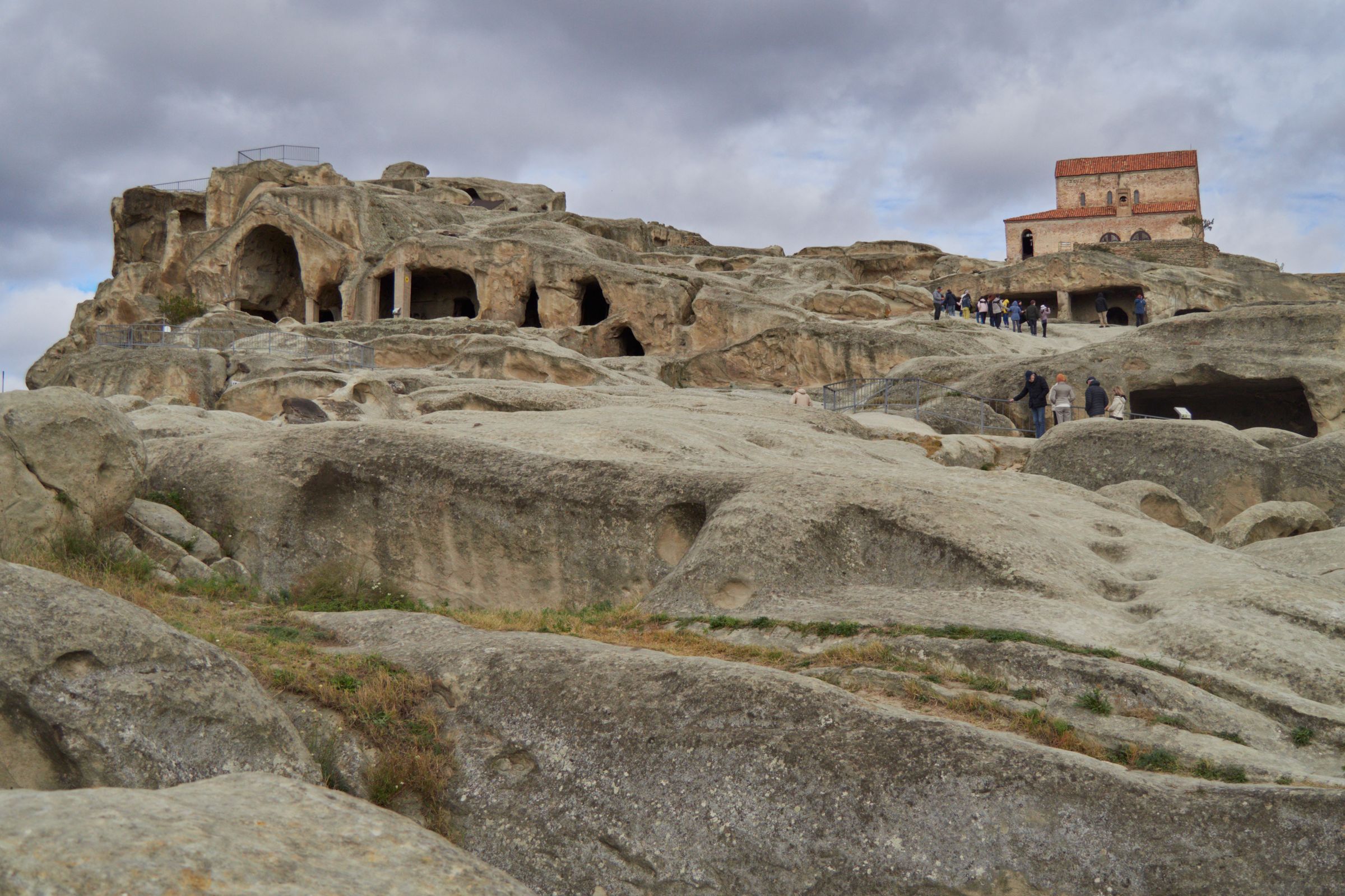
Uplistsikhe
Where stone swallowed centuries whole

A country of vineyards, watchtowers and high Caucasus light — told slowly, booked with care.
Kvemo & Shida Kartli is the historic heartland stretching south and west of Tbilisi across the Mtkvari valley — a region of cave cities, some of Georgia's oldest churches, a dramatic canyon, and the site where the world's earliest hominin fossils outside Africa were unearthed. Most visitors see it as a single long day trip from Tbilisi, pairing Uplistsikhe's cave city with Gori's fortress and Stalin Museum; those with a car and a spare day can add the Bolnisi inscription, Dmanisi's excavations, or Dashbashi's waterfall to build a fuller picture of inland Georgia beyond the capital.
This region rarely tops a Georgia itinerary, but it holds two sites of outsized global significance: Dmanisi's 1.8-million-year-old hominin fossils are among the most important paleoanthropological finds outside Africa, and the Bolnisi inscription at Bolnisi Sioni is the oldest dated Georgian text in existence. Neither draws the crowds of Uplistsikhe or Gori, which is exactly why they reward the travellers who make the detour.
The atlas holds 30 documented wonders here — archaeological site, canyon, cave, church, fortress, lake, monastery, museum. Base yourself in Gori and radiate outwards; nothing below is more than a day away.
Begin with these — then wander. Each card is a doorway, not a checklist.
Where stone swallowed centuries whole
Where stone speaks in ancient tongues
Where flamingos dance on volcanic lakes
Tbilisi's forested backyard with mountain views
Where Georgian stone first learned to pray
Crown of stone above Stalin's birthplace
Where ancient script first spoke Georgian
Sapphire walls in a forgotten valley
The dictator's birthplace, frozen in amber
Mirror of the Javakheti sky
Where stone blooms with medieval light
Where medieval walls guard humanity's ancient origins
Curated, not crowded. Our editors’ orders of merit — updated with the seasons.
Gori — arrivals, markets and the best spread of places to sleep.
Every wonder below is pinned on the national atlas with live availability beside it.
Every booking removes one tonne of CO₂ — folded in, never added at the end.
Gori is roughly ninety minutes from Tbilisi by marshrutka from Didube station or by train to Gori station, and functions as the natural base for Uplistsikhe, the fortress and the Stalin Museum. Bolnisi and Dmanisi lie south and southwest of Tbilisi on paved highways served by infrequent marshrutkas, though a private car or hired driver makes both far more workable as a single trip. Ateni Sioni, Dashbashi Canyon and the Trialeti kurgan all involve unpaved final approaches best handled with a high-clearance vehicle or a local driver rather than a standard rental car. April through June and September through October give the most reliable road conditions and the clearest light for photography across the region; Dashbashi's waterfall is strongest with spring snowmelt. Entry to Gori Fortress is free, and most sites here charge modest entrance fees rather than the premium pricing found at Georgia's headline attractions.
The Gori cluster — Uplistsikhe Cave Town, Gori Fortress and the Stalin Museum — works well as a single long day trip, roughly ninety minutes each way. Sites further south, like Dmanisi, Trialeti and Dashbashi Canyon, are better treated as separate day trips given the driving distances and unpaved final approaches involved.
Not for the Gori cluster, which is reachable by marshrutka or train from Tbilisi. But Ateni Sioni Church, Dashbashi Canyon, the Trialeti kurgan and parts of Dmanisi's approach involve unpaved roads that are far easier with a private car or hired driver, and in some cases require a high-clearance vehicle.
It's worth visiting precisely because it hasn't been substantially reframed since the Soviet era — it functions as an unaltered artifact of a personality cult rather than a balanced historical account, and is most valuable to visitors who arrive aware of that framing rather than expecting critical context on-site.
Excavations beneath the medieval fortress uncovered hominin fossils roughly 1.8 million years old — among the earliest evidence of early humans outside Africa found anywhere in the world — alongside the fortress ruins themselves and an active excavation area still being worked in season.
April through June and September through October give the most reliable road conditions for the unpaved approaches to Ateni Sioni, Dashbashi Canyon and Trialeti, and the clearest light for photography generally. Late spring also gives Dashbashi's waterfall its strongest flow from snowmelt.
High passes, wine roads, and the slow coast — open the national atlas and plot a generous route.
See Kvemo & Shida Kartli on the atlas →Late spring and September–October bring harvest light, open high roads, and terrace weather. Winter is for ski villages and sulphur baths; high summer belongs to the Black Sea. Shoulder months reward the unhurried.
Many travellers enter visa-free for a generous stay. Always confirm current entry rules for your passport before you book — then spend the saved hour on a long lunch.
Marshrutka minibuses, comfortable coaches, a handful of trains, and hired drivers cover most ground. Mountain roads ask for daylight and patience. Build slack into every itinerary.
Every booking removes 1 tonne of CO2 — no surcharge. It is included, not optional, and never an excuse to travel carelessly. Stay longer; spend locally; tread lightly on alpine meadows.
In cities and guesthouses, yes — and a few words of Georgian open every door. Look for the script; it is part of the landscape. Menus often arrive in three languages, like this site.
25 August 2026 · reviewed quarterly