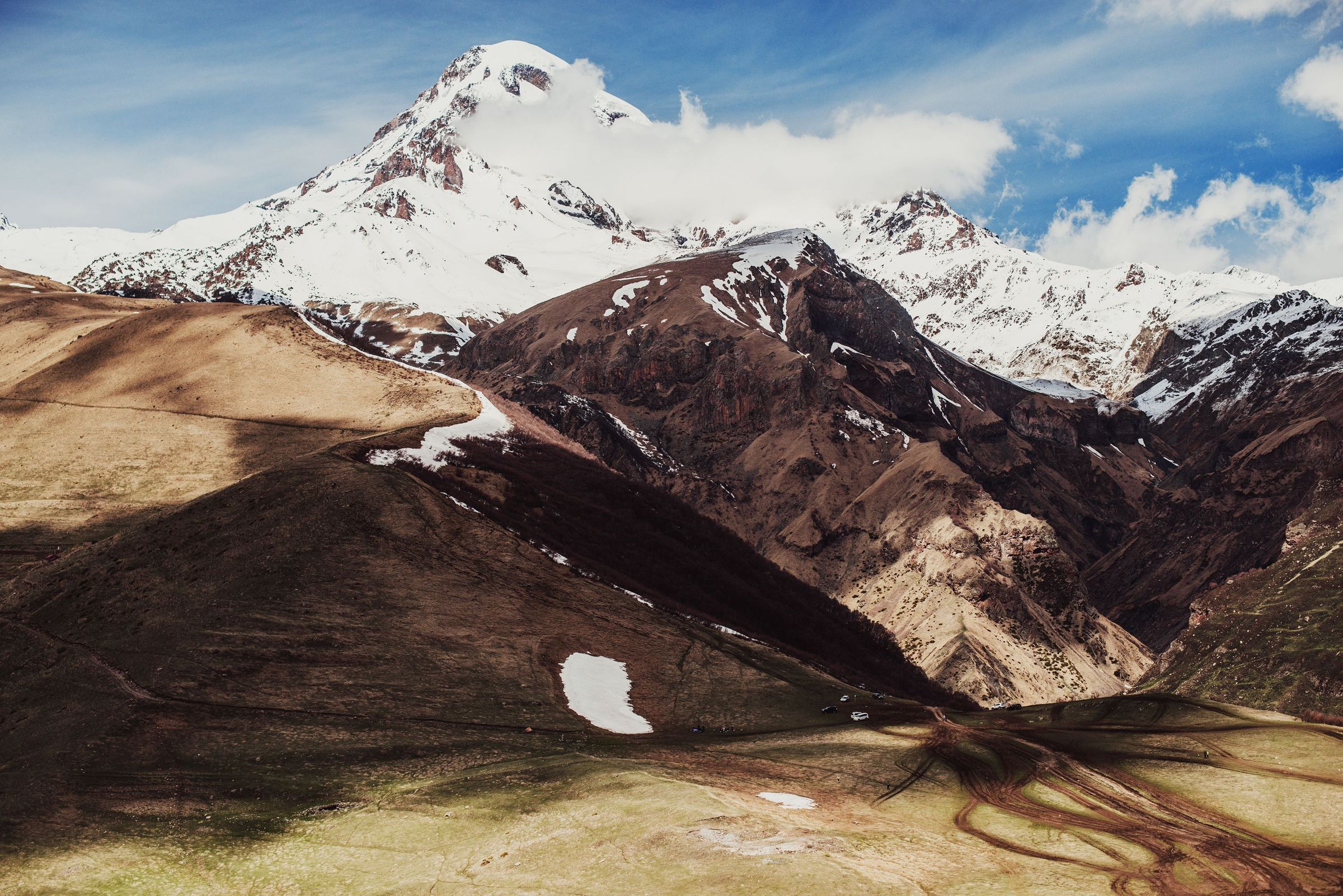
Best for iconic alpine scenery
Mount Kazbek's dormant volcanic cone anchors this park at the edge of Georgia's Military Highway, and no single image sells Georgia to first-time visitors faster than the 14th-century Gergeti Trinity Church silhouetted against its glacier. What sets Kazbegi apart is how little compromise the drama demands: the church is a short 4WD ride or a two-hour uphill walk from Stepantsminda, yet the park behind it holds a genuine high-Caucasus ecosystem of ibex, bearded vultures, and glaciers calving into the Terek River. Serious trekkers push further, toward the 3,660-meter glacier itself or the multi-day Kazbek summit route with crampons and a registered guide, while day-trippers get the postcard without the commitment. The nearby Juta valley and Chaukhi Massif — nicknamed the 'Georgian Dolomites' for their jagged spires — extend the park's appeal to a second or third day. Because it sits three hours from Tbilisi on a paved road, Kazbegi absorbs more visitors than anywhere else on this list; go early morning or stay overnight in Stepantsminda to see the church before the tour buses arrive.
Mtskheta-Mtianeti
Best for serious multi-day hiking
At 85,000 hectares, this is Georgia's largest national park and its most complete trail network — twelve marked routes threading through Lesser Caucasus forest that Tsarist Russia once prized for its mineral springs rather than its wilderness. The signature challenge is the 54-kilometer Crossing of Borjomi, a multi-day traverse through boxwood and yew stands old enough to have survived the last Ice Age, past shepherd camps and the ruined Lomismta Church. Shorter options exist too: the six-hour Trail #1 circuit from Likani rewards without an overnight kit. Wolves and brown bears still hold territory here, and rangers ask hikers to register at the Borjomi or Kharagauli visitor centers before setting out — some routes require a local guide. The park's dual identity, spa town on one side and untouched temperate rainforest on the other, means a trekking day can end with a mineral bath rather than a tent. Trails open May to October; permits are free but mandatory, and this is where Georgia's hiking infrastructure is most organized and best marked.
Samtskhe-Javakheti
Best for remote highland culture
Getting to Tusheti is as much the point as arriving. The only road in crosses the Abano Pass at 2,850 meters — Georgia's highest drivable route, open a scant four months a year and closed the moment the first snow falls — and the 4WD switchbacks alone filter out anything but committed travelers. What waits on the other side is a living highland culture rather than a museum of one: Tush shepherds still drive flocks between Kakheti's lowlands and these alpine pastures each spring and autumn, a transhumance tradition old enough to have drawn UNESCO's attention. Villages like Dartlo and Omalo keep their medieval stone defense towers standing and, in places, still inhabited. The multi-day Atsunta Pass trek toward Khevsureti crosses bearded-vulture habitat and wild rhododendron slopes for those with days to spare; shorter loops around Omalo suit a long weekend. There is no fuel, no bank, and no clinic inside the park, so come provisioned. Base in Telavi before the ascent, and treat the short season as a reason to plan ahead rather than a deterrent.
Tusheti
Best for desert and canyon scenery
Nothing else in Georgia looks like Vashlovani. In the country's far southeastern corner, 35,000 hectares of semi-arid steppe replace the Caucasus's usual green with ochre badlands, wind-carved hoodoos locals call 'Dedeckhoda,' and a genuine mud volcano at Takhti-Tepa that still bubbles cold grey clay through cracked earth. Wild pistachio woodlands — descendants of trees that once shaded Silk Road caravans — line the seasonal rivers, and the park protects one of Europe's last populations of goitered gazelle alongside wolves and imperial eagles. This was a restricted military zone through the Soviet period, which is part of why it still feels genuinely wild rather than managed for visitors. A 4WD is not optional here, and neither is the advance permit, arranged through the Agency of Protected Areas in Tbilisi or the park office near Dedoplistsqaro. Go at dawn or dusk in spring or early autumn, when the canyon walls run through bands of rust and violet and the heat hasn't yet made midday hiking uncomfortable. Base in Sighnaghi for the approach.
Kakheti
Best for a rewarding day hike
Founded in 1912, Lagodekhi is Georgia's oldest protected area, and more than a century of continuous conservation shows in the scale of its beech and boxwood forest — some trees have stood for over two hundred years, climbing from the Alazani valley floor toward the Dagestan border. The park's best-known outing, the Ninoskhevi Waterfall trail, covers roughly eight kilometers round trip through old-growth canopy to a 40-meter cascade, an achievable half-day for a moderately fit visitor and one of the most satisfying short hikes in eastern Georgia. Ambitious trekkers can continue toward Black Rock Lake, a glacial cirque at 2,780 meters on the Russian border, though that route demands a permit, a local guide, and a full day or overnight. Brown bear and East Caucasian tur inhabit the higher reaches, largely unseen by day hikers. Because it sits an easy drive from Telavi and the Kakheti wine region, Lagodekhi pairs naturally with a wine-country itinerary rather than requiring its own dedicated trip. Permits (roughly ₾15–25) are required year-round and arranged at the park office.
Kakheti
Best for wetland boat trips
Kolkheti protects the drowned, reed-choked landscape of Georgia's Black Sea lowlands, where the Rioni and Pichori rivers dissolve into brackish Paliastomi Lake before reaching the sea — a version of the ancient Colchis region that Jason's Argonauts, in myth, would still recognize. This is not hiking country; it's a boat country, with flat-bottomed craft poling through channels walled in reeds three meters tall to reach pelican and heron colonies, and the visible point where the Pichori's fresh water swirls into salt. The park anchors one of Europe's most significant peat bog systems and a genuine stop on the Black Sea migratory flyway, drawing sea eagles and pygmy cormorants alongside more common waterfowl. There's no formal entrance gate — tours depart informally from Grigoleti village or Poti, arranged through park headquarters or local ecotourism operators, and a morning excursion fits easily around a Batumi coastal stay. Visit April through October; migratory concentrations peak outside the summer heat, and a slow boat at dawn is worth more here than any trail.
Samegrelo-Zemo Svaneti
Best for large-scale birdlife
Five reserves — Saghamo, Madatapa, Khanchali, Bugdasheni, and Kartsakhi — sit across a 2,000-meter volcanic plateau in Georgia's deep south, their lakes formed where ancient lava flows dammed shallow depressions into wetland. The scale of birdlife here rivals anywhere on the African-Eurasian flyway: over 140 species pass through, and the sight of a flamingo flock lifting off Khanchali Lake at dawn, thousands of birds catching first light, is among the more genuinely spectacular wildlife moments Georgia offers, with almost no crowd to share it. Dedicated observation towers at Khanchali and Madatapa make the spectacle accessible without disturbing nesting colonies. The plateau has its own quiet character too — Armenian and Georgian shepherd communities have worked this austere grassland for generations, and a handful of stone-tower villages, like Saghamo, still stand at the water's edge. Reach the reserves by paved road from Akhaltsikhe or from the town of Ninotsminda; gravel spurs closer to the lakes can flood during spring snowmelt. Visit May through September for both reliable access and peak bird activity.
Samtskhe-Javakheti
Best for rainforest and easy coastal access
Mtirala means 'weeping' in Georgian, a fitting name for one of Europe's wettest corners — roughly 4,500mm of rain a year keeps this Adjara park in a permanent green haze. That rainfall sustains a relict Colchic rainforest that survived the Ice Ages that scraped bare much of the rest of Europe: Pontic rhododendrons grow to the size of trees, lianas wrap ancient oaks, and brown bear, lynx, and the elusive Caucasian salamander all still find cover in the understory. The main outing, a seven-kilometer trek along the Tsablnari Trail through boxwood and yew to the Mtsvane Kontskhi waterfall, works as a half-day trip, while the push to the 1,381-meter summit trades jungle for open wildflower meadow within a single hike. Its real advantage over Georgia's other rainforest parks is proximity — Kobuleti sits 25 kilometers away and Batumi just 35, meaning a Black Sea beach holiday can absorb a rainforest day without much rearranging. Trails run muddy year-round, so waterproof boots aren't optional; visit May through October and expect rain regardless of the forecast.
Adjara
Best for an easy Tbilisi day trip
Sixty kilometers from the capital, Algeti is the national park Tbilisi residents actually use — a Sunday habit for generations rather than a bucket-list pilgrimage — and it works just as well for a visitor with a spare morning and no interest in a multi-day itinerary. The park sits at a genuine ecological crossroads, where the humid broadleaf forest typical of western Georgia meets the drier hornbeam-and-oak woodland of the east, supporting roe deer, wild boar, and over a hundred recorded bird species across just 6,800 hectares. The main trail climbs to the Tbilisi TV Tower on Mount Tabori at 1,275 meters for a panorama over the capital and the Lesser Caucasus beyond, achievable in a few hours without technical difficulty. Old-growth oak along the Algeti River gorge and stone picnic tables near the entrance — genuinely used by local families, not staged for tourists — round out a low-effort outing. Reach it by marshrutka from Tbilisi's Didube station to Manglisi, then a short taxi or walk. Best visited May through October.
Kvemo Kartli