Khinkali
Best for understanding the highlands
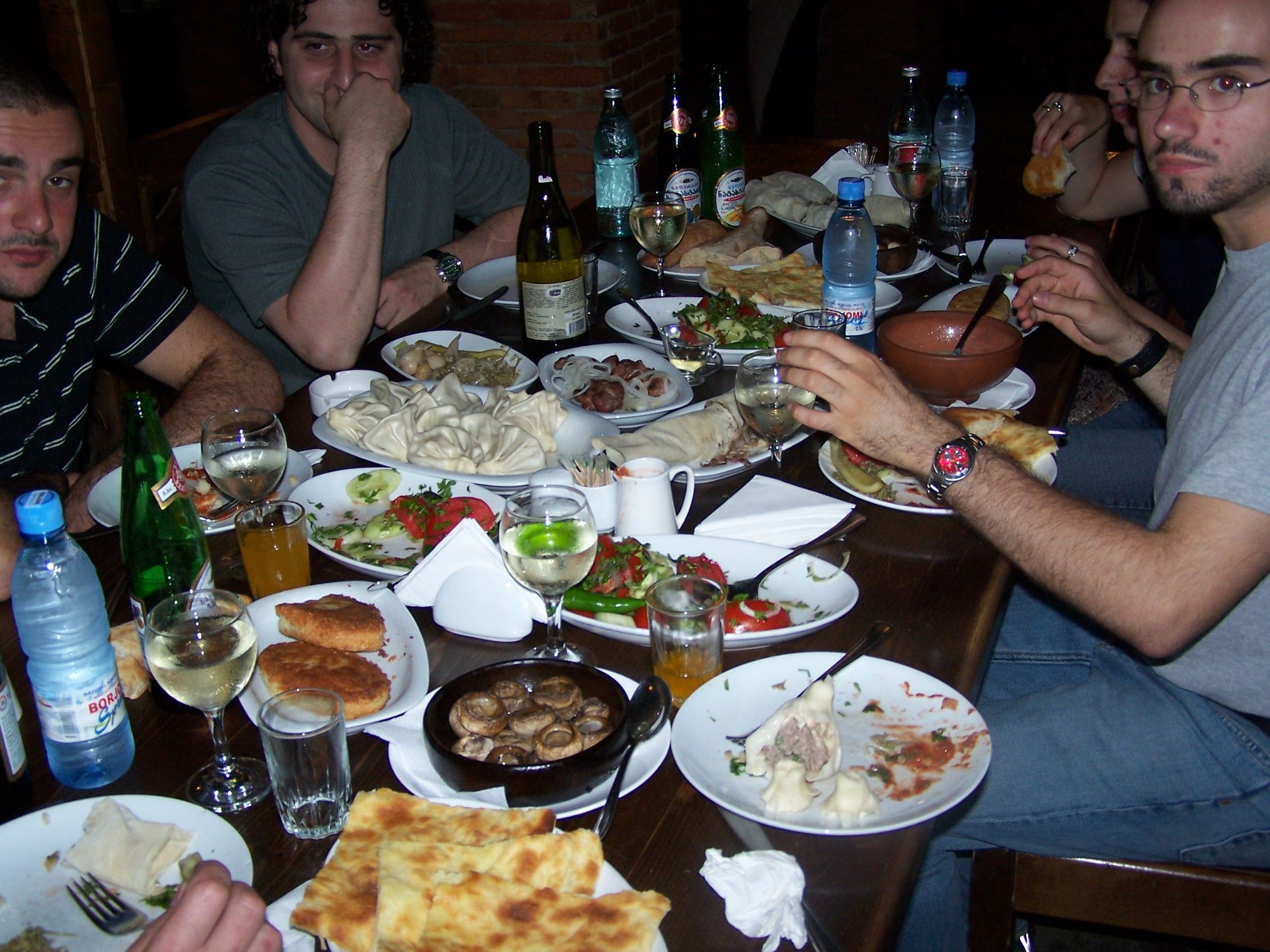
Khinkali are pleated dumplings stuffed with spiced meat and its own broth, pinched into a topknot that you hold by hand and never eat — it exists purely as a handle, and discarding a pile of them on your plate is normal, not wasteful. They are widely said to have originated in the mountainous Mtiuleti area around Pasanauri, at the confluence of the White and Black Aragvi rivers, before spreading nationwide as a working-class staple that outgrew its region. The proper technique is to bite a small hole, sip the broth first, then eat the rest — cutlery signals a tourist. In Tbilisi they turn up thin-skinned and refined; in the mountains, on the road toward Kazbegi, they arrive thicker and heartier, built for cold weather and hard travel rather than presentation. No dish moves between social classes and regions as freely as this one, which is exactly why it explains Georgia's highland roots to the whole country at once.
Khachapuri Acharuli (Adjaran Boat)
Best for coastal indulgence
The Adjaran khachapuri is unmistakable: an open boat of leavened dough filled with molten sulguni and imeruli cheese, finished tableside with a raw egg and a knob of butter that the diner stirs into the cheese before tearing off the crust to dip. It comes from Adjara, Georgia's subtropical Black Sea region, and reads as a coastal answer to the country's other khachapuri styles — richer, more theatrical, built for a resort city with Ottoman-influenced trading history and a boardwalk to be photographed on. Batumi is where it is done properly and often, though it now appears on menus nationwide, usually diluted. Order it as your one full meal, not a side: it is dense, and the ritual of breaking bread into the yolk is part of the point, not an optional flourish. It pairs well with a walk along Batumi's waterfront before or after, which is where most visitors first encounter it.
Khachapuri Imeruli
Best for everyday eating
The Imeruli khachapuri is the version Georgians actually eat most: a round, sealed disc of dough with cheese baked inside rather than piled on top, sold at bakery windows and market stalls as casually as a sandwich elsewhere. It comes from Imereti, the fertile region around Kutaisi with a humid climate suited to the tangy, elastic sulguni cheese at its centre — the same cheese, sold fresh and still warm, that fills the stalls of Kutaisi's Central Market alongside shoti bread from clay toné ovens. Unlike the Adjaran boat, it needs no cutlery, no ritual and no sitting down, which is exactly why it is the version most often eaten on the move, between train platforms or market stalls, rather than as a set-piece meal. If you want to understand why khachapuri is treated as everyday food rather than a special occasion, Imereti is where that logic holds together.
Pkhali
Best for vegetarian travellers
Pkhali are cold vegetable pâtés — spinach, beetroot, leek or cabbage, each finely minced and bound with ground walnut, garlic and blue fenugreek, then often rolled into small balls and topped with a scatter of pomegranate seeds. They appear at nearly every supra as the first wave of plates, before the hot dishes arrive, and exist precisely so a table can look and taste abundant without meat dominating it. This matters more than it first appears: Georgia has a long Orthodox fasting calendar, and pkhali is one of the dishes that let observant households eat well on fasting days without feeling deprived. For a modern vegetarian traveller the effect is the same — a proper spread of three or four different pkhali, with bread and a glass of amber wine, is a full and satisfying meal on its own, not a workaround. It travels well as a concept too: nearly every region makes some version, so it is never hard to find.
Lobio
Best cold-weather comfort food
Lobio is a slow-cooked bean stew, most often red kidney beans simmered with onion, coriander and walnut until it thickens into something closer to a rich chili than a soup, and it is usually brought to the table still bubbling in the individual clay pot it was cooked in. It is paired almost automatically with mchadi, a dense cornbread that exists specifically to scoop it, and the combination is the closest thing Georgia has to a national comfort meal for cold months. Racha-Lechkhumi, up in the mountains toward Ambrolauri, takes the same beans and bakes them inside bread instead — lobiani — turning the stew into a portable pastry for travellers and shepherds who could not sit down to a pot. Either version costs a fraction of a meat dish and explains something real about Georgian eating: the everyday table runs on beans, walnuts and bread far more than the meat-heavy supra spread suggests to first-time visitors.
Chakhokhbili
Best for a home-style family meal
Chakhokhbili is chicken (traditionally pheasant, hence the name) braised down slowly with a large volume of fresh tomatoes, onion and coriander until the sauce reduces to something thick and deeply savoury rather than watery. It is a home dish before it is a restaurant one — the kind of thing served at a family table on an ordinary Sunday rather than dressed up for a feast — and it tends to appear on guesthouse menus in wine country, where tomatoes ripen through a long warm summer and coriander grows easily in kitchen gardens. Kakheti's guesthouses, particularly around Telavi, do a version worth seeking out because the tomatoes are usually their own. It is a useful corrective to the idea that Georgian food is all dumplings and cheese bread: this is the vegetable-forward, herb-heavy cooking that actually fills most weeknight tables, built around what a household garden produces rather than what a tourist menu expects.
Chakapuli
Best spring-season dish
Chakapuli is a stew of lamb or veal braised with a heavy hand of fresh tarragon and unripe green plums (tkemali), producing a sharp, herbal, sour-forward flavour that is unlike almost anything else on a Georgian menu — it reads closer to a spring tonic than a winter stew. It is tied specifically to the season: tarragon and green plums are both at their best in April and May, which is also when chakapuli is traditionally served around Orthodox Easter, making it as much a calendar marker as a recipe. Order it outside that window and kitchens are working from preserved or frozen plums, which is fine but noticeably less bright. Kakheti's vineyard guesthouses make a strong version because the same gardens growing grapes for wine also grow the tarragon and plum trees the dish needs. If your trip lands in spring, this is the one dish on this list worth actively timing around.
Mtsvadi
Best supra centrepiece
Mtsvadi is skewered meat — usually pork, sometimes beef or lamb — grilled over grapevine-wood embers rather than charcoal, which gives it a lighter smoke than a typical barbecue and ties it directly to Georgia's wine country, where vine cuttings are a free byproduct of pruning. It is the dish built to anchor a long supra: served last among the hot courses, cut simply, and eaten alongside the toasts rather than as the meal's opening act. Kakheti's vineyard picnics, particularly around Sighnaghi and Telavi, are where it is done with the least ceremony and the best result — a fire pit in a vineyard, a case of the host's own wine, and meat that has been marinating since the previous night. It is one of the few dishes on this list where the setting genuinely changes the experience: the same skewer eaten in a Tbilisi restaurant is fine, eaten beside the vines it was grilled over is memorable.
Satsivi
Best festive dish
Satsivi is poached chicken or turkey served cold, blanketed in a thick, garlicky walnut sauce coloured golden with saffron and dried marigold — a dish built for the table rather than the plate, meant to sit out and be returned to over hours. It is most associated with Georgia's New Year and Christmas spread, alongside gozinaki (a honeyed walnut brittle), and its origins trace to western Georgia's walnut-rich growing regions around Samegrelo and Imereti, where walnut sauces do far more heavy lifting than dairy or butter. Because it is served cold, it also functions as a practical solution for a household cooking for a large gathering without needing everything to come off the stove at once. Outside the winter holidays it still appears on set-menu supras aimed at showing a visitor the fuller range of the table, and it is worth trying even off-season — the walnut sauce alone explains a lot about why Georgian cooking leans on nuts rather than cream for richness.
Kubdari
Best for trekkers and mountain travellers
Kubdari is a dense, savoury bread from Svaneti, filled with chopped meat, onion and a heavy dose of Svan salt — a herb-and-spice blend unique to the region — then baked until the crust seals in the juices. It was built as trail food for a place where the terrain demands it: Svaneti's towers and villages sit at altitude among some of the highest permanently inhabited settlements in the Caucasus, and a bread that keeps for days without refrigeration and delivers real calories was a practical necessity long before it was a tourist novelty. Mestia's guesthouses now serve it as a sit-down dish, but it earns its place on this list because it still explains the region better than any monument does: isolated, self-sufficient, and cooking built around what keeps a person moving through mountains rather than what looks good on a plate. Pair it with the trek up toward Ushguli if you can, ideally carrying one rather than eating it seated.
Badrijani Nigvzit
Best cold starter
Thin strips of fried or grilled aubergine are rolled around a paste of ground walnut, garlic and blue fenugreek, then chilled and topped with pomegranate seeds — a starter that is simple to make, keeps well, and turns up on nearly every supra table across the country regardless of region. It shares its walnut-and-fenugreek base with pkhali, and the two are often served side by side, but the aubergine gives badrijani nigvzit a smokier, meatier texture that makes it satisfying even to diners who came for the meat dishes. It is a useful dish for a first-timer specifically because it is unintimidating: no bones, no unfamiliar textures, nothing that needs explaining before you eat it, and it introduces the walnut-forward flavour profile that runs through much of Georgian cooking without any of the ceremony. Nearly any restaurant in Tbilisi does a competent version, which makes it a low-risk, high-reward first order on an unfamiliar menu.
Churchkhela
Best portable snack and souvenir
Churchkhela is made by threading walnuts or hazelnuts onto a string, dipping them repeatedly into thickened grape must until they build up a firm candy shell, then hanging them to dry — the result looks like a small candle and is sometimes called Georgia's answer to a candy bar, though it predates the comparison by centuries. It is directly tied to the wine harvest: grape must (tatara) is a byproduct of pressing, so churchkhela has traditionally been made in Kakheti's wine villages in autumn, right after rtveli, as a way of using what would otherwise go to waste. Strings of it hang in market stalls across Telavi and Sighnaghi in the harvest months, and it keeps for months afterward, which is why it travels home better than almost anything else on this list. It is also one of the few dishes on this list children eat as readily as adults, making it a reliable way to close out a family meal or a market visit.