The Secular New Year Supra (31 December)
Best for understanding the feast before you sit down to it
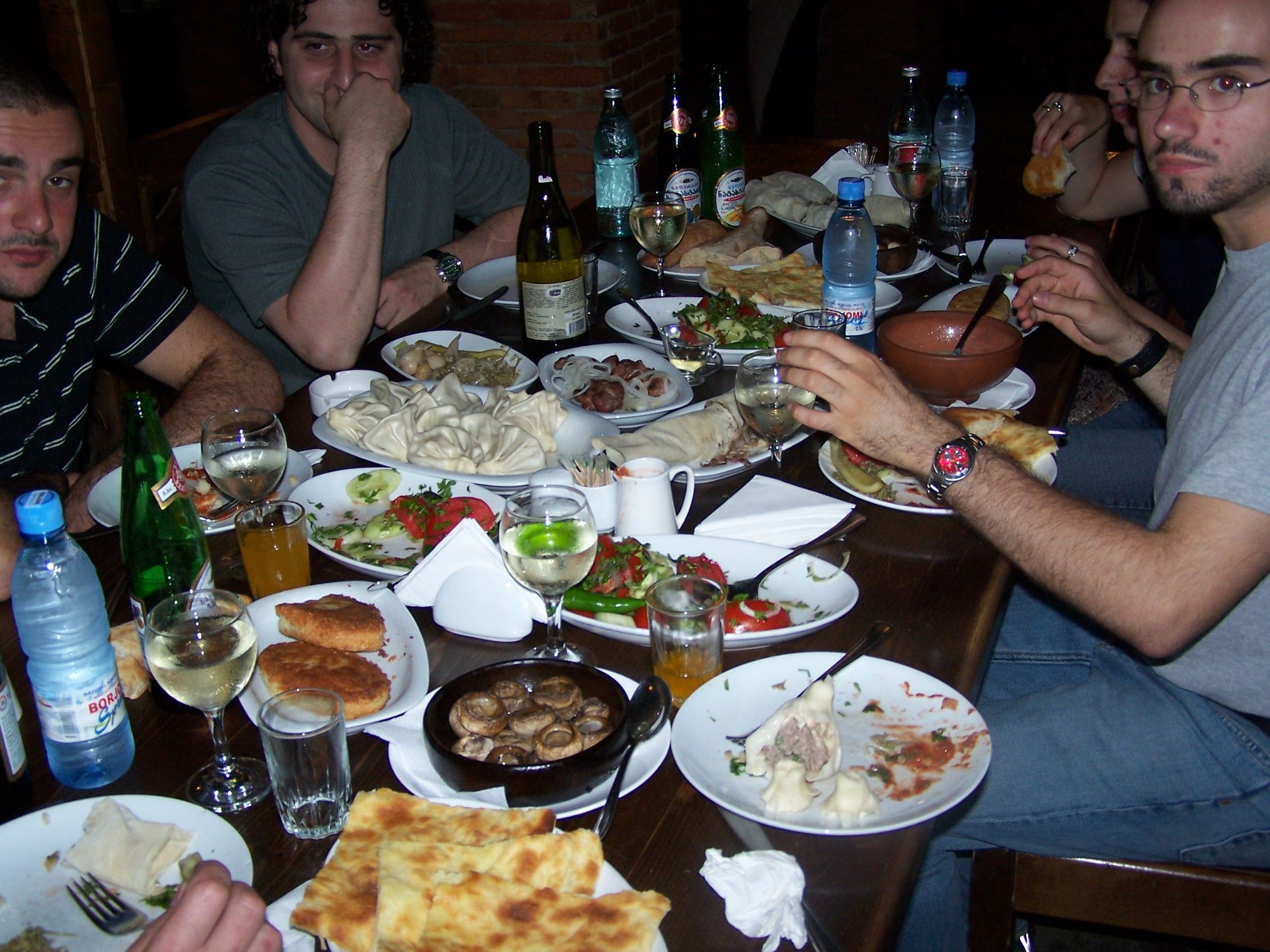
Georgia's calendar year ends the way most of its important days do: at a long table. The 31 December supra is less about a countdown and more about abundance — the table is meant to groan under food that will, by superstition, predict the fullness of the year ahead, so hosts lay out far more than any table could finish. Basila, a round bread with a coin baked inside, appears specifically at this feast; whoever finds the coin is promised luck for the coming year. Gozinaki, walnuts set in honeycomb-thick caramelized syrup, is the other fixture of the season, made in batches from December through Old New Year. A tamada still leads the toasts, but the sequence bends toward the year past and the year coming rather than the usual ancestors-and-family order. Fireworks over the city mark midnight, and families move between houses over the following days rather than treating the 31st as the only occasion — the season is a stretch, not a single night.
Midnight Over Tbilisi Old Town
Best for the countdown and fireworks
Tbilisi Old Town is where most visitors will actually be at midnight, and it earns the spot: the tangle of streets around Narikala's hillside and the Mtkvari riverbanks fills with families out walking after their own suppers, and the fireworks display over the river is visible from the bridges and embankments without needing a ticket or a reservation. The old district survived Persian, Arab, Mongol, Russian and Soviet rule, and on New Year's Eve its carved wooden balconies and narrow lanes are lit and busy rather than shuttered, which is not true of every month of the year. Rike Park, across the river, gives an open sightline back toward the Old Town hillside and the illuminated Holy Trinity Cathedral (Sameba) on its own hill — at 101 metres, deliberately built taller than any other church in the Caucasus as a statement of Georgia's post-Soviet religious revival, it is lit through the season and visible from much of the city.
Christmas Eve Liturgy at Svetitskhoveli Cathedral
Best for the religious heart of the holiday
Georgia keeps Christmas on 7 January, following the Julian calendar the Georgian Orthodox Church has never abandoned, and the Christmas Eve liturgy on the night of 6 January is the season's most solemn moment. Svetitskhoveli Cathedral in Mtskheta — founded in 1010, and considered Georgia's spiritual heartbeat since legend holds Christ's robe was buried on the site in the 1st century — holds one of the country's most significant Christmas services, packed with worshippers standing through a liturgy conducted largely in candlelight and incense. Visitors are welcome to observe respectfully from the back of the nave; modest dress (covered shoulders and knees, a headscarf for women) is required, as it is year-round. Mtskheta itself, 20 minutes from Tbilisi by marshrutka from Didube station, is easy to combine with a look at nearby Jvari Monastery on the same short trip, though the church itself may close briefly around the liturgy for logistics.
Alilo, the Christmas Morning Procession
Best for a tradition you can actually watch on the street
On the morning of 7 January, Alilo takes the Christmas story out of the churches and into the streets: children and adults in white robes, some carrying icons, banners, or handbells, parade through town singing carols and collecting food and small gifts to distribute to the poor and to orphanages. It is one of the few Georgian religious customs that is built for public viewing rather than private observance — processions converge on the main cathedral in most towns, and in Tbilisi the route runs toward Tbilisi Sioni Cathedral and the Holy Trinity Cathedral (Sameba) in the Old Town area, with a smaller, equally sincere version playing out in Mtskheta around Svetitskhoveli on the same morning. The custom dates back centuries and was revived publicly after Georgian independence, and its charity element — gathering for the needy rather than only celebrating — is treated as the point of the day, not decoration around it.
A Kakheti Wine-Country Supra
Best for the feast itself, done properly
If the New Year season has a spiritual capital of hospitality, it is Kakheti, where qvevri wine has been fermented in buried clay vessels for roughly 8,000 years — a method UNESCO recognises as Intangible Cultural Heritage. A family cellar or working winery along the Kakheti Wine Route, or in Sighnaghi itself, gives the fullest version of a holiday supra: a tamada leading the toast sequence at length, cold dishes refreshed rather than plated in courses, and wine poured from the household's own harvest rather than a bottle bought for the occasion. Alaverdi Monastery, a 6th-century foundation whose monks have made wine continuously for centuries, sits at the heart of this landscape and is worth pairing with the meal itself. Winter is quieter here than the September rtveli harvest, but that suits the season — New Year hospitality in Kakheti is a fireside, family-paced affair rather than a crowded one.
A Snow-Bound New Year in Gudauri
Best for a mountain version of the same ritual
Not every Georgian family spends the season at a lowland table — the resort towns of the Greater Caucasus run their own New Year, with skiing by day and a supra by night rather than one replacing the other. Gudauri, at 2,196 metres on the military road through the Cross Pass, is Georgia's most developed winter resort, with Mount Kazbek's 5,047-metre summit visible from the lifts on a clear day; the season's toasts here happen in guesthouse dining rooms with a mountain rather than a river view. From Gudauri, or from Kazbegi town below it, the Gergeti Trinity Church at 2,170 metres — built in the 14th century as a refuge for Georgia's most sacred relics during Persian invasions — sits under snow through the entire holiday period and is reachable by 4x4 when the walking path is impassable. The Tbilisi–Gudauri highway can close intermittently in heavy snow, so this stretch of the season should be planned with flexibility, not a fixed schedule.
Old New Year in Sighnaghi (13–14 January)
Best for a quiet, low-crowd finale to the season
Georgia's holiday season doesn't end with Orthodox Christmas — it closes almost two weeks later with Kalanda, or Old New Year, the 13 January date that marks New Year's Eve on the Julian calendar still followed for religious observance. By this point the loudest celebrations are over, and the mood is domestic: a final, smaller supra, more basila and gozinaki finishing out the season, and quiet family visits rather than fireworks. Sighnaghi, the walled hill town above the Alazani Valley built by King Erekle II to defend Kakheti from Persian and Dagestani raids, is an ideal place to let the season wind down — its cobbled streets and balconied houses are close to empty of coach traffic by mid-January, and nearby Bodbe Monastery, resting place of St Nino who brought Christianity to Georgia in 337 AD, offers a genuinely peaceful close to three weeks of feasting.