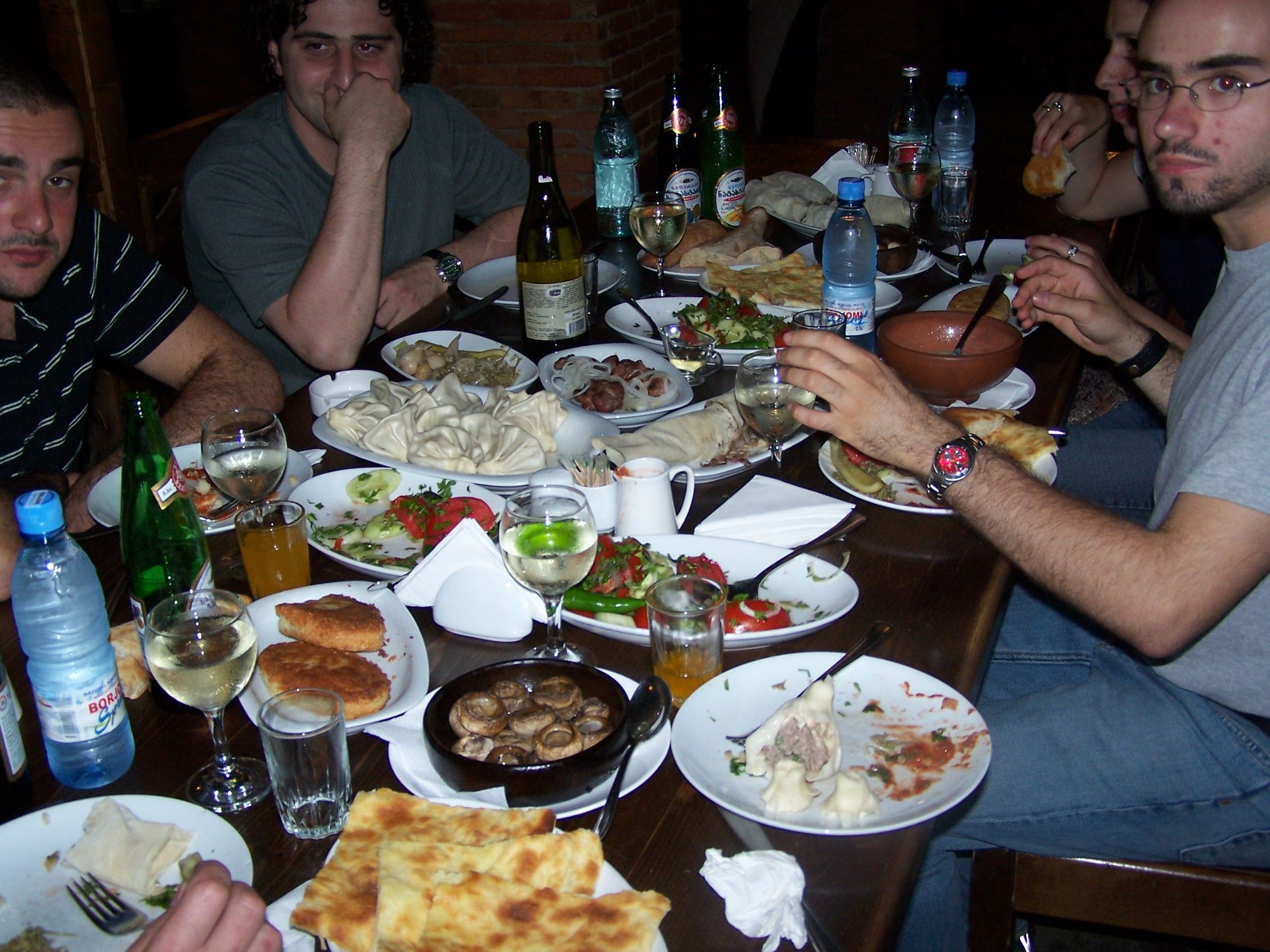
Pheasant's Tears Winery
Best for a chef-composed harvest supra
Pheasant's Tears, founded in 2007 by American painter John Wurdeman with Kakhetian winemaker Gela Patalishvili, runs its restaurant as an extension of the cellar below it, not a bolt-on. Seasonal Kakhetian dishes are built to match whatever amber and red wines are being drawn from the buried qvevri that day, and long shared tables mean solo travelers and couples routinely end up seated alongside Georgian families and other visitors mid-toast. The winery's name comes from a local saying that only wine worth drinking makes the pheasant weep, and the meal is built to earn it: expect several courses, a tamada (toastmaster) if the table has enough people, and no rush to clear plates. Visit during rtveli, the September–October harvest, and you may find grapes still being pressed by foot in the courtyard before dinner starts. Reserve ahead, especially for the harvest weeks, and come hungry rather than in a hurry.
Fabrika
Best for a first supra, no booking needed
Fabrika occupies a resurrected 19th-century textile factory on the edge of Tbilisi's Old Town, and its Soviet-era sewing hall now runs as a canteen-style food court pouring natural wine from Kakhetian producers alongside khinkali and other Georgian staples. It is not a formal supra in the countryside sense, but it is the easiest place in the capital to end up sharing a long table and a bottle with strangers, both Georgian and foreign, without a reservation or a driver. Digital nomads, street artists, and locals mix at communal benches under original brickwork, and the rooftop bar above catches golden-hour views toward Narikala Fortress. It works best as a warm-up: the toasting culture here is looser and more improvised than a wine-estate feast, which makes it the gentlest place to practice raising a glass before heading out to Kakheti or the mountains. Best from late afternoon into evening.
Twins Wine Cellar
Best for a hands-on cooking-and-toasting feast
In the village of Napareuli, brothers Gia and Gela Gamtkitsulashvili don't just pour wine from their qvevri marani — they fold visitors into the actual work of the household. Hands-on sessions have guests baking shoti bread and shaping khinkali in the traditional kitchen before sitting down to eat what they made, paired with vertical tastings of the family's Rkatsiteli and Kisi. Because the meal grows out of shared labor rather than arriving pre-plated, the toasting that follows feels earned rather than performed, and the attached Museum of Viticulture and Ethnography gives context — 19th-century drinking horns and cellar tools — for why the table works the way it does. Rtveli, the September–October harvest, is the fullest version of this, with grape-crushing added before the cooking begins. Book ahead; the family's schedule bends around the season, and availability during harvest weeks fills quickly.
Khareba Winery
Best for a group-tour supra in a dramatic setting
Khareba's defining feature is a 7.7-kilometer tunnel bored into the limestone foothills near Kvareli, built for the Soviet military in 1962 and repurposed in 2005 to age wine at a constant 12–14°C. Groups touring the tunnel end their visit at a traditional Kakhetian house on the grounds, where bread-baking and churchkhela-making demonstrations lead into a hosted meal and tasting comparing qvevri wines against the estate's European-style bottlings. It suits travelers who want the ritual of a supra — toasts, shared plates, a table that keeps refilling — without needing to arrange it themselves, since Khareba runs as an organized visit with English-language guiding and advance booking rather than an improvised village invitation. It's a more scripted table than a family cellar, but a genuinely well-run one, and the tunnel beforehand gives the meal a sense of occasion few other estates can match.
Schuchmann Wines Chateau
Best for an overnight built entirely around the table
Schuchmann, a German-Georgian winery and boutique hotel in Velistsikhe, is one of the few Kakheti estates where the supra isn't a day-trip add-on but the reason to stay the night. Guests tour a cellar running qvevri and steel fermentation side by side, taste Rkatsiteli and Saperavi on a terrace facing the Alazani Valley and the Greater Caucasus, and then move indoors for an estate dinner where the pours and the toasts keep coming well after the official tasting ends. Staying overnight rather than arriving for a single tasting session changes the pace: there's no bus to catch afterward, which is often the difference between a polite glass and a real evening. It suits couples or small groups who want their supra paired with comfortable rooms rather than a return drive to Tbilisi. Best visited May–October, roughly two hours from Tbilisi by car.
Lopota Lake Resort
Best for a resort-hosted feast that eases first-timers in
Lopota Lake Resort & Spa, built on a former Soviet collective farm around a 1.5-kilometer reservoir at 1,000 meters, pairs its own estate winery with a restaurant used to hosting travelers who have never sat through a full Georgian toasting cycle before. Meals draw on Kakhetian cuisine alongside Lopota's Saperavi, served with enough structure — a manager or host who explains what's coming — to feel welcoming rather than overwhelming for someone unfamiliar with the tamada's role. It's a gentler on-ramp than a family cellar for travelers nervous about etiquette, without losing the substance: real qvevri wine, real courses, real toasts, just delivered by a resort rather than a household. The setting helps too, with oak and beech forest reflected in still water and a lake trail to walk off the meal afterward. Reach it via the Gombori Pass, with the final stretch on unpaved road; best visited May through October.
Juta family guesthouses
Best for a mountain supra with polyphonic singing
Juta is the last inhabited settlement before Khevsureti dissolves into alpine wilderness, reachable only by a 20-kilometer unpaved 4WD road from Stepantsminda, and its handful of family guesthouses run their tables on necessity rather than tourism script. Overnighting here typically means eating korkoti — wheat with meat — at a shared table with whoever else is staying, and it's one of the few places left where Khevsur polyphonic singing is still performed rather than staged, sometimes breaking out unprompted once the toasting settles into its rhythm. There's no winery theater and no menu to choose from; you eat what the household is eating, which is precisely what makes it feel like the real thing rather than a version built for visitors. It rewards travelers already headed up to hike the Chaukhi lakes or cross to Roshka village. Reachable June through September; snow closes the road the rest of the year.