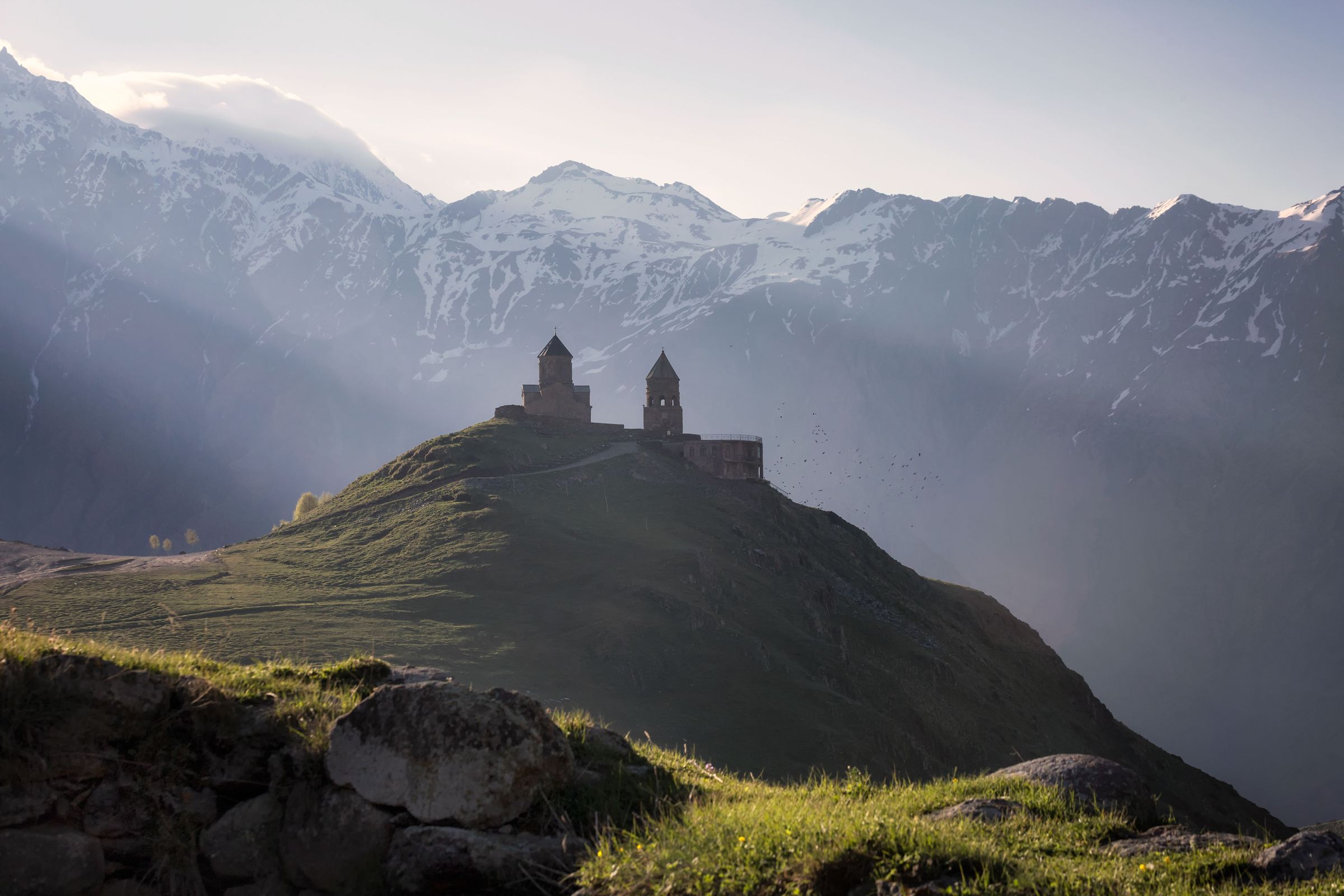
Best for a first encounter with Georgian Christianity
Jvari sits on the hilltop where, in the 4th century, St Nino planted the cross that converted King Mirian and made Georgia one of the first Christian nations on earth. The building that stands today was raised between 585 and 604 AD and is the oldest surviving church in the country — its tetraconch plan, a cross set inside a circle, became the template every later Georgian church builder worked from. Nothing here has been rebuilt or over-restored: the 6th-century stone altar screen and bema survive largely intact. The reason to come, beyond the history, is the view — Jvari stands directly above the point where the Aragvi and Mtkvari rivers meet, one pale, one dark, visible as a clean line from the churchyard wall. Ten minutes below is Mtskheta, Georgia's ancient capital, making the two impossible to separate on a visit. Go in late afternoon when the tour buses have thinned and the light turns the confluence gold.
Mtskheta-Mtianeti
Best for coronation history and royal tombs
Svetitskhoveli means 'Life-Giving Pillar', named for a legend involving Christ's robe, a cedar tree, and a healing spring — the details are told on-site, but the substance is straightforward: this was Georgia's coronation cathedral and the burial place of its kings for a thousand years. Built in 1010 under King George I by the architect Arsukisdze, it stands at the same river confluence as Jvari, in the walled old town of Mtskheta, and its scale still surprises visitors used to smaller Georgian churches — this is a cathedral in the fullest sense, with a cruciform plan, carved stone facades, and 17th-century wall paintings inside depicting the site's founding legend. The 12th-century royal gates carry bronze reliefs of the Ascension. Come with Jvari on the same day — they share a single ticketless, modest-dress visit and together explain how Georgian statehood and Georgian Christianity became the same story.
Mtskheta-Mtianeti
Best for Byzantine mosaics and medieval scholarship
David the Builder, the king who unified medieval Georgia and pushed back the Seljuks, chose Gelati as his life's crowning project in 1106 — not just a monastery but an academy of theology, philosophy and science, deliberately built as the intellectual capital of his revived kingdom. He is buried here, by his own request, beneath a plain stone at the monks' feet rather than in a grand tomb. The reason to make the trip from Kutaisi is what survives on the walls: a 12th-century mosaic of the Virgin and Child in the apse, executed by Byzantine masters, ranks among the finest surviving Byzantine mosaic work outside Constantinople itself. The academy building and scriptorium, where scholars trained into the 18th century, still stand alongside the church. Visit in the morning, when light comes through the eastern windows straight onto the mosaic — afternoon visits see it in shadow. Ten kilometres away, Bagrati Cathedral and Motsameta Monastery make an easy same-day loop from Kutaisi.
Imereti
Best for scale — a monastery that is also a cave city
Vardzia is not a church with a few cells attached; it is a city of roughly six thousand rock-hewn rooms cut into the Erusheti Mountains, commissioned by King Giorgi III and expanded into a fortified capital by his daughter, Queen Tamar, in the 1180s. Thirteen levels descend into the cliff face, with tunnels that once carried water up from the Mtkvari River below and chambers that served as throne room, wine cellars, and bakeries for a working royal residence. At its heart, the two-storey Church of the Dormition holds a rare 12th-century fresco showing Tamar herself alongside her father — one of the only surviving contemporary portraits of Georgia's greatest monarch. Much of the complex is climbable via stairs and walkways cut into the rock, and the monastic vineyard terraces are still tended today. This is a half-day site at minimum; wear real shoes, not sandals, for the stone steps.
Samtskhe-Javakheti
Best for a remote pilgrimage into desert wilderness
Founded in the 6th century by St David Garejeli, one of the Thirteen Assyrian Fathers who established Georgian monasticism, David Gareja is less a single building than a complex of monasteries strung across a semi-desert ridge on the edge of the Kakheti steppe. The Lavra monastery at its centre is still active — monks live and chant here as they have, with interruptions only for Soviet-era closure, for close to fifteen hundred years. A steep hour's walk up from the Lavra leads to the Udabno caves, a ridgeline of abandoned cells and chapels with views stretching toward the Azerbaijani border, and the Bertubani caves hold 13th-century frescoes including a rare royal portrait cycle. The landscape itself — ochre cliffs, no shade, near-total silence — is as much the point as the buildings. The final approach road is unpaved; hire a driver from Tbilisi or Sagarejo rather than attempting it in a rental sedan, and carry more water than feels necessary.
Kakheti
Best for combining pilgrimage with Georgia's wine country
Alaverdi's cathedral was rebuilt in 1029 as a 55-metre cruciform basilica that stood as the tallest church in the Caucasus for centuries, and the monastery around it has made wine without interruption since its founding in the 6th century — its qvevri cellar, where clay vessels are buried underground for traditional fermentation, is among the oldest continuously operating wine cellars anywhere. That double identity, sacred and agricultural, is what makes Alaverdi distinct from Georgia's other great monasteries: this is the spiritual anchor of the Alazani Valley's vineyards, and tastings can sometimes be arranged directly with the monks. Inside, fragments of 11th-century fresco survive under centuries of candle soot, and the lower levels expose the original 6th-century foundations around a spring-fed baptismal chapel. Visit during the September–October grape harvest (rtveli) if the timing allows — the whole valley turns into a working landscape, and the monastery sits at its centre rather than apart from it.
Kakheti
Best for stone carving and an easy stop on the Military Highway
Ananuri is a fortress first and a church second — built in the 1680s by the eristavi, the ruling dukes of the Aragvi valley, as both a military stronghold and a place of worship, which is why the Church of the Assumption sits inside crenellated walls rather than a quiet monastic compound. What sets it apart is the carving: the south facade is covered in some of the finest surviving stonework in Georgia, grapevines, hunting scenes, and geometric interlace cut by master masons whose names are lost. The complex crowns a promontory above the turquoise confluence of the Aragvi and Mtkvari rivers, directly beside the Georgian Military Highway on the route toward Kazbegi and the Russian border — meaning almost every visitor to the high Caucasus passes within sight of it. That makes Ananuri the easiest of Georgia's major church sites to fold into a longer day trip rather than a destination requiring its own outing.
Mtskheta-Mtianeti
Best for a gentle pilgrimage with a view
Bodbe holds the remains of St Nino, the woman credited with bringing Christianity to Georgia in 337 AD, and it has drawn pilgrims to her grave since at least the 9th century — the current domed church dates to the 1880s, but the crypt chapel beneath it, with its still-flowing spring, marks the original burial site. The monastery today is a working convent, its nuns tending gardens on the same terraced hillside where Nino is said to have planted a cross of grapevines. What makes Bodbe worth the detour, beyond the pilgrimage itself, is the view from the terrace behind the upper church: the entire Alazani Valley opens below, vineyards running toward the snow line of the Caucasus, with the peaks of Tusheti visible on a clear day. It sits two kilometres from Sighnaghi's walled old town, an easy walk, making the two a natural single visit rather than separate trips.
Kakheti
Best for a genuinely unusual monastic tradition
A 40-metre limestone monolith rising from an Imereti valley, crowned by a tiny hermitage that ascetics have occupied on and off since at least the 9th century — Katskhi Pillar practises the Stylite tradition, monks living atop pillars in imitation of St Simeon, a form of devotion almost unheard of in the modern world. A single monk, Father Maxime, currently maintains the church and cells at the top, reached by an iron ladder bolted to the rock face with 122 rungs; access is restricted and granted at his discretion, so most visitors experience the pillar from the valley floor rather than the summit. That is not a disappointment — the sight of the hermitage itself, and the 6th-century basilica ruins at the base, older than the hermitage above, make the stop worthwhile regardless of whether the ladder is open. The wooden cross visible at the top was planted in 1995, replacing one destroyed under Soviet rule.
Imereti
Best for a mountain church with a genuine glacier view
Lamaria crowns Ushguli, the highest continuously inhabited settlement in Europe at 2,100 metres, and it is the plainest church on this list by design — a single-nave 12th-century hall church with rough stone walls and almost no interior decoration, built for a Svan community whose faith was shaped by isolation and survival rather than imperial patronage. What competes with any fresco elsewhere in Georgia is the setting: the church's east window frames the glaciated massif of Shkhara, at 5,193 metres the highest peak in Georgia, filling the sky directly behind the altar. The medieval Svan defensive towers of Ushguli's Chazhashi quarter, a UNESCO-listed ensemble, stand within walking distance. Reaching it requires a 4WD trip from Mestia — around 40 kilometres and two and a half hours on a rough road, open May through October and closed by snow in winter — which keeps Lamaria the least visited and most quietly extraordinary church on this list.
Samegrelo-Zemo Svaneti