Kakheti's Qvevri Wine Country
Best for Regenerative, Low-Input Wine Travel
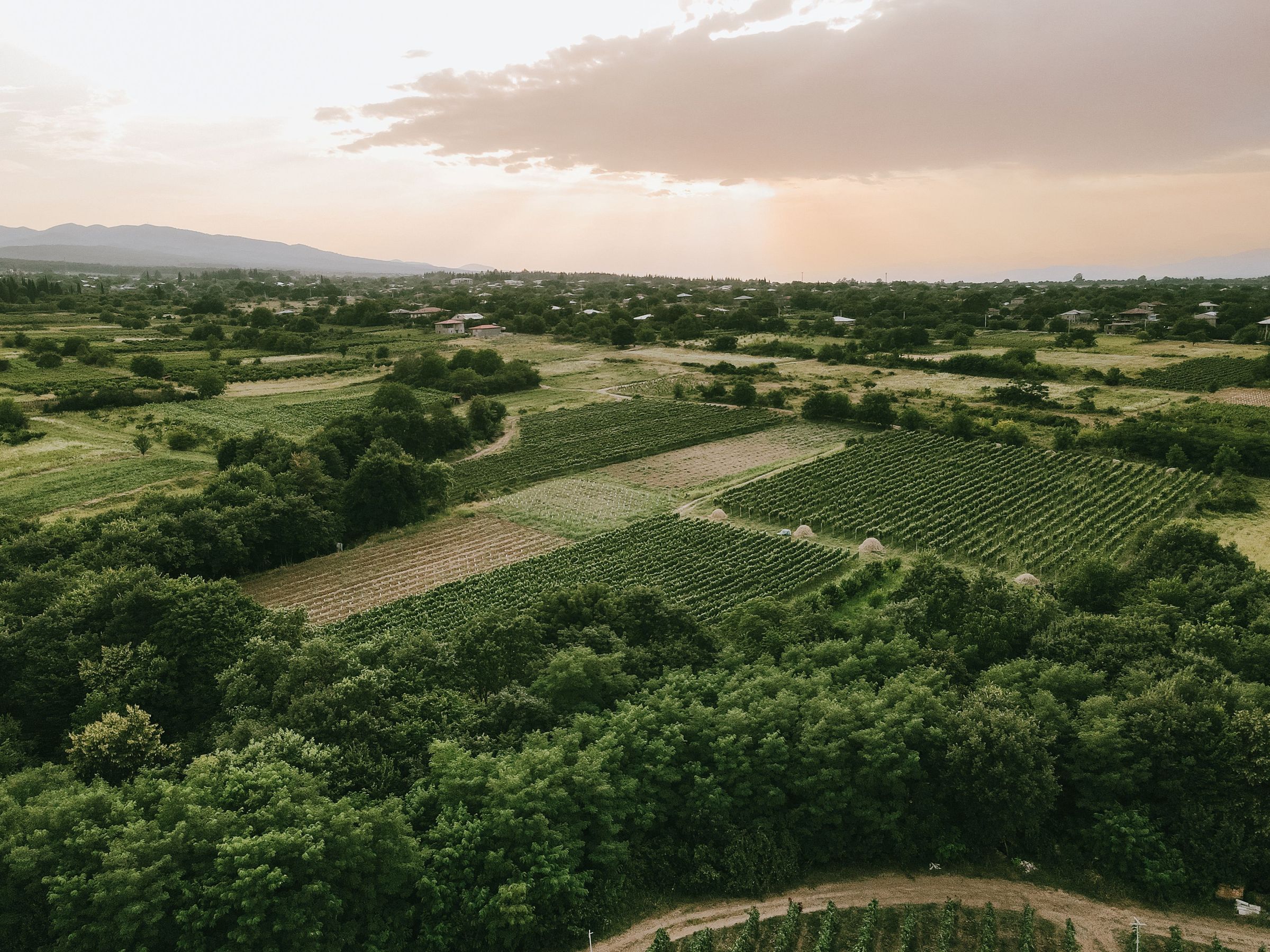
Kakheti's estates still make wine the way Georgians have for roughly 8,000 years, and that tradition happens to be about as low-intervention as winemaking gets. At Pheasant's Tears in Sighnaghi and at Kakhetian Traditional Winemaking in Telavi, grapes are fermented skin-on in buried clay qvevri rather than steel tanks — no refrigeration, no industrial pumping, just underground vessels sealed with beeswax and left to work through the Alazani valley's own microclimate. Shumi Winery's estate spans 700 hectares across distinct microclimates and doubles as a working museum of the UNESCO-listed qvevri tradition, so a single visit covers both the history and the harvest. Family-run and mid-sized estates dominate here, which keeps tourism revenue inside the valley rather than flowing to a distant parent company. Visit during rtveli, the September-October harvest, to see grapes stomped by foot and qvevri filled by hand — the closest thing Georgia has to watching its oldest industry run exactly as it always has.
Tusheti National Park
Best for Off-Grid, Community-Based Highland Travel
Tusheti is sustainable travel by necessity, not marketing: there is no hotel infrastructure inside the park, no fuel, no banks, and often no phone signal, so every visitor stays in a family homestay in Omalo, Dartlo, or Shenako and eats what that family cooks. That structure channels tourism income directly to the shepherd communities who still drive their flocks between highland summer pastures and Kakheti's lowlands each year, a 3,000-year transhumance tradition recognised as endangered heritage. The single road in, over the 2,850-metre Abano Pass, is snowbound roughly nine months of the year, which caps visitor numbers automatically rather than through any policy. What's left is a genuinely intact highland culture: fortified Svan-style tower villages, the Tushetoba shepherd festival each August, and valleys with more livestock than vehicles. Go for a short Omalo loop or push further into the Pirikiti Valley — either way, your money stays in the villages you're walking through.
Svaneti's Tower Villages
Best for High-Altitude Trekking With a Light Footprint
Svaneti proves that a UNESCO-listed landscape and a working, inhabited village can be the same place. Ushguli's four hamlets, strung along the Enguri River beneath Shkhara's 5,193-metre glacier, are reached from Mestia by a rough 4WD track that closes entirely from November to April — a natural limit on off-season pressure. Once there, the best of it is on foot: the walk from the villages to the Shkhara glacier tongue follows the river through wildflower meadows where Svan families still graze their flocks, no vehicle required. Guesthouses run by local families dominate accommodation over any larger hotel, so a night's stay funds the same households whose ancestors built the 9th- to 12th-century defensive towers still standing over the valley. Base in Mestia for services and day trips, and treat Ushguli itself as a place you walk through slowly rather than a photo stop on a loop.
Borjomi-Kharagauli National Park
Best for Rail-Accessible Forest Hiking
Georgia's largest national park, 85,000 hectares of old-growth mixed forest folding through the Lesser Caucasus, is also its easiest to reach without a car: the train from Tbilisi runs directly into Borjomi, putting a full day of ranger-marked forest trails within walking distance of the station. Permits are free from the Borjomi or Kharagauli visitor centres, and routes like the six-hour Likani-to-Lomismta circuit move through genuine old-growth stands where Caucasian red deer and chamois still turn up at dawn in the Kvabiskhevi Gorge. The park exists partly because of Borjomi's mineral springs — the original Ekaterine Spring pavilion, where the water was first bottled in 1890, still stands in Borjomi Central Park — so a spa town's 19th-century tourism economy ended up preserving one of Europe's last substantial temperate forests almost by accident. It's the rare Georgian wilderness experience that needs neither a 4WD nor an overnight homestay to reach properly.
Kolkheti National Park's Wetlands
Best for Wetland Conservation and Birdwatching
Kolkheti protects the drowned, reed-choked remainder of the ancient Colchis Lowland, centred on Paliastomi Lake, where boat tours run out of Grigoleti and Poti through local ecotourism operators rather than a fixed park concession. There are no formal entrance gates here — access runs through the same small operators and boatmen who've worked these waters for generations, which means tourism revenue lands directly with them rather than a distant operator. The draw is genuinely rare habitat: reed beds three metres tall sheltering pelicans, herons, and sea eagles, and the point where the Pichori River's fresh water visibly swirls into the Black Sea's salt. It's a slow, low-impact way to spend a day — a flat-bottomed boat through the reeds does far less damage to a wetland ecosystem than any road ever could, and the lack of built infrastructure is itself the conservation strategy.
Adjara's Rainforest Parks
Best for Colchic Rainforest Walks and Traditional Craft
Mtirala and Machakhela National Parks, both reachable by marshrutka from Batumi, protect fragments of Colchic temperate rainforest that have survived largely unchanged since the Tertiary period some 50 million years ago — moss-draped evergreen oak and chestnut forest that once sheltered leopards and hyenas. Machakhela adds a living craft economy to the conservation story: the gunsmith workshops of Tskhmuravi still forge traditional Machakhelian hunting rifles using techniques brought by 16th-century refugees, a heritage skill kept alive because the surrounding forest kept the villages isolated enough to preserve it. Trails here run through 300-year-old chestnuts and endemic Pontic rhododendron thickets to swimming pools at the Intsra Waterfall, all on foot or by a single access road rather than a network of new construction. Visit May through October, and treat Batumi's coastal buzz and this rainforest as two completely different sides of the same short drive.
Imereti's Canyon Boardwalks
Best for Low-Impact Engineered Access to Fragile Gorges
Okatse and Martvili canyons, both a short marshrutka ride from Kutaisi, solve the same problem the same way: how do you let people see a fragile limestone gorge without letting foot traffic wreck it. Okatse's answer is a 780-metre elevated walkway clinging to the canyon wall, ending at a cantilevered glass-floored platform over the 100-metre drop — visitors never touch the canyon floor or its Colchic rainforest understorey at all. Martvili does it by water instead: a guided boat ride through the narrowest stretch of the 700-metre gorge, past the 7th-century monastery that once used its pools for baptismal rites, keeps hundreds of daily visitors off the fragile riverbank entirely. Both routes fund trail maintenance and local guiding jobs in the gateway villages of Gordi and Martvili. It's a useful model for the rest of the site: engineered access can protect a place better than leaving it open ever could.