Best for a walkable capital base
Tbilisi is the obvious hub for a car-free trip because it doesn't just tolerate walking, it rewards it. The Old Town's tangle of balconied lanes, sulfur bathhouses and Sioni Cathedral sits within a single compact basin, connected by a cheap and genuinely useful metro and a cable car up to Narikala Fortress that turns a stiff climb into a five-minute ride with a view over the whole city. Rustaveli Avenue, the main museums and the Holy Trinity Cathedral (Sameba) are all within reach on foot or a short metro hop, and marshrutka stations for every day trip in this list depart from here. Most travellers use Tbilisi as their fixed base for a week or more, sleeping in the same bed each night while the city changes around them. It's also simply worth lingering in: the old bathhouse district, the wine bars tucked into courtyards and the balcony architecture reward slow wandering rather than a checklist visit.
Tbilisi
Best for an effortless half-day pilgrimage
Georgia's ancient capital sits barely twenty minutes from Tbilisi by frequent marshrutka, making it the easiest car-free excursion in the country. The Old Town itself is small enough to cover entirely on foot: Svetitskhoveli Cathedral, said to hold Christ's robe, anchors a UNESCO-listed historic centre that has been the spiritual heart of Georgian Christianity since the 4th century. Jvari Monastery, perched on the ridge above town where the Mtkvari and Aragvi rivers meet, is the one stop here that benefits from a short taxi up the hill, since the walk is steep and shadeless, but the fare is negligible and shared with other visitors. Because the whole trip fits into a morning or afternoon, Mtskheta works well paired with a second half-day activity back in Tbilisi, and it's frequently the first place first-time visitors see outside the capital. Small guesthouses and church-run shops line the main street, and the confluence viewpoint below Jvari, where the rivers visibly change colour as they meet, is worth the short detour even for those who skip the monastery climb.
Mtskheta-Mtianeti
Best for wine country without driving
Sighnaghi is the rare hill town where the drive is usually the point, yet it's entirely reachable by direct marshrutka from Tbilisi's Ortachala station, a journey of roughly two and a half hours through the Kakheti vineyards. Once there, the appeal is that you never need to move again: the town is ringed by its own preserved 18th-century walls, small enough to cross in twenty minutes, with balconied streets that spill views over the Alazani Valley toward the Caucasus. Wine tastings happen inside the town itself, in cellars and family-run guesthouses rather than out at remote estates, so the car-free traveller isn't shut out of Kakheti's signature experience. The town square, the Sighnaghi Museum and the walk along the fortress ramparts fill a full day comfortably, and staying overnight rather than day-tripping lets you catch the valley at sunset, when the light does more for the view than any itinerary could.
Kakheti
Best for the train-connected second city
Kutaisi is where Georgia's rail network does the car's job outright: a comfortable train links it to Tbilisi in around four hours, with sleeper options for overnight travel. Once there, the city rewards walking on a smaller, calmer scale than the capital. The Kutaisi Central Market is a genuine working market rather than a tourist stage, the State Historical Museum holds some of the country's most significant archaeological finds, and the Bagrati Cathedral overlooks the Rioni River from a hilltop close enough to reach on foot. Kutaisi also functions as the practical gateway to western Georgia's caves and canyons for travellers willing to book a shared minivan tour for a single day rather than self-drive; Prometheus Cave and the Okatse and Martvili canyons are commonly sold as day trips departing from town, which keeps the car-free chain intact even when the destination itself isn't walkable.
Imereti
Best for a seaside city break
Batumi is served by both direct flights and a comfortable train from Tbilisi, and it's built for a car-free stay in a way few Black Sea cities are. The Boulevard runs for several kilometres along the seafront, purpose-built for walking, cycling and simply sitting with a view of the water, and it strings together most of what makes the city worth visiting: the Alphabet Tower, the Ferris wheel, the Piazza and the Batumi Dolphinarium. The Botanical Garden sits a short bus ride up the coast and is worth the detour for its terraced hillside views over the sea. Batumi's character is different from the rest of Georgia's car-free circuit: it's a resort city with a Belle Époque skyline built during an oil boom, layered over an older port town, and it works as either a beach-focused finish to a Georgia trip or a standalone long weekend.
Adjara
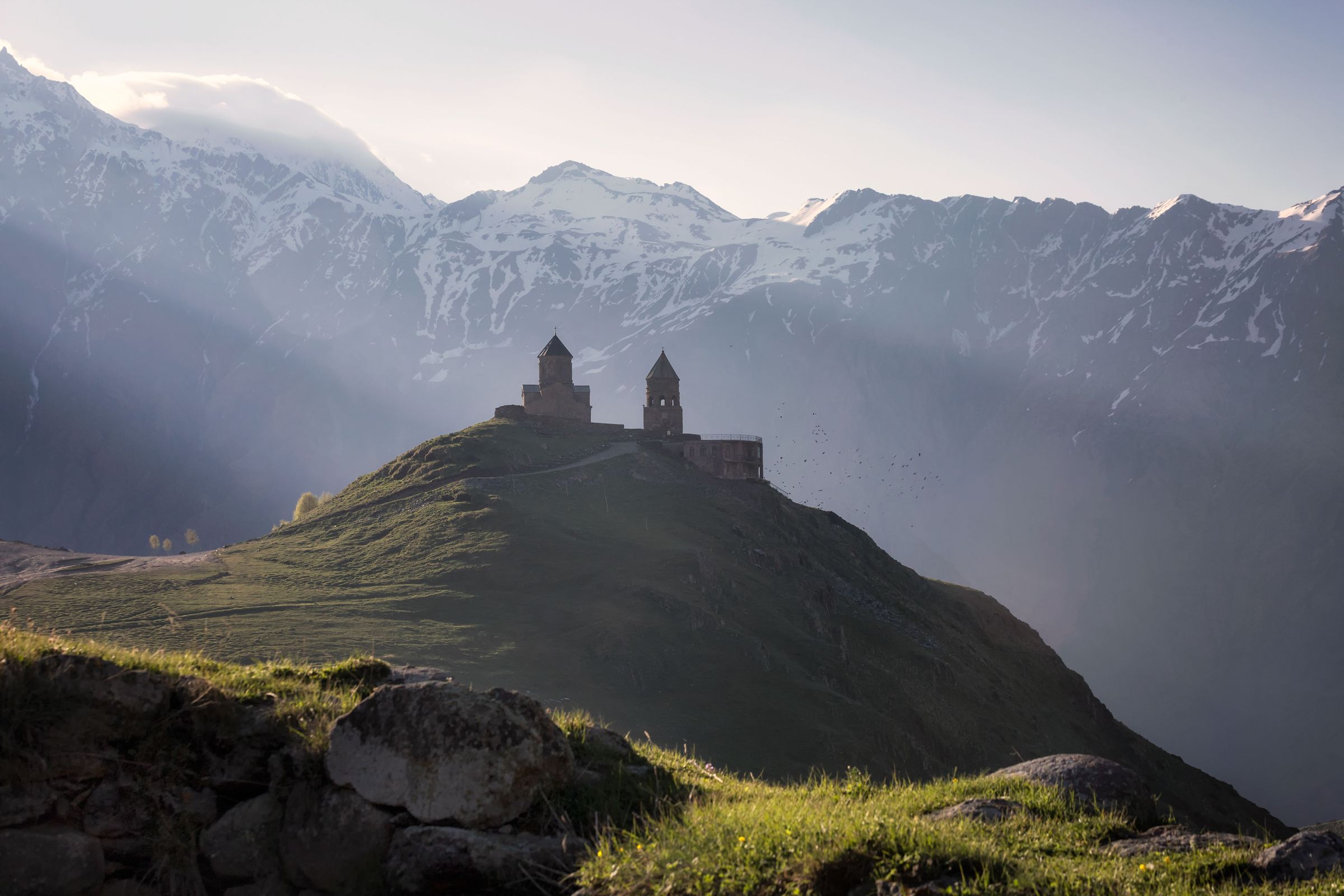
Kazbegi & Gergeti Trinity Church
Best for high-mountain drama
The Georgian Military Highway to Stepantsminda (Kazbegi) is one of the most dramatic roads in the Caucasus, and it's run constantly by shared taxis and marshrutkas from Tbilisi's Didube station, no rental needed. The three-hour journey climbs through the Aragvi valley and over the Jvari Pass before dropping into the shadow of Mount Kazbek, a 5,047-metre volcanic cone that dominates the skyline. From the town, Gergeti Trinity Church sits at 2,170 metres on a bare ridge with the glacier rising directly behind it; the walk up takes roughly an hour and a half, or a shared 4x4 taxi covers the rough final stretch for a small shared fare. The church's isolation is the whole point: no village, no trees, just wind and the mountain, and it remains one of the most photographed and genuinely moving views in the country. Kazbegi National Park's lower trails around town add a day or two of gentler hiking for those who stay overnight.
Kazbegi / Mtskheta-Mtianeti
Best for a slow spa-town escape
Borjomi is reached by direct train from Tbilisi, a route that runs through the Kura river valley and drops you within walking distance of the town's reason for existing: its mineral springs. Borjomi Central Park, built around the original spring pavilions, has functioned as a resort since Russian imperial nobility began visiting in the 19th century, and it remains a genuinely restorative place to walk rather than a photo stop. The town itself is compact and shaded by mature parkland, easy to cover without transport, and the entrance to Borjomi-Kharagauli National Park, one of the largest protected areas in the Caucasus, sits close enough to town for a car-free traveller to walk one of the shorter marked trails without arranging a guide or vehicle. It's a slower, quieter stop than the rest of this list, better suited to a traveller looking for a pause than another checklist of sights.
Samtskhe-Javakheti
Best for cable-car alpine views
Gudauri sits on the same Georgian Military Highway as Kazbegi, roughly two hours from Tbilisi by shared taxi or marshrutka, and it solves the usual problem of mountain scenery requiring a vehicle: its cable car and chairlift network, built for winter skiing, runs through the warmer months as well, carrying visitors up to ridge-level viewpoints over the Cross Pass without a single hairpin bend driven. The Gudauri Viewpoint itself, just off the highway, needs no lift at all and delivers one of the most sweeping panoramas of the Greater Caucasus range available from a paved pull-off. In winter this becomes one of the region's principal ski resorts, reachable the same car-free way; in summer and shoulder season it's quieter, colder at altitude than the valley below, and worth the layers for the view alone. The village itself has grown around the ski trade, so cafes and guesthouses cluster near the lift base, making it easy to arrive on one marshrutka, ride the cable car, and catch a later one back to Tbilisi the same day.
Mtskheta-Mtianeti
Methodology — how we ranked
We started from every place in Georgia with a reliable, publicly bookable way in that doesn't require a rental car or private driver: a marshrutka (shared minibus) route, a scheduled train, or a cable car. Each finalist was then weighed on the frequency and reliability of that connection, how much of the destination is walkable once you arrive, the strength of the experience itself (scenery, cultural weight, uniqueness), and value for the traveller who wants substance over convenience. We excluded places that technically have a bus but require irregular waits, a rough onward hike with no clear trailhead access, or a connection unreliable enough to strand a traveller for a full day.