The Supra: Georgia's Feast Ritual
Best for understanding why Georgians eat the way they do
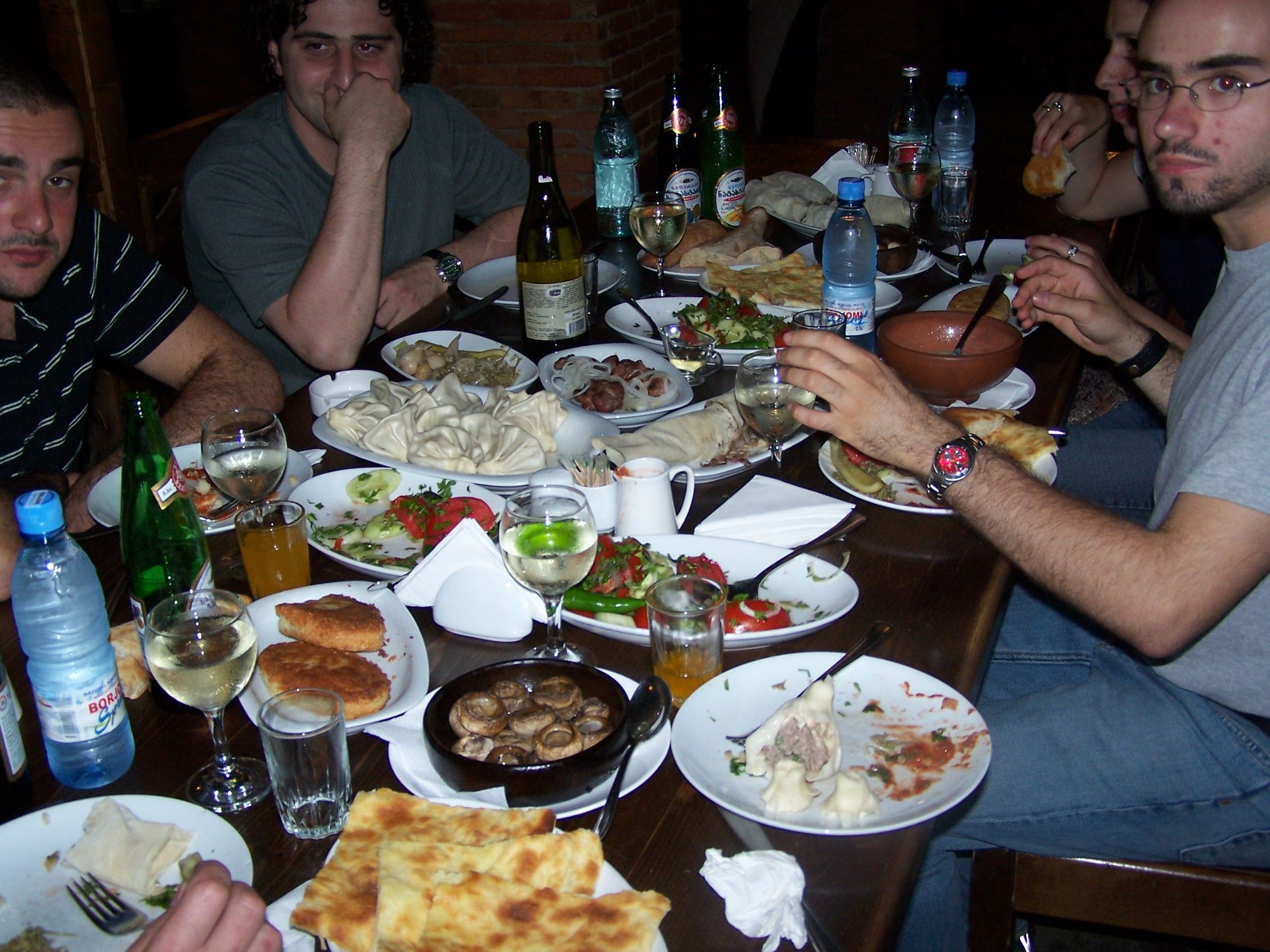
Before any dish makes sense, the supra does. This is the structured feast — a long table, endless small plates, and a tamada (toastmaster) who paces the evening through rounds of toasts to peace, ancestors, love and the guests themselves, each one answered by a drink of wine. It is not a meal you order; it is a social institution with its own etiquette, and refusing a toast is a bigger faux pas than refusing food. Villages around Sighnaghi and Bodbiskhevi in Kakheti still run this exactly as their grandparents did: winemakers open their courtyards, ladle amber wine straight from a buried qvevri, and pair it with whatever the household has that day — usually far more than anyone can finish. Understanding the supra before you travel reframes everything that follows: khinkali, khachapuri and wine are not separate attractions, they are pieces of one long communal table. Ask any guesthouse in Kakheti to arrange one; the good ones are informal, family-run, and unforgettable rather than performed.
Khinkali Country: Pasanauri and the Military Highway
Best for dumpling purists
Khinkali — pleated, juice-filled dumplings pinched into a topknot you're meant to hold and never fork — are claimed to have originated in Pasanauri, where the Georgian Military Highway climbs past the confluence of the White and Black Aragvi rivers before the road pushes on toward Gudauri and Kazbegi. This is the pilgrimage stop: modest roadside houses serving them boiled, filled with minced mountain beef and pork and a broth you sip through a torn edge before eating the rest. Further up the highway, Stepantsminda (Kazbegi) does its own busy trade in khinkali alongside sulguni cheese, feeding trekkers heading up to Gergeti Trinity Church. The etiquette matters here: the twisted dough knob on top is a handle, not food, and a good khinkali house is judged by locals on the seal holding through the boil rather than on plating. Order by the count, not the plate — ten per person for a serious appetite is normal — and treat the stop as part of the Military Highway itself, not a detour from it.
The Kakheti Wine Route: Qvevri, Cellars and Chacha
Best for wine travellers
Kakheti is where Georgian food and Georgian wine become the same subject. The Alazani Valley has fermented wine in buried clay qvevri since roughly 6000 BCE, a method UNESCO recognises as Intangible Cultural Heritage, and it is still how most family cellars around Telavi, Napareuli, Sighnaghi and Kvareli work. Twins Wine Cellar in Napareuli, run by brothers whose family has made wine there for generations, pairs tastings with an actual working museum of viticulture tools; Pheasant's Tears in Sighnaghi, founded by an American painter turned winemaker in 2007, runs a restaurant beside its marani serving seasonal Kakhetian dishes alongside its amber and red qvevri wines. Expect chacha (grape brandy) offered well before noon, tonis puri (clay-oven bread) eaten with your fingers, and the wine served in a tumbler rather than a stemmed glass. Telavi is the practical base — it has the region's transport links and hotel stock — with day trips out to the smaller wine villages, none of which are set up for solo drop-ins without at least a phone call ahead.
Kutaisi Central Market and the Imereti Table
Best for market immersion and cheese
Kutaisi's Bazroba (Central Market) has anchored the city since the late Soviet era, and it is not staged for visitors — it is a working artery where Imereti's agricultural heart pumps daily. Farmers arrive before dawn with cheese still molded in traditional clay pots, loaves of shoti bread warm from tone ovens, and homemade amber wine decanted into plastic bottles from family cellars. Imereti's food identity runs cooler and creamier than Kakheti's: this is khachapuri imeruli territory, a round bread stuffed and topped with the region's tangy Imeretian cheese rather than the egg-and-butter Adjaran version. Smaller market towns like Khoni and Terjola north of the city give the same experience without any tourist infrastructure at all — no guesthouse websites, no staged folklore, just farmers bringing cheese and honey to a Tuesday market. Go early, before 9am, when the produce is freshest and the stalls are still filling; by mid-afternoon the best cheese is usually gone.
Adjara's Khachapuri Coast
Best for khachapuri obsessives
Adjara gave khachapuri its most photographed form: khachapuri Acharuli, a boat-shaped bread filled with cheese and finished with a raw egg and a knob of butter dropped into the molten centre at the table, which you stir together and tear the crust to dip. Batumi's restaurants serve it constantly, but the better version of the experience is on the coast south of the city, where beach towns like Kvariati — a cove of smooth, river-polished stones with water clear enough to see the seabed — pair simple grilled mtsvadi (skewered meat) and khachapuri with an evening swim. The dish is rich enough that one boat feeds two people comfortably; ordering one each is a rookie mistake most first-time visitors make once. Adjara's subtropical climate also means the produce differs from the rest of Georgia — citrus, hazelnuts and a more Black Sea-influenced table — so use Batumi as a base and treat the coastal towns south of it as day trips rather than trying to do both the city and the beaches in one sitting.
Svaneti's Highland Kitchen
Best for mountain cuisine and disappearing traditions
Svaneti sits above the wine belt and the market towns, and its food reflects total isolation: this is the home of kubdari, a dense meat-filled bread built for calorie-heavy days at altitude, and of Svan salt, a spice blend of garlic, coriander and dried herbs that finds its way onto everything. The Upper Svaneti Open-Air Museum area is not a curated exhibit — it's a functioning UNESCO site where families still live in the same fortified stone-tower homesteads their ancestors built between the 9th and 12th centuries, and traditional meals are still served in them rather than reconstructed for display. Villages like Mazeri, in the shadow of the Ushba massif, and Iprari and Tsvirmi further along the valley, produce their own aged mountain cheeses in small quantities that rarely leave the region. Mestia is the practical base, with guesthouses that cook family-style rather than à la carte; expect the menu to be whatever the household has that day, not a fixed list, and expect portions built for people who walk mountains for a living.
Racha's Smoked Pork and Rare Sweet Wine
Best for off-the-path culinary pilgrims
Racha is Georgia's least-visited food region and arguably its richest: this alpine valley produces Khvanchkara, a naturally semi-sweet red wine made from the Aleksandrouli and Mujuretuli grapes that grow nowhere else on earth, historically favoured by Tsar Nicholas II and reportedly kept for Stalin's private table. Its residual sweetness comes purely from arrested fermentation, not fortification, giving it a wild strawberry and alpine raspberry character unlike anything from Kakheti or Imereti. The food matches the wine's richness: Racha is known across Georgia for its smoked pork, prepared and cured for the long mountain winters, served alongside the dense breads and preserves typical of isolated highland communities. The journey to Ambrolauri, the regional centre, winds through the Rioni River gorge past stone villages where families have tended these particular vines since the 19th century — this is a deliberate detour, not a stop on the way to somewhere else, and it rewards travellers willing to make it one.
Tbilisi: Where Tradition Meets the Modern Table
Best for contemporary Georgian cooking and street food
Tbilisi is where every regional tradition converges and where a newer food scene has grown up around it. Fabrika, a 19th-century textile factory resurrected in 2016 on the edge of the Old Town, is now the city's most relaxed food-and-culture hub — raw Soviet brickwork housing a rooftop, casual kitchens and khinkali served alongside modern Georgian plates, with the Caucasus glowing behind it at sunset. Around the Old Town and Sioni Cathedral, family-run cellar restaurants serve the full regional spread — Kakhetian wine, Imeretian khachapuri, Racha's pork — in one sitting, useful for travellers who won't make it to every region in person. The Dry Bridge Market, running since the 1990s as Georgians sold family belongings to survive economic collapse, is more flea market than food market, but the churchkhela (walnut-and-grape-must candles, often called Georgian Snickers) sold along its edges and around the Old Town streets are the country's most portable snack. Use Tbilisi to sample everything once, then travel to the regions for the versions that made each dish famous.