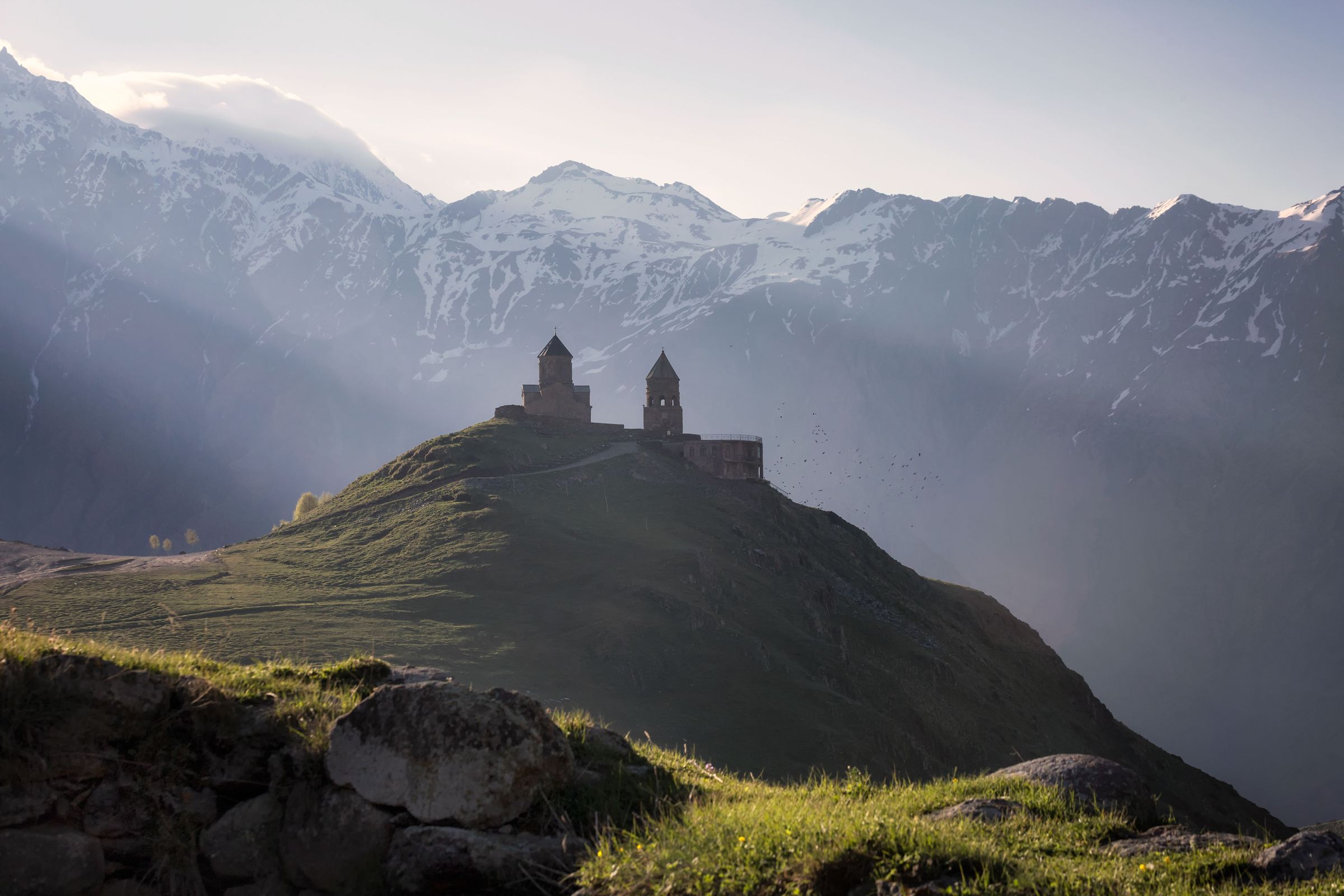
The Hiking Trail from Stepantsminda
Best for Fit Independent Hikers
The classic approach starts at the edge of Stepantsminda and climbs roughly 6 kilometres and 400 metres of elevation, mostly on a rough 4WD track rather than a dedicated footpath, reaching the churchyard in three to four hours at a steady pace. The route gains height gradually at first through scrubby hillside, then opens into full views of Kazbek's eastern face as you near the ridge, so the reward builds rather than arriving all at once. There's no shade and no water source along the way, so start with a full bottle and sun protection even on a cool morning — the elevation and reflected light off snow are more punishing than the distance suggests. This is the only way to properly earn the view: walkers who climb rather than ride tend to linger longer at the top, and the descent is easy on the knees if you take it slowly on the loose gravel sections.
4WD Jeep from the Village Center
Best for Limited Time or Non-Hikers
Local drivers run jeeps from Stepantsminda's main square up the same rough track the hikers use, covering the climb in fifteen to twenty minutes rather than several hours. Vehicles typically take four to six passengers and drivers wait at the top for an agreed window before returning, so agree the return time and price before you set off — negotiation happens on the spot rather than through a fixed counter. This is the sensible choice for travelers with limited time in Kazbegi, anyone visiting with children or older relatives, or hikers who want the view without spending a half-day getting there so they can push on to Juta or Truso Valley the same afternoon. The trade-off is obvious: you skip the slow reveal of the mountain that walking provides, and the churchyard can feel busier when jeeps are dropping groups every few minutes through the late morning.
Horseback Ride to the Church
Best for a Different Kind of Adventure
Local horses and guides can be arranged informally in Stepantsminda for the ride up to Gergeti, a slower but more atmospheric option than the jeep and considerably easier on the legs than the hike. It suits travelers who want to feel the landscape rather than just drive through it, and who are comfortable on an unfamiliar horse over a rocky, uneven track — this is genuine mountain terrain, not a groomed bridle path, so it isn't the right choice for complete riding beginners without a steady guide alongside. Arrangements are made directly with local operators rather than booked online in advance, and prices and horse availability shift with the season, so ask at your guesthouse the day before rather than assuming you can turn up and ride immediately. The pace also means you'll want a full morning rather than treating it as a quick errand before lunch.
Timing Your Visit for Sunrise
Best for Photographers
Kazbek's summit is most reliably clear in the first hours after dawn, before afternoon cloud builds against the massif through the warmer months — arriving by 4WD or an early hike start puts you at the churchyard while the light is still low and gold on the bell tower and the mountain's eastern face behind it. This isn't only about photography: an early arrival also means the churchyard itself is close to empty, a very different experience from the crowds of a July midday when jeeps are running continuously. The best-known composition is from the viewpoint roughly 50 metres northwest of the church, where the whole Kazbek massif frames the bell tower in a single view. Winter sunrise can deliver even sharper light on clear days, though the trail and track are icy and access depends entirely on conditions that week.
The Gergeti Glacier Extension
Best for Serious Trekkers Wanting More
Beyond the church, the trail continues roughly 4 kilometres further toward the Gergeti Glacier, passing an old meteorological station and gaining serious altitude — the full route from Stepantsminda to the Meteo Station at 3,650 metres climbs about 1,900 metres over 8 kilometres and takes six to eight hours one way, so this is a separate full-day undertaking rather than an add-on to a church visit. It rewards trekkers with close views of blue ice and the fractured seracs of Kazbek's icefall, and functions as the practical base camp approach for anyone considering the mountain's standard summit route, which requires glacier experience and registration with the Mountain Rescue Service in Stepantsminda. For most visitors, hiking even partway past the church toward the glacier's lower moraine on a clear day is reward enough without committing to the full ascent.
Combining with Juta Valley and the Chaukhi Massif
Best for Multi-Day Trekkers
Juta sits about 20 kilometres from Stepantsminda by unpaved road, reachable by 4WD or a five-to-six-hour hike, and makes the obvious next stop for anyone with more than a single day in the region. The valley opens onto the Chaukhi massif — three jagged granite spires locals call the Georgian Dolomites — and a full-day hike from Juta reaches the Chaukhi lakes at 3,300 metres, or the Abudelauri Colored Lakes, three glacial pools tinted green, blue, and milky white by mineral content. Staying overnight in a Juta guesthouse before or after the Gergeti hike turns a single highlight into a proper multi-day highland trip, and the contrast is worth it: Gergeti's drama comes from one commanding peak, Chaukhi's from a jagged skyline of several. This pairing suits trekkers already comfortable with rough 4WD tracks and long trail days rather than a first visit to the mountains.
Combining with Truso Valley
Best for Off-the-Beaten-Path Travelers
Truso Valley runs about 15 kilometres along the Terek River southwest of Stepantsminda, reached by a rough 4WD track, and offers a completely different register from Gergeti's single dramatic viewpoint: mineral springs stain the valley floor rust and ochre, the abandoned stone towers of Keterisi village stand empty since their evacuation in 2008, and the Abano Glacier terminates at the valley's head. It's quieter than the church and the Juta trailhead precisely because it requires more effort and offers no single postcard shot, which is exactly its appeal for travelers who've already done the obvious Kazbegi highlights and want a half-day that feels genuinely remote. Arrange a driver in Stepantsminda rather than attempting the track independently, and note the valley sits close to the South Ossetia boundary, so staying on marked paths matters here more than elsewhere in the region.