Argo Cable Car
Best for catching the sun from altitude before your evening on the boulevard begins
Start earlier than dusk proper — the Argo Cable Car needs daylight to earn its fare. The gondola lifts from the coast up to Anuria Mountain at 2,450 meters, a ride that trades subtropical lowland for subalpine meadow in a single unbroken ascent, with Batumi, the curve of the bay, and the Lesser Caucasus foothills opening up beneath you. It runs seasonally, typically May through October, and the light in the hour before sunset is when the whole descent — city, sea, and mountains stacked in one frame — looks its best. Ride up with an hour of daylight still in hand, take the short alpine trails near the upper station if you have the legs for it, and come back down as the boulevard below starts switching on its lights. It's the one stop on this walk that isn't actually on the boulevard, but it sets up everything that follows: you descend already knowing the shape of the coastline you're about to walk along at ground level.
Batumi Piazza
Best for a coffee-and-people-watching start to the evening
Batumi Piazza sits a short walk inland from the seafront, laid out in a fan of mosaic paving with Italianate colonnades and an Astronomical Clock — a gift from Italy — that performs on the hour. It's the natural place to begin the evening proper: pull up a chair at one of the cafés under the arcades, order a coffee or a glass of Adjaran wine, and let the square's slower rhythm — street musicians, families out for the evening passeggiata, pastel columns catching the last warm light — set the pace before you head for the water. The Piazza has none of the boulevard's kinetic sculptures or towers, and that's the point: it's Batumi's cosmopolitan, unhurried side, the European-aspiring counterpart to the coast's more theatrical stretch, and a genuinely pleasant half hour before the main walk begins.
Batumi Sea Port
Best for maritime atmosphere and the day's last working light
From the Piazza, it's a short walk to the Sea Port, which has anchored Adjara's fortunes since 1878 when the Russian Empire built it as an oil-export terminus for Baku's petroleum. The retro-futuristic 1960s passenger terminal, with its curved concrete canopy, still functions — seasonal ferries run to Odessa and Bulgarian ports from May through October — and the maritime promenade running from the port toward the boulevard proper is where fishermen still cast lines a few meters from where private yachts moor. Come as the light starts to fade: the working cranes and container stacks in one direction, the glittering casino-lit skyline in the other, capture Batumi's layered identity — Soviet infrastructure, post-independence ambition, and stubborn maritime habit — better than any single monument on the walk.
Batumi Alphabet Tower
Best 360-degree view over the bay before the light goes
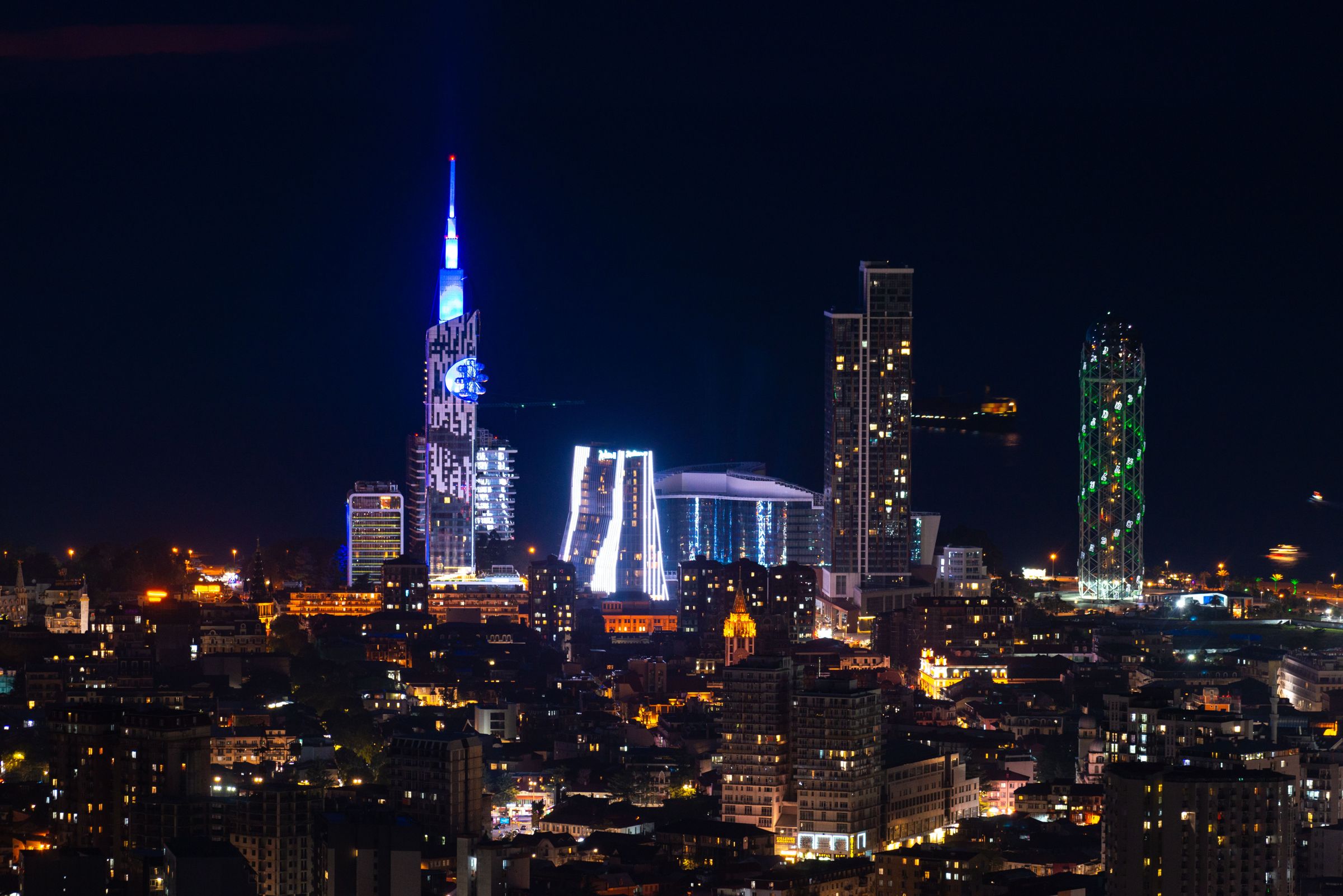
Unveiled in 2012, the Alphabet Tower spirals 130 meters above the promenade, its exterior wrapped in 33 illuminated steel letters of the Mkhedruli script — one of only fourteen independent writing systems still in active use worldwide. Time the elevator ride for the last hour before sunset: the glass-walled observation deck looks out over Batumi Bay toward the Turkish coastline, and on a clear late-spring evening the Caucasus foothills are still visible before the color drains from the sky. Elevator tickets run 15–25 GEL depending on access level, and the tower stays open until 10pm in peak season, so there's no need to rush the ascent. As true dusk sets in, the 33 letters begin igniting in sequence, eventually spelling out Sakartvelo — Georgia's own name for itself — across the darkening tower, best watched from the promenade below once you've come back down.
The Dancing Fountains
Best free spectacle for a family evening
As full dark settles over the boulevard, roughly 150 jets along its central stretch begin synchronizing to a rotating soundtrack of Georgian polyphony and Western pop, a nightly show that runs from May through October and costs nothing to watch. It's the most reliably crowded few minutes of the walk — locals with children, couples, tour groups — and deliberately so: the fountains were part of the post-2010 transformation that turned a modest Soviet-era promenade into a genuine evening destination, and they succeed at exactly what they're built for. Find a spot on the surrounding benches a few minutes before a show starts (performances repeat through the evening rather than running once), and treat it as a pause rather than a destination in itself — the real finale is a few hundred meters further along the water.
Ali and Nino Monument
Best sunset photograph and the walk's natural finale
End here. Two seven-meter steel figures, created by Georgian sculptor Tamar Kvesitadze in 2010, glide toward each other on hidden rails, merge briefly, and part again — a ten-minute cycle repeated on a loop daily until close to midnight, freely accessible on the waterfront promenade. The sculpture illustrates the doomed romance at the heart of Kurban Said's 1937 novel of the same name, a Muslim Azerbaijani boy and a Christian Georgian girl whose love survives the story but not its ending, and the piece's slow, wordless choreography carries real weight if you know that context going in. Against a fully dark sea, with the Alphabet Tower's letters still glowing somewhere behind you, this is the moment the evening builds toward — arrive for at least two full cycles, since the first pass rarely feels like enough.