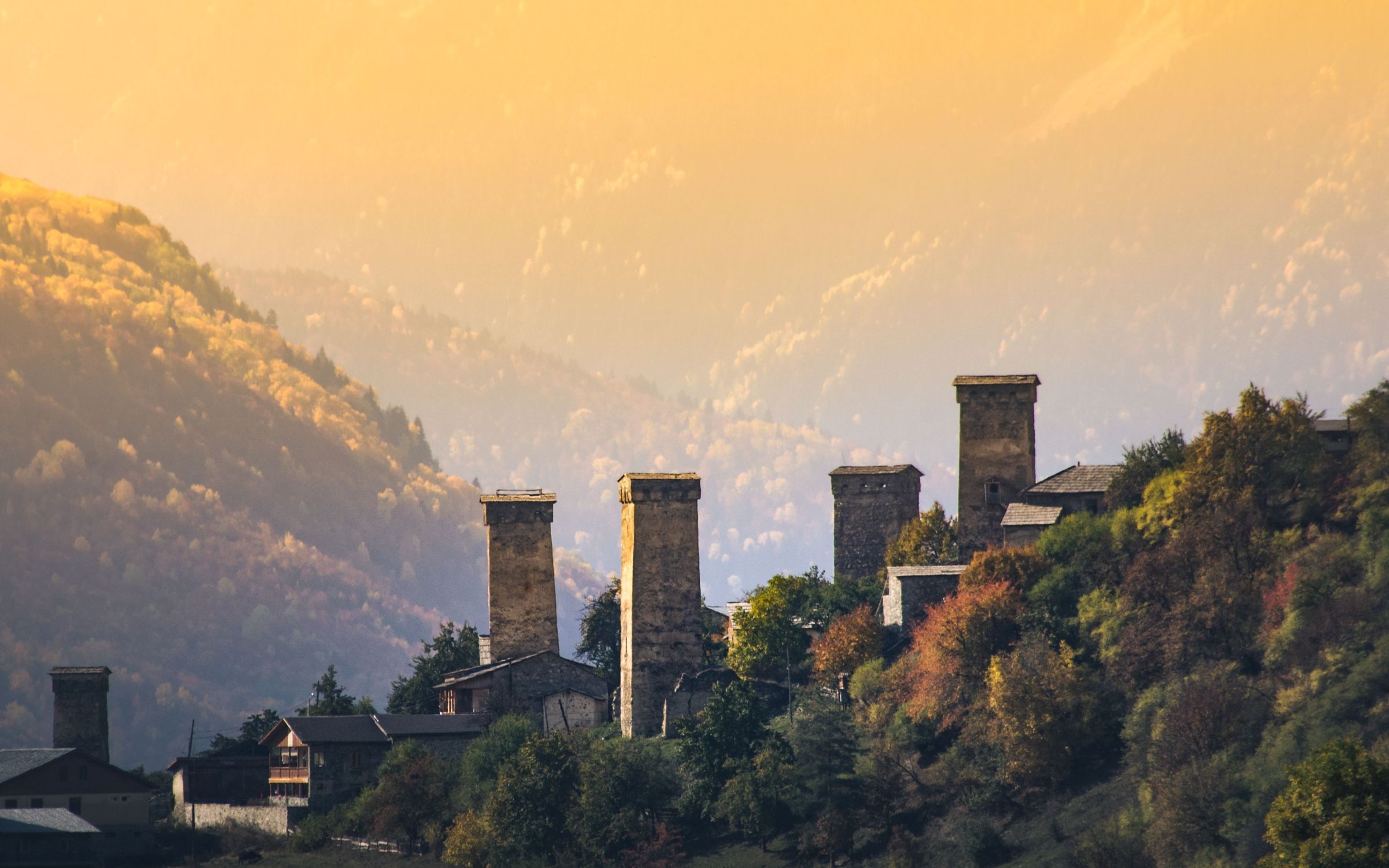
Tetnuldi Ski Resort
Best for advanced skiers and freeriders
Tetnuldi opened in 2016 on the southern flank of Mount Tetnuldi, Georgia's second-highest peak, and it was built with freeride in mind rather than groomed convenience. Three lifts serve 9.5 kilometres of marked runs across a 2,260–3,160 metre elevation band, but the real draw is what lies past the piste markers: wide alpine bowls, gladed tree sections and lift-accessed backcountry that pull skiers from across the Caucasus and beyond. The vertical drop from summit to base runs 1,400 metres, with optional off-piste lines dropping toward the Koruldi Lakes basin. What keeps it from feeling like a generic resort is the setting — several runs look straight down on the stone defensive towers of Latali village, and the Mikhail Khergiani House-Museum in Mestia, honouring Georgia's most celebrated mountaineer, is fifteen minutes back down the valley for an apres-ski detour. Snow is reliable November through April, crowds are not a problem, and there is no helicopter budget required to get real high-mountain terrain.
Hatsvali
Best for first-time skiers, families and view-seekers
Hatsvali is the smaller, gentler counterpart to Tetnuldi, and for many winter visitors it's the better first day. A single chairlift, installed in 2011 as one of Svaneti's first pieces of modern winter infrastructure, climbs 1.5 kilometres through old-growth forest to a 2,347-metre summit where the Greater Caucasus opens up in full — Ushba's twin peaks on one side, Tetnuldi on the other, and Mestia's cluster of medieval towers directly below, punctuating the snowfields like sentries. The skiing itself suits beginners and intermediates rather than experts, with a 2.6-kilometre main piste that tracks the stone towers of Lanchvali and Laghami villages the whole way down. The lift runs daily 10:00–16:00 from a base station about two kilometres above central Mestia, and the appeal isn't difficulty — it's the juxtaposition of alpine skiing directly over a living eight-century-old settlement, which is not a view any other ski area in Georgia offers.
Mestia's inhabited tower quarter
Best for a first afternoon getting your bearings
Before heading up either lift, the town itself rewards a slow walk. Mestia preserves dozens of the stone tower-houses that made Svaneti a UNESCO site — 9th-to-13th-century structures built by individual Svan clans for defense during blood feuds, and still lived in or maintained rather than roped off as museum pieces. In winter, with snow softening the roofs and smoke rising from a handful of the towers still heated, the town looks closer to its medieval self than it does in the crowded summer months. The Margiani tower house is open to visitors and gives the clearest sense of how families actually used the upper defensive levels versus the ground-floor living space. It costs nothing but time, it's entirely walkable from any guesthouse in town, and it sets up everything else on this list — the museum collections and the ski-slope views of towers both make more sense once you've stood among them.
Svaneti Museum of History and Ethnography
Best for a whiteout or rest day
When weather closes the lifts or legs need a day off, this is where Svaneti's history is best explained. Opened in 1936 and rehoused in a striking modernist stone-and-glass building in 2012, the museum holds Georgia's richest collection of Svaneti's material culture: gilded medieval icons carried down from remote mountain churches — including a 12th-century icon of St George from the Laghami church with its gold leaf still intact — manuscripts in Georgian asomtavruli and nuskhuri script dating to the 9th and 10th centuries, and ethnography halls with tower-house models, ritual banners and the distinctive silver-buckled Svan costume. The building itself frames the collection against the same peaks that kept these treasures safe from Mongol, Persian and Soviet destruction over the centuries. It's open daily 10:00–18:00 except Mondays, and gives real context to towers you'll otherwise just be photographing from outside.
Mikhail Khergiani House-Museum
Best for mountaineering history
This is a small wooden house on Seti Square, not a curated exhibition, and that's exactly its appeal. Mikhail Khergiani (1932–1969), a Svan mountaineer who conquered peaks across the Caucasus and Himalaya before dying young on the Matterhorn, has his story preserved here largely as his family left it — original 1950s ice axes and crampons, worn ropes, black-and-white photographs of his first ascents on Ushba, and a household prayer corner left untouched. It's a fifteen-minute stop, best folded into the same walk as the tower quarter or the ethnography museum, and it explains something the ski slopes only hint at: why a region this small produced a disproportionate share of the Soviet Union's elite climbers. Summer hours run 10:00–17:00 daily; in the shoulder months it's worth calling ahead, since opening depends on family presence.
Latali's towers and frescoed churches
Best half-day out of town
Latali sits on a forested ridge about 45 minutes from Mestia by 4WD, close enough to manage as a winter half-day without betting on a remote mountain road staying open. Its towers stand alongside a genuine artistic draw: the Matskhvarishi Church of the Savior, a 12th-to-13th-century building whose interior holds a fresco cycle of the Last Judgment and donor portraits in Svan dress, commissioned when Svaneti sheltered Christian art through some of Georgia's most turbulent centuries. The smaller Church of St George adds a second stop nearby. This is also the village visible from several of Tetnuldi's ski runs, so pairing a morning on the slopes with an afternoon here gives the towers a second, ground-level context. Roads this close to Mestia are kept passable through the season far more reliably than the track toward Ushguli, which makes Latali the sensible substitute when the deeper villages are snowed shut.
A Svan supra in a tower house
Best cold-weather evening
Winter is when a traditional Svan supra makes the most sense — a long table, ritual toasts, and food built for mountain cold, typically kubdari (meat-filled bread) and tashmijabi (a dense cheese-and-potato dish), often hosted by a guesthouse family inside or beside one of the tower structures. This isn't a staged dinner theatre; it's the same hospitality tradition that has run through Svan tower-house life for generations, with toasts sometimes still offered in the endangered Svan language rather than Georgian. Most Mestia guesthouses can arrange one with a few hours' notice, and it costs relatively little against the memory of it — a stone-walled room, a wood stove, and hours of unhurried food while snow settles outside. After a day on the Hatsvali or Tetnuldi lifts, it's the natural way to close the day, and it needs nothing more than asking your guesthouse host directly.