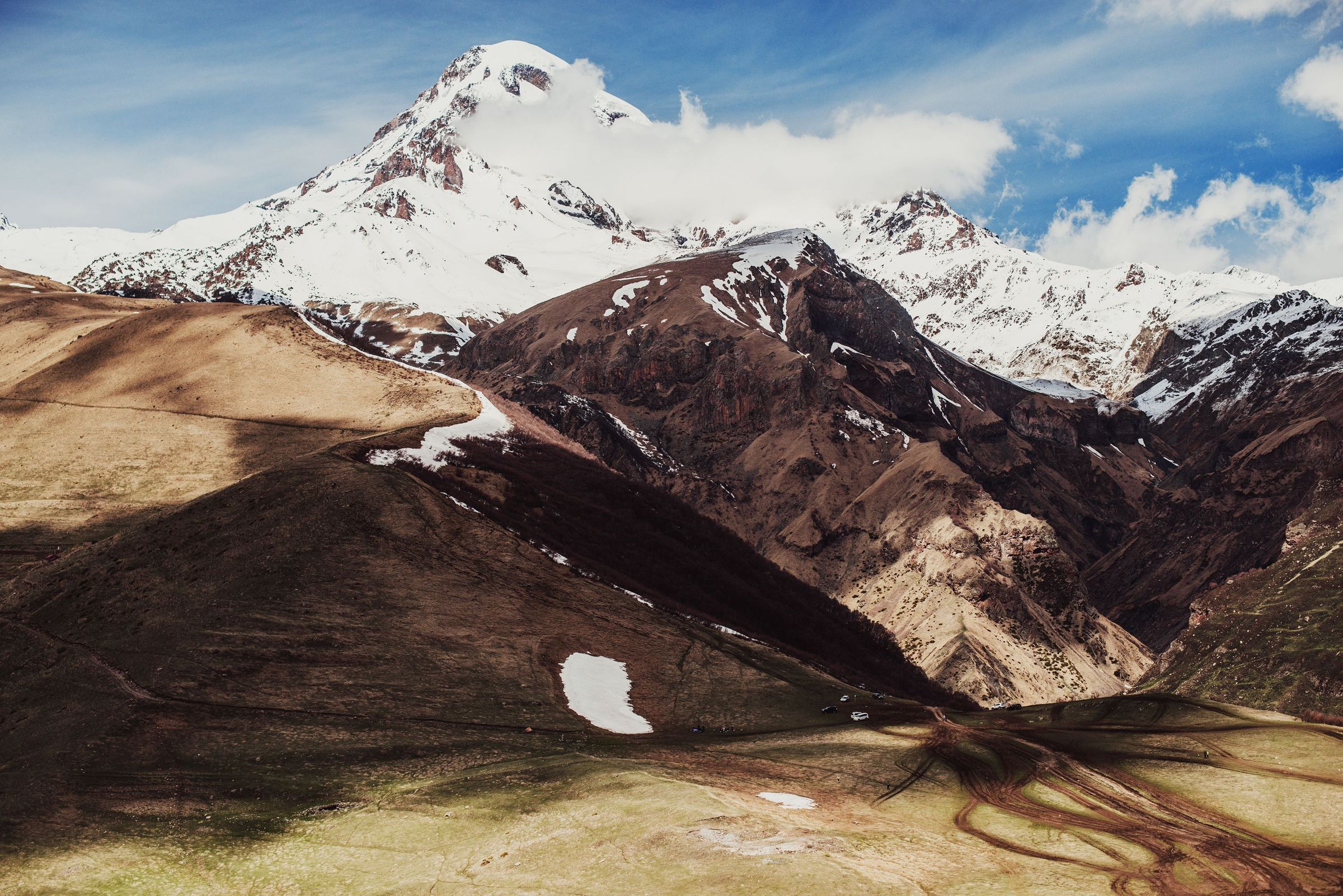
Jvari Pass

Jvari Pass: where empires crossed beneath sacred summits

Jvari Pass

Jvari Pass sits at 2,379 meters on the Georgian Military Highway, the ancient artery linking Tbilisi to Vladikavkaz first charted by Russian engineers in the 19th century and trodden long before by Silk Road caravans and invading armies. The pass itself is modest—a weather-beaten sign, a small chapel, a clutch of shacks selling churchkhela and kubdari to truckers—but the revelation comes in the approach. Here the Terek Valley narrows, the road clinging to cliffs above thundering water, until suddenly the full massif of Mount Kazbek (5,047m) erupts into view, its glaciers hanging like frozen cataracts above the Gergeti church. This is the Caucasus unfiltered: raw, vertiginous, historically freighted. You come not for amenities but for the moment when altitude and proximity collapse distance, and a 5,000-meter peak feels close enough to touch.

On the ground See

  • The Gergeti Trinity Church viewpoint—park at the pass trailhead and hike or take a 4WD the final kilometers to the 14th-century church silhouetted against Kazbek's icefields
  • The Soviet-era "Arch of Friendship" monument at Gudauri, just south of the pass, a concrete curve celebrating the 1783 Treaty of Georgievsk and the 1983 bicentennial, now a paragliding launch and haunting photographic subject
  • The Jvari Pass observation deck at 2,400m, where on clear mornings you can sight both Kazbek's symmetrical cone and the jagged twin summits of Mount Shani (4,451m) across the Russian border

Practical Know before you go

Best visited June-September when the pass stays open and skies clear; winter brings heavy snow and frequent closures—check real-time road conditions with the Georgian Roads Department before departing Tbilisi.

Last reviewed 25 August 2026 · reviewed quarterly