Tbilisi Old Town & Narikala Fortress
Best for arrival-day orientation
Land, drop your bags, and walk straight into Abanotubani and the Old Town rather than resting — jet lag fades faster on your feet. The district survived Persian, Arab, Mongol and Soviet rule in layers you can still read: 19th-century carved balconies hang over Byzantine-footprint churches, and families still live in the courtyard houses rather than treating them as a museum. Take the cable car from Rike Park up to Narikala Fortress, a 4th-century citadel expanded by Arab and Mongol builders and shattered in an 1827 munitions explosion — what survives commands the best single view in the city: the Mtkvari River bending below, the brick domes of the bathhouse district, and the Holy Trinity Cathedral catching the last light. Walk down through the Botanical Garden side rather than back the way you came. Anchiskhati Basilica, the city's oldest surviving church, sits a few minutes off the main pedestrian drag and is easy to miss — don't. Aim to arrive at Narikala within two hours of sunset; the ridge cools fast and the city below turns gold.
Abanotubani Sulfur Baths
Best for unwinding after a long flight
Tbilisi's name means 'warm place,' and it comes from these springs: brick-domed bathhouses fed by natural sulfur water at 38–42°C, in continuous use since long before Marco Polo passed through. Book a private khasha room rather than the shared public pools for a first visit — thirty to ninety minutes gets you a heated stone chamber, and most houses offer an optional kisa scrub and massage on top. Orbeliani Baths, with its blue-tiled Persian facade on Abano Street, is the most photographed; the smaller, plainer houses further down the same street are cheaper and just as authentic, without the queue. This slots naturally into the end of day one, after Narikala — the sulfur smell and the heat are far more pleasant as a way to close a travel day than to open one. Baths generally run 8am to midnight, so there's no need to rush straight from the airport; a late-afternoon or evening soak works well and helps reset your body clock before the longer drives of day two.
Mtskheta & Jvari Monastery
Best for understanding Georgia's Christian roots
Leave Tbilisi early on day two for Mtskheta, the former capital of the kingdom of Iberia and the spot where Georgia adopted Christianity as its state religion in 337 AD — a UNESCO World Heritage town that never emptied out into ruin the way many ancient capitals did. Svetitskhoveli Cathedral, believed to hold Christ's robe beneath its sanctuary floor, is the anchor sight, but don't skip the short drive or 10-minute uphill walk to Jvari Monastery on the hilltop above town. Built between 585 and 604 AD, Jvari is Georgia's oldest surviving church and the origin point of the cross-in-square design used across the country ever since; its platform gives you the precise, visible confluence of the Aragvi and Mtkvari rivers below. The whole stop — town plus hilltop — takes two to three hours and sits directly on the route north, making it the natural first leg of the Georgian Military Highway day rather than a separate excursion.
Ananuri Fortress
Best scenic stop on the road north
About 70km up the Georgian Military Highway from Tbilisi, Ananuri is where the road first shows you why this drive is a destination in its own right. The 17th-century fortress complex, seat of the feudal Dukes of Aragvi, sits on a forested promontory where the Aragvi River meets a turquoise reservoir — it's the image that ends up on most Georgia guidebook covers, and it earns the reputation. The Church of the Assumption inside the walls, finished in 1689, carries a rare carved frieze of the Last Judgment by the local master Tazari Jughayisdze, worth the climb up the worn stone steps to the keep on its own. Twenty to thirty minutes is enough for most travellers — this is a driving-day waypoint, not a half-day site — but it's the kind of stop worth timing deliberately rather than rushing through: spring and autumn light on the water is considerably better than the midday summer glare most tour buses hit.
Gergeti Trinity Church & Kazbegi (Stepantsminda)
Best single-day mountain experience
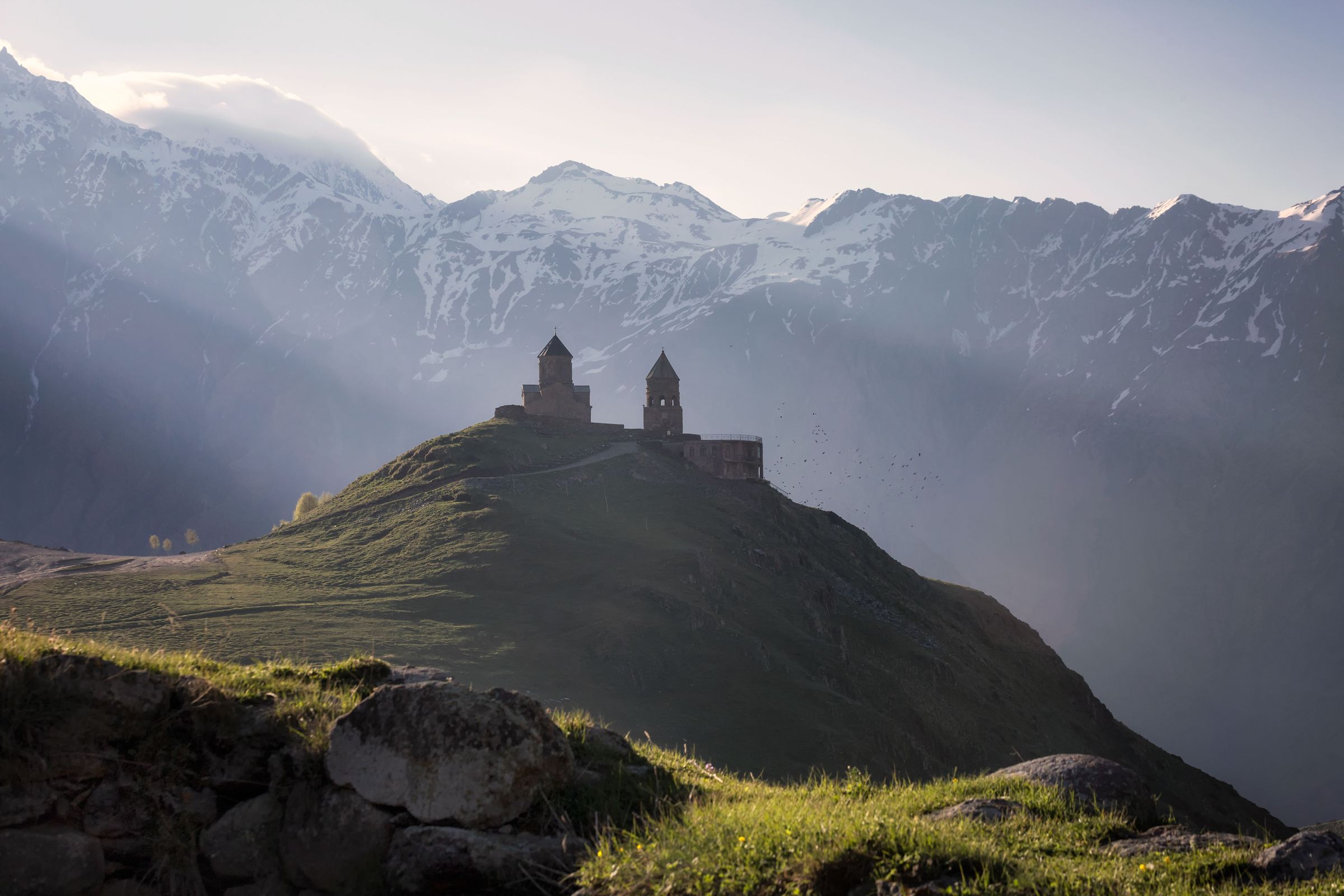
This is the stop that makes the itinerary. Continue north past Gudauri to Stepantsminda (still widely called Kazbegi), then take a 4WD track or the 3–4 hour hiking trail up to Gergeti Trinity Church, a 14th-century stone chapel standing alone at 2,170 metres with nothing behind it but the glaciated face of Mount Kazbek at 5,047 metres. There is no village up here, no tree line, just wind and the church — it's the single most photographed scene in the country for good reason, and it's genuinely more affecting in person. July and August bring crowds by mid-morning, so an early departure from Tbilisi (or an overnight in Stepantsminda) pays off. Staying overnight rather than day-tripping is worth the extra logistics if your schedule allows it: it lets you catch the church at dawn light with the summit glowing rose-gold, and gives you a buffer against the Highway's occasional weather closures. Road conditions on the final ascent require a hired 4WD taxi from town — don't attempt it in a standard rental car.
Sighnaghi & Bodbe Monastery
Best for wine-town wandering
Head east into Kakheti on day three, Georgia's wine heartland, and make Sighnaghi your first stop. Perched on a ridge above the Alazani Valley, its 18th-century walls — commissioned by King Erekle II and still fully walkable along all 4km and 23 towers — enclose a town of carved wooden balconies and cobbled lanes that has changed remarkably little. It's compact enough to see properly in two to three hours: walk a stretch of the wall for the valley view toward the Caucasus, then take the short 2km walk or drive downhill to Bodbe Monastery, where Saint Nino — the 4th-century figure credited with converting Georgia to Christianity — is buried among gardens and older frescoes. Sighnaghi is also the right base if you want to slow the pace and stay a night in Kakheti rather than return to Tbilisi the same evening; Kabadoni Boutique Hotel, inside the old town, is the best-known option for travellers wanting to linger.
Kakheti Wine Tasting & Telavi
Best for hands-on wine culture
Round out the day — and the trip — with the reason Kakheti exists on any wine lover's map: qvevri, the buried clay vessels used here for an unbroken 8,000 years, the oldest winemaking method archaeologists have found anywhere on Earth, now recognised by UNESCO as intangible cultural heritage. A tasting at a family cellar near Sighnaghi, Velistsikhe or Tsinandali, ideally built around a small supra with a tamada-led toast, gives a far more honest sense of the tradition than a large commercial winery tour. If time allows before heading back to Tbilisi, Telavi — Kakheti's working capital since the 10th century and King Erekle II's royal seat — makes a good final stop: the Batonistsikhe fortress and the 900-year-old plane tree in the main square are both walkable in under an hour, and the Saturday market is where locals actually buy their own saperavi and rkatsiteli by the liter. From Telavi or Sighnaghi it's roughly two hours back to Tbilisi for a same-night flight or a fourth day free.