Days 1–2 — Tbilisi
Best for arrival and getting your bearings
Land in Tbilisi and spend your first full day in the Old Town on foot: Narikala Fortress for the view over the city and the Kura river, the sulfur bathhouses of Abanotubani below it, and Rustaveli Avenue for the 19th-century boulevard grandeur that makes Tbilisi feel like a small Vienna dropped into the Caucasus. The Georgian National Museum is worth two hours on its own, particularly the prehistoric gold and the Soviet Occupation exhibit. Evenings belong to a supra — a proper multi-course Georgian feast with a toastmaster (tamada) directing the wine — which sets the tone for the rest of the trip better than any museum. Two nights here lets you actually eat and walk rather than tick boxes; Tbilisi rewards slowness, and it's also the transport hub you'll return to before flying home, so there's no cost to giving it real time now.
Day 3 — Mtskheta and Ananuri, on the way north
Best for Georgia's religious heart in half a day
Leave Tbilisi mid-morning and stop at Mtskheta, Georgia's ancient capital and the seat of its church: Svetitskhoveli Cathedral, said to hold Christ's robe, and Jvari Monastery on the hilltop above the confluence of the Mtkvari and Aragvi rivers — the view Pushkin wrote about, and still the best single vantage point in the region. Both sit inside a UNESCO World Heritage designation and can be seen properly in two to three hours, including the short climb up to Jvari itself. Continue north on the Georgian Military Highway and break at Ananuri, a fortified 17th-century church-and-tower complex on the edge of the Zhinvali reservoir, one of the most photographed stops on the whole route and worth twenty unhurried minutes rather than a drive-by from the car park. The road climbs steadily from here, so build in time for the change in temperature. Push on to Stepantsminda (Kazbegi) by early evening, arriving before dark on the pass, since the final switchbacks are best driven in daylight.
Days 4–5 — Kazbegi (Stepantsminda) and Gergeti Trinity Church
Best for high-mountain scenery without a multi-day trek
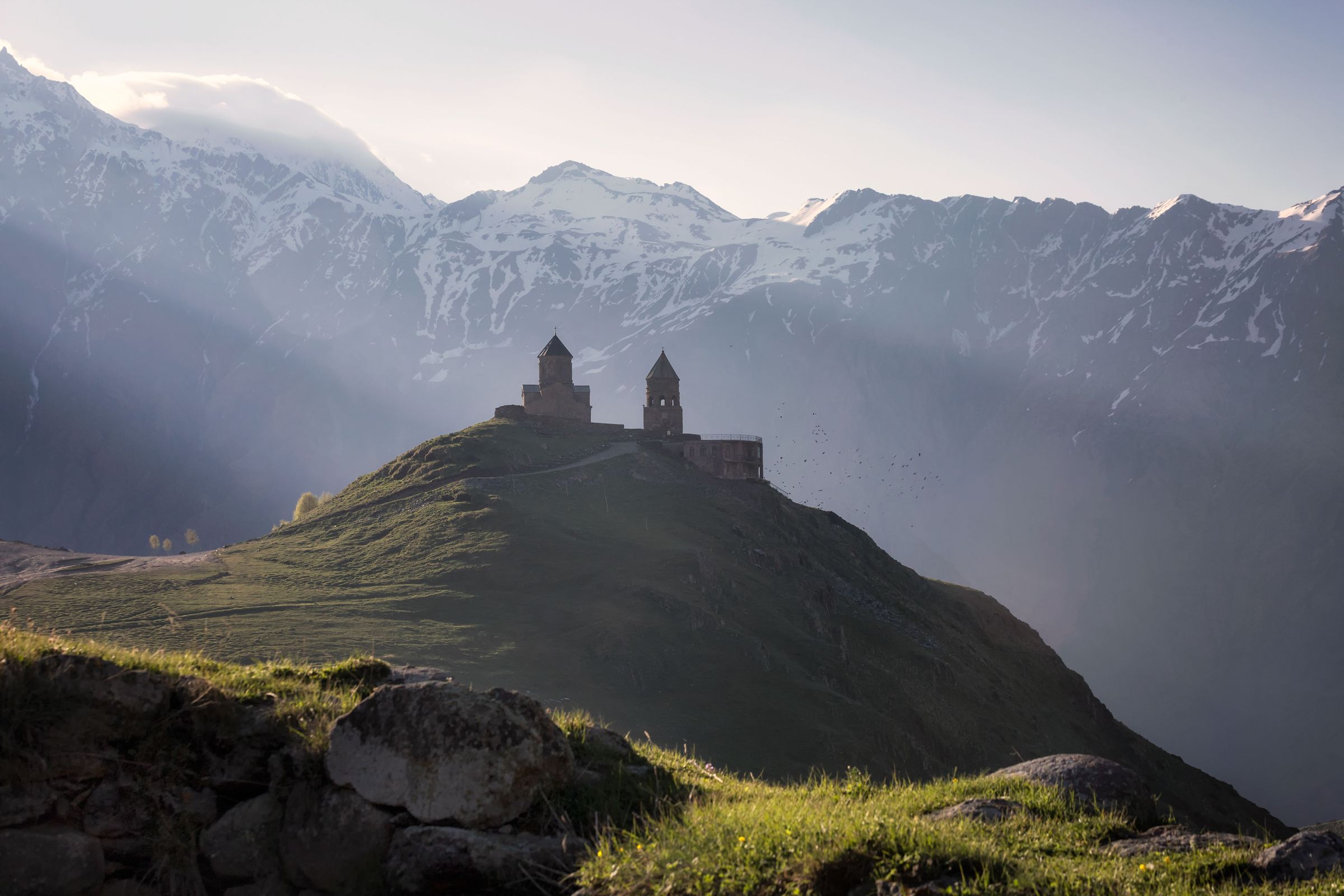
Base in Stepantsminda for two nights. The essential walk is up to Gergeti Trinity Church, perched at 2,170m directly beneath Mount Kazbek's glacier — doable on foot in about two hours each way, or by 4x4 taxi from the village if the weather, your schedule, or your knees say otherwise. Gudauri, on the Georgian Military Highway between Tbilisi and Kazbegi, is worth a stop for the ridge views alone even outside ski season, and makes a good short leg-stretch on the drive up. Give the second day to weather-dependent flexibility: Kazbek is frequently in cloud, and the locals running the 4x4s will tell you honestly whether it's a church day or a wait-it-out day. This is the one leg of the itinerary genuinely worth two nights rather than one, because a single overcast afternoon can otherwise cost you the entire reason you came this far north — and a clear one, when it happens, is worth every hour spent waiting for it.
Days 6–7 — Kakheti wine country
Best for wine, monasteries, and a change of pace
Drive back through Tbilisi (or around it on the bypass) into Kakheti, Georgia's wine heartland and the source of its 8,000-year-old qvevri winemaking tradition, recognised by UNESCO as intangible cultural heritage. Base in or near Sighnaghi, the walled hill town above the Alazani Valley, and use it for two nights rather than one. Visit Alaverdi Monastery and Bodbe Monastery, then spend an afternoon at a family qvevri cellar tasting wine made in buried clay vessels rather than steel tanks — a completely different experience from a European winery tour, and usually paired with a home-cooked meal rather than a formal tasting menu. David Gareja, the cave monastery complex on the semi-desert border with Azerbaijan, is a worthwhile half-day detour if you have the time and don't mind a rough final stretch of unpaved road. Kakheti is the itinerary's deliberate change of register: slower, warmer, and built around food and wine rather than altitude.
Day 8 — Tbilisi to Kutaisi, via Imereti
Best for a transitional day that isn't wasted
This is the itinerary's long driving day, and it's worth doing in daylight rather than splitting badly across two shorter ones. From Kakheti, cross back toward western Georgia and break the journey in Imereti: Prometheus Cave, one of the country's largest and best-lit show caves, with a boardwalk route through illuminated chambers, and Martvili Canyon, where a short boat ride runs beneath turquoise cliffs and waterfalls carved into limestone. Overnight in Kutaisi, Georgia's third city and the gateway to Svaneti, rather than pushing straight through to the mountains — arriving into unfamiliar mountain roads after dark is neither pleasant nor safe, and there's nothing to see in the dark anyway. Kutaisi itself has a walkable old centre and Bagrati Cathedral on its hill above the Rioni river if you have an hour spare before dinner, plus a livelier restaurant scene than most stopovers this size.
Days 9–10 — Svaneti: Mestia and Ushguli
Best for medieval tower villages and the highest permanently inhabited settlement in Europe
The road from Kutaisi to Mestia climbs through the Enguri gorge past the Enguri dam and takes most of a day; fly instead if the short seasonal Kutaisi–Mestia route is running and you'd rather save the hours for the mountains themselves. Mestia is Svaneti's hub, its stone defensive towers built by families who spent centuries defending against blood feuds, avalanches, and invaders alike — the Svaneti Museum of History and Ethnography in town explains why the towers, not the houses, were built to last. From Mestia, the 4x4 track (or a long, spectacular full-day walk) to Ushguli reaches Europe's highest permanently inhabited community, a cluster of medieval tower villages sitting under the glaciers of Mount Shkhara, Georgia's highest peak. This is the itinerary's finale rather than an add-on: give it the full two days, fly back to Tbilisi from Mestia or Kutaisi, and don't try to combine it with anything else on the same trip — Svaneti rewards being the last thing you see, not a stop squeezed between two others.