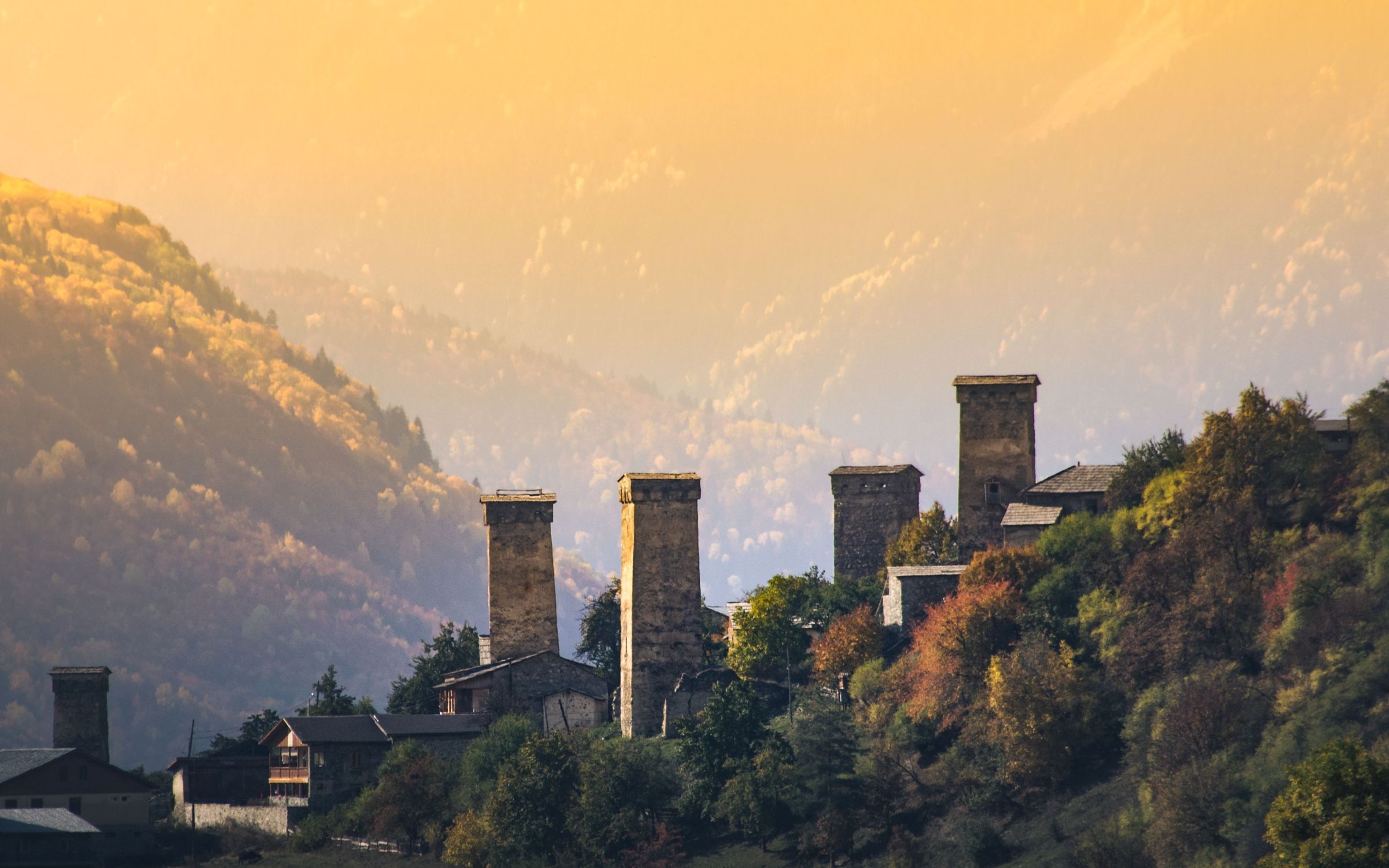
Chazhashi, Ushguli
Best for the single densest, most complete tower cluster in Svaneti
Chazhashi is the core of the four-hamlet Ushguli community and the reason Upper Svaneti carries UNESCO World Heritage status: roughly 200 medieval defensive towers, some dating to the 9th century, still rise from a single valley floor. Unlike a restored open-air museum, Chazhashi is inhabited — families still use the upper machub levels of their towers for storage as they have for centuries, and the 12th-century Church of the Assumption sits among them with an active congregation. The Jageli and Gelashvili clan towers are among the best preserved. Ushguli itself, at 2,100-2,200 metres, ranks among the highest permanently inhabited settlements in Europe, and the towers here read as clan architecture rather than a fortress built by a single authority — each family built and defended its own. Reach it by 4WD from Mestia (roughly 2.5-3 hours over 40km of rough track, impassable November to April) or on foot as the final stage of the multi-day Mestia-Ushguli trek, which most people who make the effort say is the better way to arrive.
Mestia
Best for seeing towers without a 4WD, plus the museums that explain them
Mestia is Svaneti's administrative town at 1,500 metres, and it holds the densest concentration of towers that are still lived in or actively maintained within easy walking distance of paved roads, restaurants and a place to sleep. This is also where the region's history is explained rather than just displayed: the Svaneti Museum of History and Ethnography, reopened in a striking modern building in 2012, holds 10th-century illuminated manuscripts, gilded icons and tower-house models rescued from remote village churches, while the smaller Mikhail Khergiani House-Museum preserves the home of the Svan mountaineer who died on the Matterhorn in 1969. For travellers who can't manage the Ushguli road, Mestia is the honest answer to "can I see real Svan towers without 4WD" — yes, and you'll understand them better here than anywhere else in the region. Daily flights connect Tbilisi to Mestia's small airstrip when weather allows, and the Zugdidi-Mestia road has been fully paved since 2010.
Queen Tamar's Tower, above Ushguli
Best for a single, uncluttered tower against the Caucasus skyline
This solitary tower stands apart from the Chazhashi cluster on a grassy knoll roughly 300 metres away, and that isolation is the point: Svan tower placement followed individual family landholdings rather than collective village defence, and this is the clearest place to see a tower functioning purely as one household's fortress. Its royal name comes from oral tradition rather than any documented link to Queen Tamar, but the commanding position above the Enguri gorge, with Shkhara's glacial face behind it, explains why the association stuck. The original stone entrance, set three metres above ground and reached by a removable wooden ladder, is intact — standard Svan security against raids. Photographers climb the 20-minute path from Chazhashi at dawn, when the tower catches first light alone against the peak, well before the main cluster does.
Latali
Best for towers paired with medieval frescoes, as an easy add-on from Mestia
Latali sits on a forested ridge roughly 45 minutes by 4WD (or a 3-4 hour walk) from Mestia, and it proves the region's fame rests on more than landscape alone. Twelve preserved medieval towers stand through the village, but its real draw is the Matskhvarishi Church of the Savour, a 12th-13th century building whose interior holds a rare fresco cycle of the Deesis and the Last Judgment, commissioned by local nobles when Svaneti sheltered Christian art during turbulent centuries elsewhere in Georgia. A smaller Church of St. George nearby adds more traditional stone defensive architecture. The old ox-track linking Latali to neighbouring Chazhashi and Zhabeshi passes several more inhabited towers, making this a good half-day loop for anyone who wants towers and painted churches together without committing to the full Ushguli road.
Nakipari
Best for towers standing guard over an intact medieval fresco cycle
Nakipari's Church of St. George dates to the 10th century and preserves one of the Caucasus's most significant early fresco cycles, painted in layers between the 11th and 13th centuries — a Deesis in the apse with original azurite and cinnabar pigment still visible, and a 12th-century donor portrait identifying local noble patronage. Immediately beside the church stands a three-storey Svan tower, still used for grain storage and reached by an external wooden ladder, making the pairing of fortified stone and painted sanctuary unusually direct here. Because Nakipari sees fewer visitors than the villages directly on the main Ushguli road, it rewards an unhurried look rather than a drive-by. It sits about 7km north of Mestia on the road toward Zugdidi; a 4WD or a roughly 90-minute walk from the village of the same name gets you there.
Etseri
Best for towers seen without the crowds, on the way in or out
Etseri sits where the Zugdidi-Mestia highway begins climbing into the highlands proper, and it preserves the same 9th-to-12th-century Svan defensive architecture as its famous neighbours — including well-preserved towers of the Khergiani and Japaridze clans — but amid walnut groves and cornfields rather than trekking traffic. The 10th-century Church of St. George on a forested slope above the village adds rare fresco fragments, and old irrigation channels along the Etseristskali River show the sophistication of medieval Svan water management. Because Etseri is a scheduled marshrutka stop rather than a destination in its own right, it's easy to miss entirely — which is exactly why it's worth a deliberate half-hour stop for anyone driving the Zugdidi-Mestia road who wants towers without competing for the view.
Adishi
Best for towers seen as a trekking reward, with a glacier for a backdrop
Adishi is a village of perhaps forty people at 2,040 metres, reached only on foot or horseback as the second night's stop on the classic Mestia-Ushguli trek. Its stone towers, some dating to the 8th-10th centuries and clustered in the village centre, sit in direct view of the Adishi Glacier's tongue, which hangs visible from the settlement and feeds the milky river below. What makes the towers here different from Chazhashi's cluster is the setting: no road, no other tourist infrastructure, just family guesthouses, wandering cows, and a barefoot or horseback river crossing the next morning. This is the place to understand Svan towers as working buildings in a genuinely isolated valley, not as a heritage backdrop — and it's earned only by walking or riding in.
Becho and Zhabeshi
Best for towers framed against Mount Ushba's twin peaks
These two Svan communities on the western side of the region trade Shkhara's drama for Ushba's: from Becho's Dolra valley floor, the 4,710-metre twin summits present their full frontal symmetry, best at sunrise when alpenglow catches the south peak first. Fewer than ten stone houses with attached defensive towers remain around Becho, built with the same techniques as Ushguli's but seen by a fraction of the visitors, while nearby Zhabeshi — now also the staging post for the Tetnuldi ski lifts — keeps a dozen or so medieval towers scattered through its upper quarters, including the Gabiani family tower. Both villages are reached by roughly 1.5-2 hours of 4WD from Mestia and work well together as a loop for travellers who've already done the Ushguli road and want Ushba's towers instead of Shkhara's.