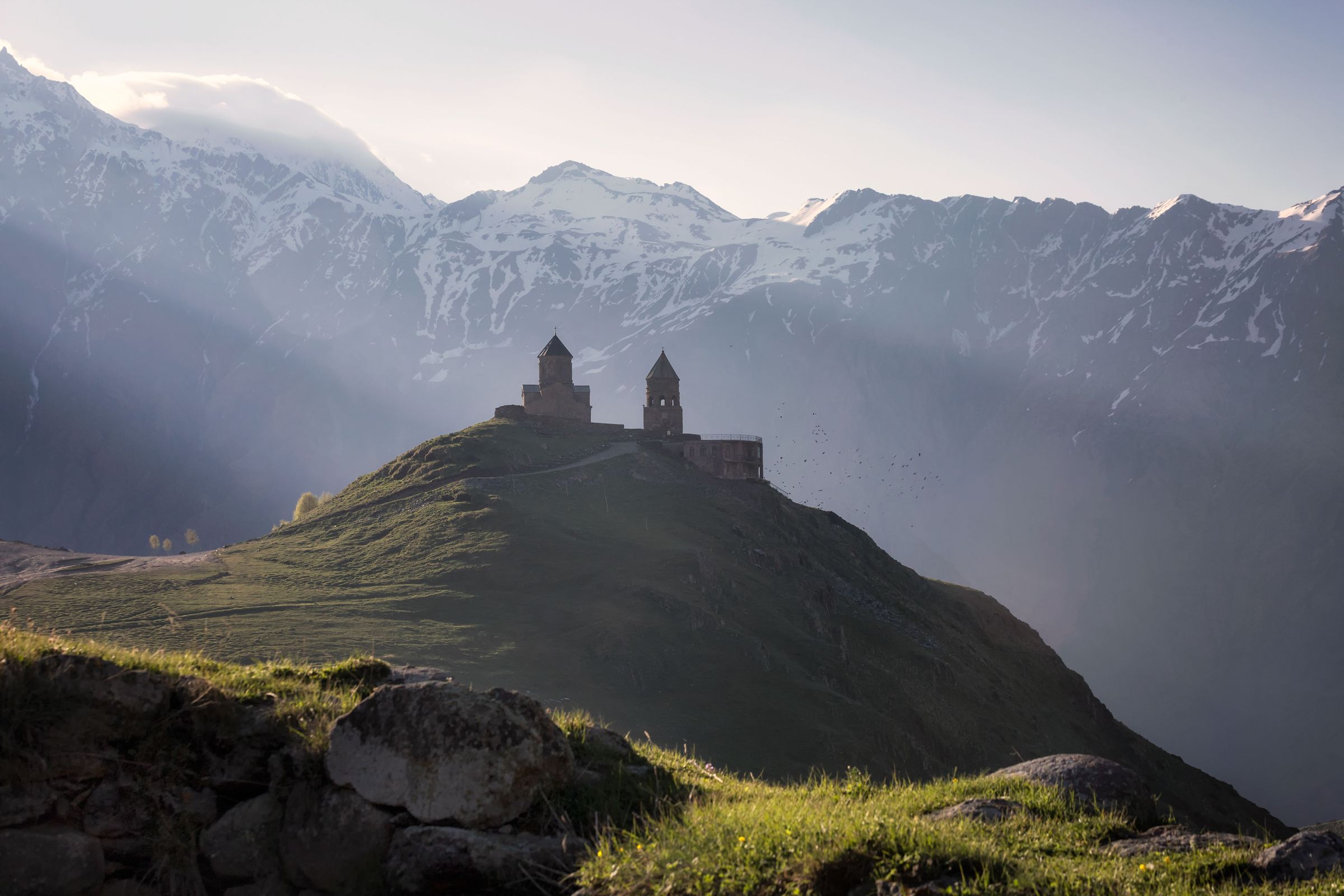
Best Overall
Everything about Kazbegi points toward this church, and for once the postcard earns its reputation. Built in the 14th century on a bare ridge at 2,170 metres, Gergeti Trinity Church was chosen precisely for its isolation — no village, no trees, just a stone cross-in-square sanctuary facing Mount Kazbek's eastern wall at close range. Georgians hid the precious Mtskheta cross here during Persian invasions, and the sense of a last redoubt still holds. Walk the trail from Stepantsminda (three to four hours up) rather than taking the 4WD track, and the mountain grows steadily rather than arriving all at once. Inside, worn 18th-century fresco fragments survive despite centuries of unheated winters. The single best photograph in the country is taken from the small rise fifty metres northwest of the church, where the bell tower sits framed against the full glacier. Arrive before 9am in July and August, when jeep convoys turn the churchyard into a scrum.
Kazbegi National Park, above Stepantsminda
Mount Kazbek & the Gergeti Glacier Trail
Best for Serious Trekkers
Kazbek is a dormant volcano at roughly 5,047 metres, the mythological site where Prometheus was chained for stealing fire, and one of the more approachable 5,000-metre summits in the range — approachable being relative. Full ascents require glacier travel skill, a registered guide, and permits arranged through the Mountain Rescue Service in Stepantsminda, and belong to a different trip than this list. What's open to a strong day-hiker is the trail past Gergeti Trinity Church toward the Gergeti Glacier and the Bethlemi Hut, a Soviet-era shelter at 3,650 metres that now serves as summit base camp. The eight kilometres from Stepantsminda gain nearly 1,900 metres, six to eight hours one way, so most people hire a 4WD to the church to shorten it. The reward is standing at the glacier's fractured tongue with meltwater thundering underfoot, ice that yields to effort without requiring an expedition. Go July through September, and carry crampons if you push onto hard ice near the terminus.
Kazbegi National Park
Juta Valley & the Chaukhi Massif
Best Day Hike
Juta is a scatter of stone houses at 2,200 metres that had no road until the 1980s, sitting directly beneath seven granite towers locals call the Georgian Dolomites. The valley is the trailhead for the best single day-hike in the region: up through wildflower meadows and moraine to the Chaukhi lakes at 3,300 metres, two turquoise cirque pools set against a wall of five-thousand-metre rock. It's a genuine full day — figure eight to ten hours round trip from the village — but unlike the Gergeti crowds, you'll often have the trail to yourself past the first hour. Juta itself is worth the 20-kilometre unpaved drive from Stepantsminda on its own merits: overnight in a family guesthouse and you'll likely be fed korkoti and hear Khevsur polyphonic singing that survives almost nowhere else. Climbers use Juta as base camp for Chaukhi East's mixed rock-and-snow route, first climbed in 1938. Best June through September; the access road closes with early snow and reopens late.
Khevi, 20km southwest of Stepantsminda
Best for History and Solitude
Truso is the valley Kazbegi's other attractions don't prepare you for: a fifteen-kilometre glacial corridor along the Terek River, with the South Ossetian border running just beyond the ridgeline. Keterisi, an Ossetian village of stone towers, was evacuated during the 2008 war and now stands empty except for shepherds who still bring flocks through in summer. Mineral springs stain the valley floor rust and ochre, fizzing straight out of limestone fissures with no signage and no one else around. Further up, the Abano Glacier calves into turquoise moraine pools roughly 2,800 metres up. This is Georgia's clearest lesson in how recent and how close its conflicts remain, delivered without a museum or a plaque. A rough 4WD track runs from Ketrisi village in Kazbegi municipality, with the final stretch on foot; stay on marked paths near the border. Open May through October, and arrange a driver in Stepantsminda who knows the route — this is not a rental-car trip.
Truso Valley, southwest of Kobi
Best Scenic Drive
Every road trip up the Georgian Military Highway ends here, and it's worth slowing down for rather than treating as a corridor to Russia. The Tergi River has cut a passage barely wide enough for the road through granite walls rising a thousand metres, and for two thousand years this was the only viable route between the Black and Caspian Seas — Persian, Roman, Mongol, and Russian armies all fought to hold it. A ruined 12th-century fortress, Tamar's Fortress, still clings to a cliff above the road, and the Russia-Georgia Friendship Monument at the Jvari Pass marks the gorge's northern approach with sweeping views back down the valley. No village interrupts the drama — just river noise amplified by stone and the occasional golden eagle overhead. The final ten kilometres toward the Russian border require a free permit from Stepantsminda police, and foreigners can't pass the last checkpoint, but everything worth seeing sits well before it. Best May through October; landslides and snow close the road at short notice in winter.
Georgian Military Highway, north of Stepantsminda
Best Easy Walk
If Kazbegi's trekking numbers sound intimidating, this is the counter-argument: a twenty-minute walk from a highway pull-off to a genuine 25-metre waterfall, no permit and no fee involved. Upper and Lower Gveleti drop through a narrow limestone ravine fed by snowmelt off the Kazbek massif, reached via an 800-metre trail from the Military Highway through old boxwood and fern. The lower fall is the easy prize, approached across stepping stones with spray catching whatever light filters down the canyon; the upper fall asks for a further scramble upstream through birch forest for those who want it. Trucks bound for the Russian border thunder past on the road above while you stand in near-total quiet at the base of the falls — one of the sharper contrasts the Georgian Military Highway offers. There's no infrastructure at the trailhead, so come with proper footwear; the path turns icy and unsafe in winter and the lower pool can flood with spring snowmelt. Best May through October, and easily combined with Dariali Gorge on the same stop.
Near Gveleti village, Georgian Military Highway
Sno Village
Best Cultural Detour
Sno sits a short drive south of Stepantsminda, on the turnoff toward Juta, and rewards the five minutes it takes to stop. A 16th-century fortress built by the Snoazde family crowns the hill above the village, three surviving towers looking down the Aragvi gorge, while the valley below preserves medieval stone towers belonging to the Svanidze clan — some dating to the 12th century, built as much for prestige as defence. Families here still tend ancestral orchards and maintain small roadside shrines, a way of life that Stepantsminda's guesthouse economy has mostly displaced. Then the village delivers its curveball: a monumental stone head of a bearded man, one of several giant sculptures carved in the 1980s by Georgian artist Merab Piranishvili, looming beside the road like a forgotten colossus. The combination — unmortared medieval masonry and Soviet surrealism weathering side by side — is the kind of detail a rushed Kazbegi day trip skips entirely. Sno also makes a quieter, cheaper guesthouse base than Stepantsminda itself for travellers heading on to Juta.
Sno Valley, 5km south of Stepantsminda
Best Multi-Day Trek
Three glacial lakes fed by the Chaukhi massif, each stained a distinct and genuinely startling colour — green from submerged algae, milky white from suspended glacial flour, and a deep saturated blue from mineral-rich springs — sitting at roughly 3,000 metres in the Khevsureti foothills. This is the payoff trek for anyone who found Juta's day-hike crowd too thick: reached via a rough 4WD track to Roshka village and then three to four hours of hiking each way with no facilities en route, Abudelauri sees a fraction of Gergeti's traffic. Some trekkers link it to Juta via the 3,438-metre Chaukhi Pass, turning it into a genuine two-day crossing that follows the same route seasonal shepherds have used for generations, overnighting in a Roshka family home on kubdari and guda cheese. It demands proper planning — no marked buses serve either trailhead, so arrange transport and possibly a guide through a Stepantsminda guesthouse before setting out. Best July through September only; earlier in the season the passes hold snow.
Khevsureti foothills, via Roshka or Juta
Best No-Hike Option
For the rainy day, the tired legs, or the traveller who simply doesn't want to hike in Kazbegi, Sioni Church sits ten minutes' walk from Stepantsminda's main square and still delivers genuine weight. Its 14th-century bell tower, built with defensive crenellations to shelter villagers during raids, has watched over the same Mount Kazbek backdrop that every trader and pilgrim on the Georgian Military Highway has passed since the 19th century. Inside, dim and incense-scented, faded medieval fresco fragments survive in the apse, including a rare depiction of the Dormition of the Virgin that outlasted Mongol raids and decades of Soviet neglect. The stone baptismal font in the churchyard is still used for local Orthodox ceremonies, which gives the whole site a lived-in quality that purely historic monuments lack. It's open daily year-round and needs no 4WD, no guide, and no advance planning — just a walk down from wherever you're staying, making it the obvious way to spend an hour on an otherwise resting day.
Stepantsminda town centre
Methodology — how we ranked
This ranking covers sites within Kazbegi municipality and the immediate Stepantsminda base, weighed on experience (does it earn the effort to reach it), uniqueness (is it distinctive within the Caucasus, not a generic viewpoint), access (road condition, hiking time, permit requirements), value (cost against reward), scenery, cultural or historical weight, and sustainability (whether visitor numbers threaten the place it sends you to see). Sites best reached as their own separate trip — Gudauri's ski slopes, Ananuri Fortress on the road up from Tbilisi, the deep Khevsureti villages of Shatili and Mutso — are covered on their own pages rather than folded in here, so this list stays genuinely about Kazbegi itself.