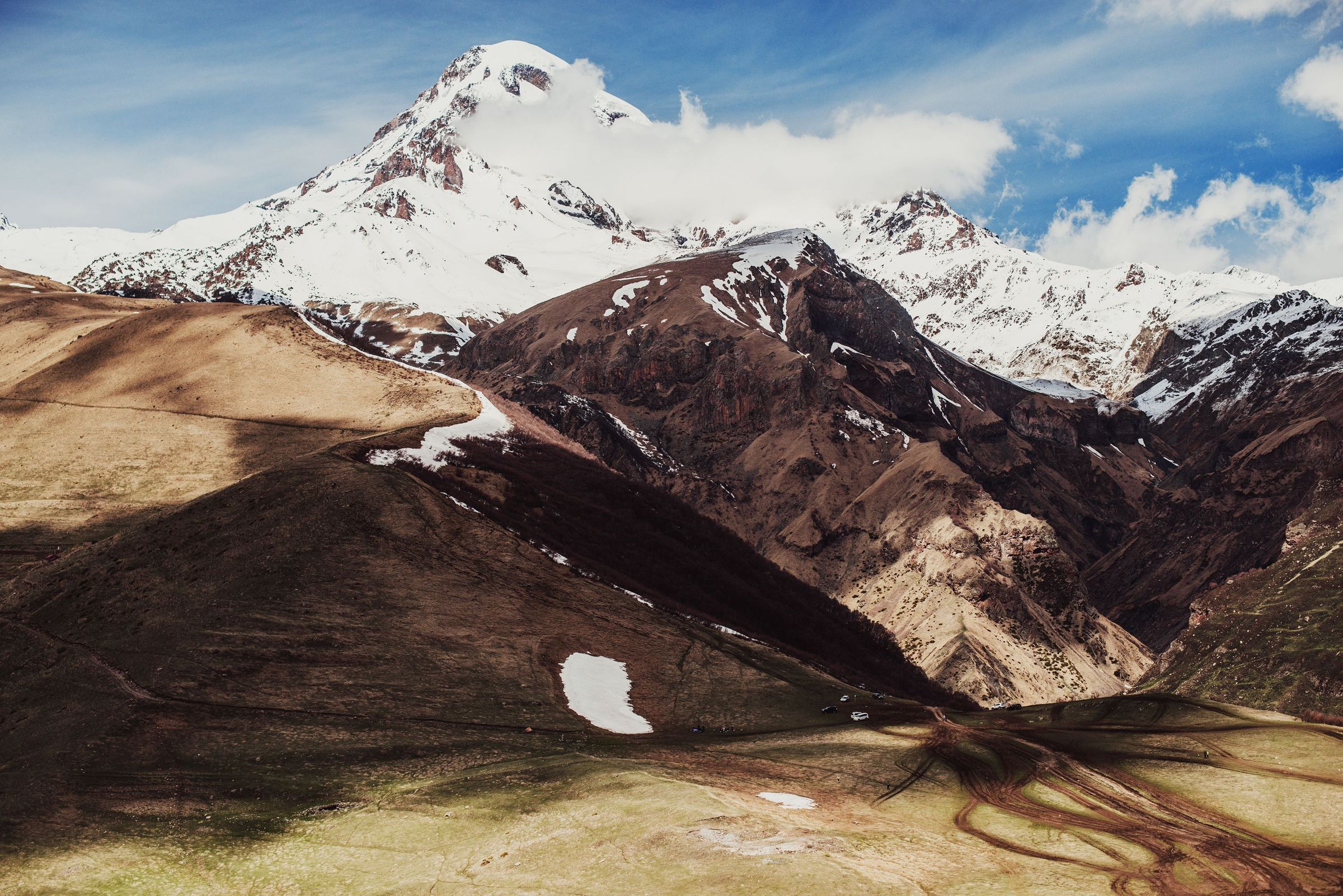
Mount Kazbek itself
Best for understanding what all the reverence is about
Kazbek rises to 5,047 metres as a solitary volcanic cone above the Caucasus watershed, visible for miles along the Georgian Military Highway before you reach it. Greek myth places Prometheus's punishment here — chained to the rock for stealing fire and giving it to humanity, an eagle sent daily to tear at his liver. Georgians never needed the Greek story to treat the mountain as sacred: they call it Mkinvartsveri, 'ice-capped peak', and for centuries shepherds and travellers on the highway below have crossed themselves at the sight of it. What makes Kazbek different from other 5,000-metre Caucasus giants is its isolation — a single cone rather than a ridge, so it dominates the Stepantsminda valley from every angle rather than hiding behind neighbouring summits. You do not need to climb it to feel its weight; simply standing in the valley at dawn, watching alpenglow move down the ice, delivers most of what the mountain has to give.
Gergeti Trinity Church
Best single view in the Georgian Caucasus
Gergeti Trinity Church sits at 2,170 metres on a bare ridge with no village, no trees, and Kazbek's glacier rising directly behind the apse. Built in the 14th century, this plain stone cross-in-square church once sheltered the precious Mtskheta cross during Persian invasions — its isolation was its defence. The interior holds fragments of 18th-century fresco, remarkable survivors of centuries of harsh winters, but the real experience happens outside: the viewpoint fifty metres northwest of the church frames the entire Kazbek massif behind the bell tower in one composition that needs no explanation. Reach it by the 6-kilometre hiking trail from Stepantsminda (three to four hours up) or by 4WD taxi on the rough mountain track, and go early — July and August bring convoys of jeeps by mid-morning, and the church rewards whoever arrives before them with something closer to the silence pilgrims once found here.
The Gergeti Glacier trail
Best way to get close to Kazbek's ice without technical climbing
Beyond the church, a marked trail continues four kilometres toward the Gergeti Glacier, gaining altitude past the old meteorological station and delivering ever-closer views of Kazbek's fractured seracs and crevassed tongue. The full route from Stepantsminda to the Meteo Station at 3,650 metres — a Soviet-era mountaineers' hut still used as base camp for summit attempts — climbs roughly 1,900 metres over six to eight hours one way, though hiring a 4WD to the church shortens the day considerably. This is where casual hikers get to stand near genuine glacier ice, blue and thundering with meltwater, without ropes or crampons on the lower approach. Carry proper footwear and expect the trail to firm into hard ice in shaded sections even in midsummer; go July through September, and treat crampons as sensible rather than optional if you push past the station itself.
The Kazbek summit route
Best for climbers who want a genuine 5,000-metre peak
For mountaineers, Kazbek offers one of the most accessible 5,000-metre summits anywhere in the world — no technical rock climbing on the standard route, but real glacier travel, crevasse hazard, and altitude that demands respect. Ascents typically stage through the Bethlemi Hut near the Meteo Station, with summit attempts requiring registration and permits through the Mountain Rescue Service in Stepantsminda and, ideally, a certified local guide given the crevasse fields and frequent whiteout conditions near the top. This is not a walk-up despite its accessibility on paper: parties have been caught by fast-moving weather even in peak season. It belongs on this list because it is genuinely one of the more approachable Caucasus giants for climbers with prior glacier experience — not because it is easy.
Truso Valley
Best for solitude and raw geology
Truso Valley cuts a 15-kilometre glacial corridor west of Kazbek, the Terek River running past mineral springs that stain the valley floor rust and ochre and the abandoned Ossetian village of Keterisi, evacuated during the 2008 war and now used only seasonally by shepherds. The Abano Glacier terminates above the valley, calving into turquoise pools, while the ridgeline to the south marks the boundary with Russian-occupied South Ossetia. This is the place to come if Gergeti feels too populated: the valley holds the visible collision of border politics, climate, and centuries of transhumance in one landscape, with almost none of the jeep traffic that reaches the church. A rough 4WD track runs in from Ketrisi village, but the final kilometres require walking or arranged local transport, and marked paths should be kept to near the border zone.
Juta Valley and the Chaukhi massif
Best full alpine day hike from a Kazbek base
Juta sits at 2,200 metres beneath Chaukhi, three jagged granite towers locals and guidebooks alike call the 'Georgian Dolomites' — a formation distinct from Kazbek itself but reached from the same Stepantsminda base via an 18-kilometre unpaved road. Until the 1980s no road reached this seasonal hamlet at all, and the isolation still shows in a way of life built around transhumance and stone houses. From the village, a full-day trek climbs to the Abudelauri Colored Lakes — three glacial pools stained green, blue, and milky-white by mineral content — or to the Chaukhi lakes at 3,300 metres beneath the massif's granite spires. It is the natural pairing trip for anyone based in Stepantsminda who wants one serious alpine day beyond the church-and-glacier circuit, best attempted June through September when the high trails are clear of snow.
Dariali Gorge and the Gveleti Waterfalls
Best scenic detour for travellers short on time
North of Stepantsminda, the Dariali Gorge squeezes the Terek River between granite walls rising a thousand metres — for millennia the only viable route between the Black and Caspian Seas, fought over by Persian, Roman, Mongol, and Russian armies, with the ruins of a 12th-century fortress still clinging to the cliffs above the road. A short trail near the village of Gveleti leads to twin waterfalls, upper and lower, dropping through a narrow limestone ravine; the lower fall is reachable in a ten-minute riverside scramble and rewards with spray-lit views back up the gorge. This is the option for anyone with only a few hours around Stepantsminda: no permit, no altitude gain, just the same Caucasus drama compressed into a half-day stop, with Kazbek itself visible from the gorge's southern mouth.
Stepantsminda
Best base for the whole Kazbek region
Stepantsminda — known for decades under its Soviet name, Kazbegi — sits at 1,740 metres directly beneath the mountain, a modest grid of guesthouses and family kitchens with an incomparable position. Byron called Kazbek 'the Glorious' and Pushkin wrote it into Russian literature; today the town functions as the practical staging point for everything above it, three hours by marshrutka from Tbilisi's Didube station. Evenings here mean khinkali and local dairy — salted sulguni and thick matsoni yogurt sold from family homes along the main road — eaten beneath the same peak that has anchored highland Georgian identity for centuries. There is no reason to base a Kazbek trip anywhere else: every valley and trail on this list radiates from Stepantsminda within a half-day's reach.