Best for a first orientation to the country
This is where every Georgia trip should start. Tbilisi's old quarter follows the bend of the Mtkvari River on the site where, legend says, King Vakhtang Gorgasali's falcon fell into a hot spring — giving the city its name, from the Georgian word for 'warm.' The district has absorbed Persian, Arab, Mongol and Russian influence without losing its own character: balconied wooden houses lean over narrow lanes, sulfur bathhouses steam beneath brick domes, and Sioni Cathedral and the Narikala fortress views sit a short walk apart. It rewards wandering more than a checklist — courtyards open onto small workshops and wine cellars, and the old caravanserai streets still function as they did centuries ago. Because it's compact and walkable, it's also the easiest place in the country to adjust to Georgian pace before heading further afield.
Tbilisi
Mtskheta and Svetitskhoveli Cathedral
Best for understanding Georgian Christianity
Twenty minutes from Tbilisi, Mtskheta was the capital of the Georgian kingdom of Iberia for eight centuries and remains the country's spiritual centre. Svetitskhoveli Cathedral, founded in 1010, is built on the spot where legend places Christ's robe buried beneath a sacred cedar — the name means 'Life-Giving Pillar.' The cathedral's scale is startling for a town this size, and it still functions as a working church rather than a museum piece, with pilgrims and locals moving through it daily. Pair it with a walk along Mtskheta's old streets and the hilltop view from Jvari Monastery across the river, where the Mtkvari and Aragvi rivers meet in the valley below. Because it's so close to the capital, it's the single easiest UNESCO-grade site to add to a Tbilisi-based itinerary without sacrificing a full day.
Mtskheta-Mtianeti
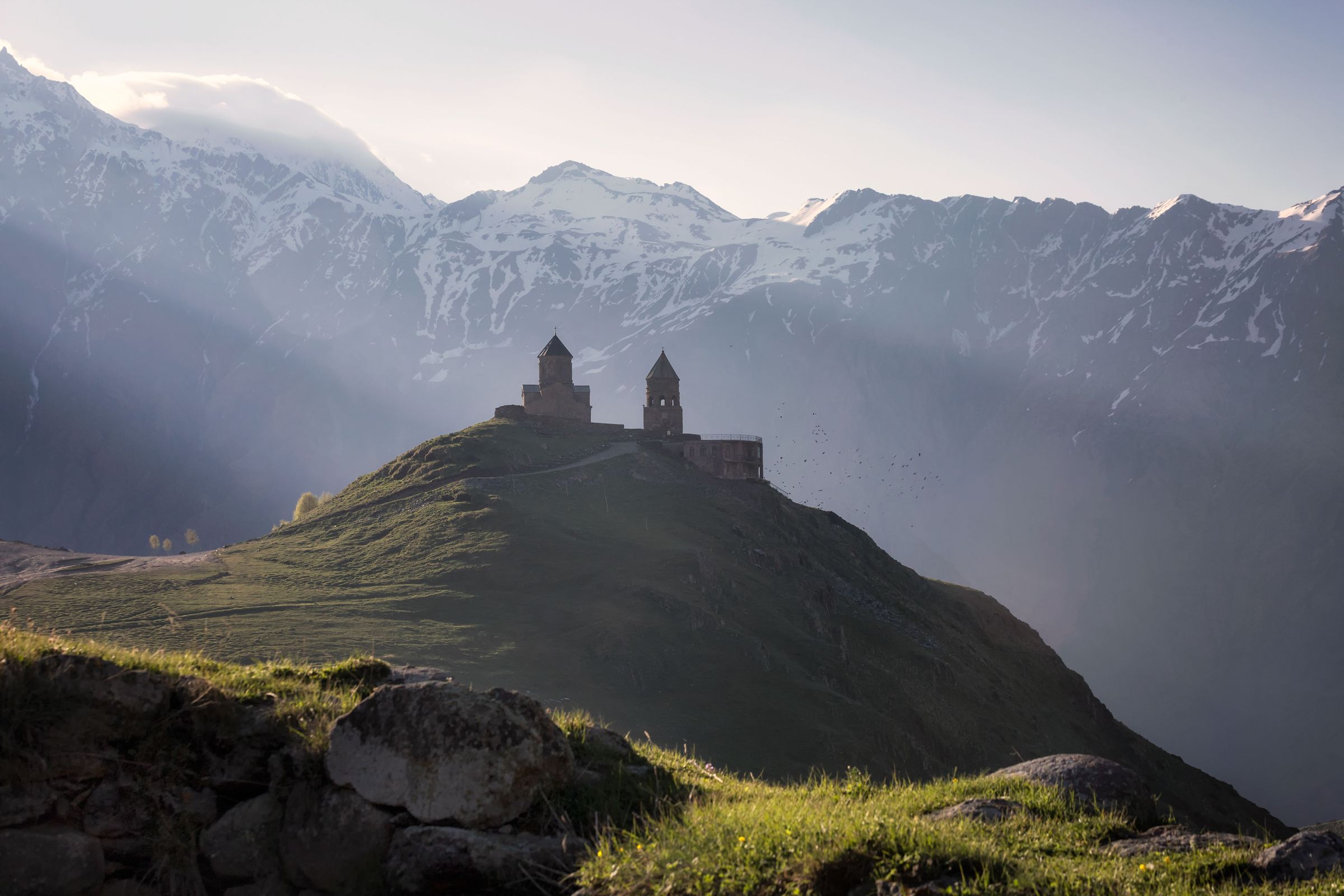
Kazbegi and Gergeti Trinity Church
Best for dramatic mountain scenery in a single day
The drive north on the Georgian Military Highway climbs through the Aragvi valley, over the Jvari Pass, and into the shadow of Mount Kazbek, a 5,047-metre dormant volcano that Georgian myth casts as the mountain where Prometheus was chained. Gergeti Trinity Church sits alone on a bare ridge at 2,170 metres beneath it, a 14th-century stone church with no village around it — just wind, sky, and the glacier filling the view behind the apse. Reaching the church means a steep walk or a 4x4 up a rough track from the town of Stepantsminda; both are manageable in a day trip from Tbilisi, though staying overnight lets you see the peak at sunrise, when it's most often free of cloud. Few short excursions anywhere deliver this much high-mountain drama for so little time invested.
Kazbegi (Mtskheta-Mtianeti)
Sighnaghi and the Kakheti wine road
Best for wine culture and hilltop views combined
Kakheti is Georgia's wine heartland, and Sighnaghi is its best base for a first visit. The town's 18th-century defensive walls, built by King Erekle II against Persian and Dagestani raids, still form a walkable circuit around balconied streets overlooking the wide Alazani Valley. Below the town, family wine cellars still ferment in qvevri — the buried clay vessels that give Georgian amber wine its distinctive character, a method old enough that Georgia is widely credited as the birthplace of wine. A short drive away, Bodbe Monastery holds the grave of St. Nino, the 4th-century figure credited with bringing Christianity to Georgia in 337 AD. Together the town, the vineyards and the monastery make Kakheti the most complete single-region day trip outside the capital.
Kakheti
Uplistsikhe cave town
Best for ancient history without a long detour
Uplistsikhe is one of the oldest urban settlements in the Caucasus, a city carved directly into sandstone cliffs above the Mtkvari River, occupied from the early Iron Age through the late Middle Ages. Its name means 'Lord's Fortress,' and it once sat on a branch of the Silk Road, sheltering pagan temple sites, Christian churches and everyday dwellings within the same rock. Unlike Vardzia, which requires a longer drive into Samtskhe-Javakheti, Uplistsikhe is close enough to Tbilisi and Gori to fold into a single day alongside other Shida Kartli sites. Walking the exposed passageways and grain pits gives a tangible sense of pre-Christian Georgian life that the churches and monasteries elsewhere don't cover.
Shida Kartli
Vardzia cave monastery
Best for a single overwhelming historical site
Vardzia is not simply a monastery but a cave city of roughly 6,000 dwellings burrowed into the Erusheti Mountains, commissioned by King Giorgi III in the 12th century and expanded into a summer residence by his daughter, Queen Tamar, at the height of Georgia's medieval golden age. Multiple stories of chambers, chapels and passageways are cut directly into the cliff face above the Mtkvari River, and the frescoed main church still holds a portrait of Tamar herself. It's further from Tbilisi than most first-timer stops — reachable on a long day trip or better paired with a night in Akhaltsikhe or nearby Borjomi — but it delivers a scale and atmosphere unmatched by any other cave site in the country, including the more accessible Uplistsikhe.
Samtskhe-Javakheti
Kutaisi and Prometheus Cave
Best base for exploring western Georgia
Kutaisi, Georgia's third-largest city, was the capital of ancient Colchis and later of the unified Georgian kingdom under David the Builder — this is the region the Golden Fleece myth is set in. The city itself is worth a walking morning, but its real value for first-timers is as a base: Prometheus Cave, a 1.4-kilometre karst system of dripstone chambers near Tskaltubo that stayed classified under Soviet rule until independence, sits close by, as do the Martvili and Okatse canyons. With its own airport serving international budget routes, Kutaisi is increasingly how visitors enter western Georgia at all, making it a practical hub rather than just a historical stop.
Imereti
Best short nature stop near Kutaisi
Martvili Canyon is a 700-metre limestone gorge cut by the Abasha River, its emerald pools once considered sacred by the region's pre-Christian inhabitants and later used for baptismal rites by the monks of the 7th-century St. Andrew the First-Called Monastery on its rim. A boardwalk follows the canyon walls above turquoise water, and a short boat ride covers the most dramatic stretch. It's compact enough to combine with Prometheus Cave or Okatse Canyon in a single day out of Kutaisi, and it offers a different kind of scenery from the mountains and monasteries that dominate the rest of a first Georgia itinerary — worth including for variety, not just novelty.
Samegrelo-Zemo Svaneti
Mestia and Ushguli, Svaneti
Best for travellers with a week or more to spend
Svaneti asks for more time than anywhere else on this list, which is why it sits near the end rather than the top — but it rewards the trip. Mestia, the region's cultural centre at 1,500 metres in the Enguri valley, and Ushguli, one of the highest continuously inhabited settlements in Europe, are both built around Svan defensive towers dating from the 9th to 13th centuries, stone structures that UNESCO recognises as a singular form of mountain adaptation. Families still live inside some of them. The drive between Zugdidi and Mestia, and the rougher road on to Ushguli beneath Shkhara's 5,193-metre glacier, is itself part of the experience. This is the place to add once Tbilisi, Kakheti and Kazbegi are covered and a return trip — or a longer first one — is on the table.
Samegrelo-Zemo Svaneti
Batumi and the Black Sea coast
Best for combining a beach stop with the mountain itinerary
Batumi is a different Georgia entirely: a subtropical port city on the Black Sea with a seven-kilometre boulevard first laid out in 1884 for the elite of an expanding trading city. Its skyline mixes restored art nouveau buildings with contemporary towers, and the Boulevard, Piazza and old town make for an easy day or two of walking, eating and swimming that contrasts sharply with the mountain and monastery circuit elsewhere in the country. It's most useful for visitors flying in via Batumi's own international airport, or for anyone wanting to close a longer Georgia trip with a slower, coastal few days rather than another historical site.
Adjara