Best Things to Do in Batumi

Best of Georgia · By destination

Best Things to Do in Batumi

How to read this ranking

Ordered for how you travel, not for spectacle.

Each place below is scored for character, welcome, access across seasons, and the feeling it leaves — never for inventory. Use the traveller-type notes when two names pull equally.

The quick answer

Batumi's best experiences run along its seven-kilometre Black Sea Boulevard — the Alphabet Tower, the moving Ali and Nino sculpture and the Piazza's evening bustle — then push outward to the Botanical Garden's cliffside terraces, the Argo cable car above the city, and day trips south to the Roman ramparts of Gonio Fortress and the quieter pebble coves at Kvariati and Sarpi. The nine picks below mix free waterfront walking with a handful of paid attractions and two short trips beyond the city limits, and work whether you have an evening in Batumi or four days on the coast.

Top picks

  • Best Overall: Batumi Boulevard
  • Best Views: Batumi Alphabet Tower
  • Best Day Trip: Gonio Fortress
  1. Batumi Boulevard

    Best introduction to the city

    Batumi Boulevard has been the city's front room since 1884, when Governor Mikhail Vorontsov ordered a tree-lined promenade for the expanding port's Russian officers and their families. It has grown through Soviet-era leisure architecture into a seven-kilometre stretch that now carries almost every layer of the city's reinvention at once: original 1930s colonnades and tea pavilions survive near the old port, magnolias and palms shade the full length, and from May through October the Dancing Fountains send 150 jets into synchronised routines set to Georgian polyphony and Western pop. Walk it end to end — about ninety minutes at an easy pace, or rent one of the bicycles docked along the route — and you pass most of Batumi's other big waterfront draws without a single taxi. Start in the late afternoon so the walk carries you into the fountains and the evening crowds without the midday heat, and don't rush the older southern stretch near the port, where the boulevard still looks and feels like the 1930s.

    Batumi city centre

  2. Ali and Nino Moving Sculpture

    Best for the single photo everyone takes home

    Two seven-metre steel figures glide toward each other on hidden rails along the Boulevard, merge for a moment, then part again — a cycle that repeats roughly every ten minutes from dusk until close to midnight. Georgian sculptor Tamar Kvesitadze built the piece in 2010 to illustrate Kurban Said's 1937 novel Ali and Nino, in which a Muslim Azerbaijani boy and a Christian Georgian girl fall in love across a border their families cannot accept. The sculpture doesn't resolve the story so much as repeat its heartbreak on a loop, which is exactly the point: union and separation as the same continuous motion. It reads as pretty at midday and genuinely moving at sunset, when the figures silhouette against the sea and the crowd goes quiet for the few seconds they touch. Read the novel beforehand if you can — the emotional weight lands considerably harder with the context, and it costs nothing to stand and watch a full cycle or two.

    Batumi Boulevard

  3. Batumi Alphabet Tower

    Best views over the city and coastline

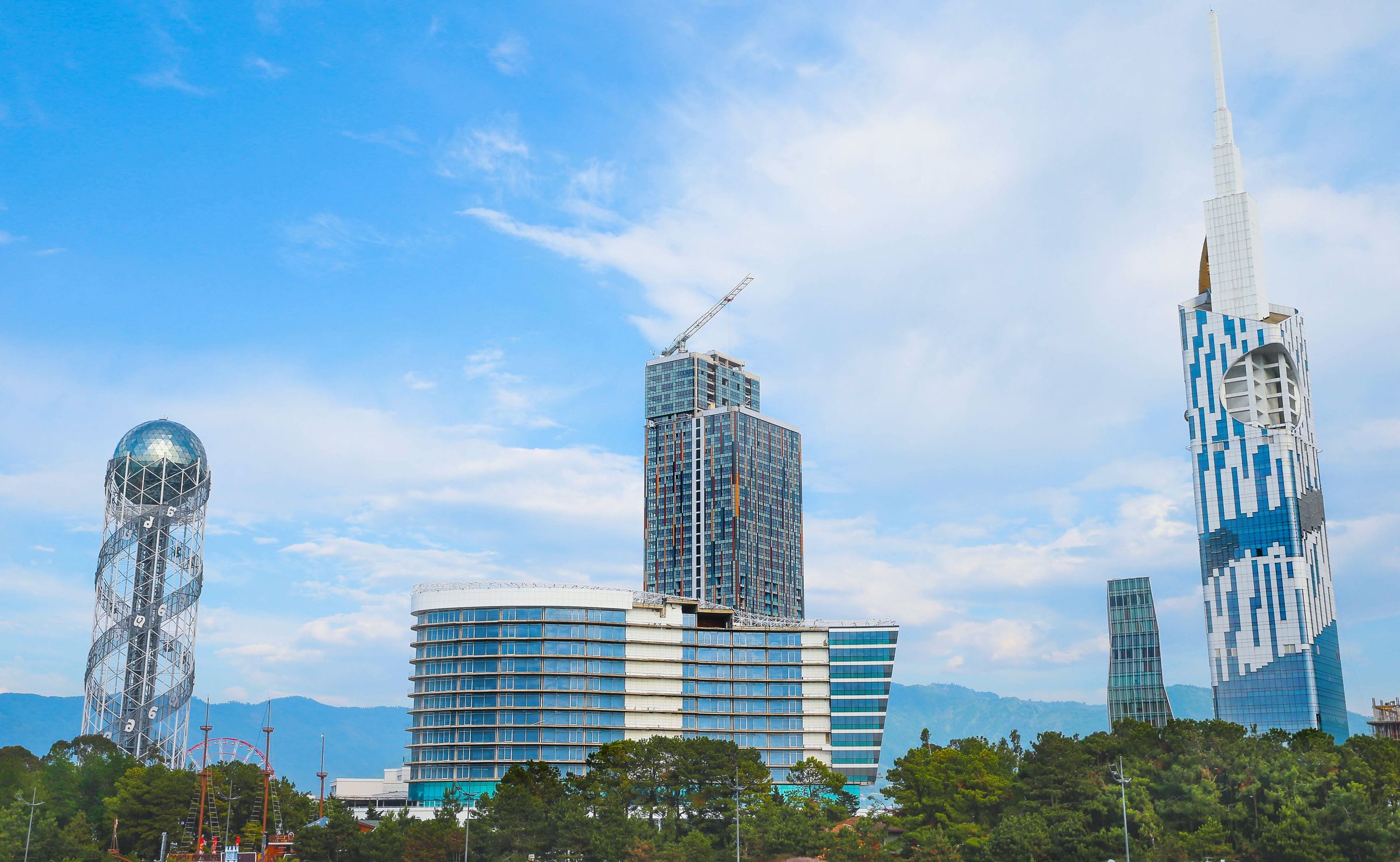
    Unveiled in 2012, the Alphabet Tower spirals 130 metres above the Boulevard on a double helix of 33 illuminated steel letters, each representing a sound in Georgia's Mkhedruli script — one of only fourteen independent writing systems still in active use anywhere in the world. It is an unapologetically strange landmark, more homage to linguistic survival than conventional monument, but the elevator ride to the glass-walled observation deck earns its ticket price on clear days: Batumi Bay unfolds directly below, the Lesser Caucasus foothills rise green behind the city, and on the clearest afternoons the Turkish coastline is visible across the water. Go up in late afternoon and time your descent to watch the tower's own nightly light show begin from the Boulevard below, when the letters ignite in sequence and spell out Sakartvelo — Georgia's own name for itself — across the dark. Tickets run 15–25 GEL depending on deck access.

    Batumi Boulevard

  4. Batumi Piazza

    Best for an evening among locals rather than tourists

    A few streets back from the sea, Batumi Piazza is where the city's Italianate ambitions get their fullest expression: a fan of intricate mosaic paving ringed by pastel colonnaded arcades, anchored by an astronomical clock gifted by an Italian partner city. It photographs well by day, but the square earns its place on this list after dark, when the café tables fill, street musicians set up under the arcades, and the clock's hourly mechanism draws a small crowd without ever feeling staged for visitors. There's no admission and no fixed itinerary here — the point is to sit, order a coffee or a glass of Adjaran wine, and watch a working Georgian city square do what it does most evenings, regardless of the season. It sits an easy ten-minute walk from the Boulevard, making it a natural stop between an afternoon by the sea and dinner.

    Batumi city centre

  5. Batumi Botanical Garden

    Best half-day away from the waterfront

    Founded in 1912 by the Russian botanist Andrei Krasnov as a living laboratory for what could grow in Georgia's humid subtropical climate, the Botanical Garden now spreads across 111 hectares of cliffside terrain planted with more than 5,000 species from nine climatic zones. Himalayan pines share a hillside with Californian sequoias and Mexican cacti; a century-old planting of Japanese cherry trees explodes into bloom every April; and the lower terraces still hold the original tea and citrus plantations that once supplied Russian aristocracy. The paths plunge and climb across 220 metres of elevation with the Black Sea in view from almost every turn, so treat it as a walk rather than a quick stop — two to three hours is realistic if you follow more than the main loop. It sits about 40 minutes from central Batumi by marshrutka #31, with taxis costing roughly 25–30 GEL each way; entry is 40 GEL, and spring or early autumn brings the best combination of blooms and walking temperature.

    Green Cape, north of Batumi

  6. Argo Cable Car

    Best for mountain panoramas without a hiking boot

    The Argo gondola lifts off from the Boulevard and climbs to Anuria Mountain at roughly 2,450 metres, passing in a matter of minutes from subtropical sea-level palms to subalpine ridgeline. The ride itself is the attraction: Batumi's skyline, the curve of the bay, and the forested folds of the Lesser Caucasus all fall away below the cabin in a single ascent that few Black Sea cities can offer this close to their centre. At the top, short trails lead across open meadow with views back down to the coast, and the air is noticeably cooler than the city below — a genuine relief in midsummer. It runs seasonally, typically May to October, and is worth checking for weather and operating hours before making the trip, since cloud cover on the ridge can flatten the views considerably.

    Batumi Boulevard

  7. Batumi Archaeological Museum

    Best for Colchian gold and ancient trade history

    Behind an unassuming Boulevard-side entrance, this museum holds one of Georgia's most important collections of Colchian goldwork — the metalwork of the ancient kingdom that gave rise to the Golden Fleece myth. The pieces span the Bronze Age through classical antiquity, including intricate filigree jewellery from the 6th to 1st centuries BCE alongside Greek imported pottery, Roman glassware and coins recovered from the fortified settlement at Gonio just south of the city. Together they make the case that Adjara was never a backwater: this was a working Black Sea trading hub sophisticated enough to absorb Greek and Roman influence while keeping a distinct local style. The collection is compact enough to see properly in an hour, which makes it an easy pairing with a Boulevard walk on a hot afternoon when shade is worth more than scenery. Open Tuesday to Sunday, 10:00–18:00, closed Mondays.

    Batumi Boulevard

  8. Gonio Fortress

    Best historical day trip from the city

    Ten kilometres south of Batumi, Gonio-Apsaros is one of the best-preserved Roman fortresses anywhere in the former empire — a 4.5-hectare citadel whose stone walls still rise five metres above the Chorokhi River delta. Founded as Apsaros in the 1st century AD to guard Rome's eastern Black Sea frontier, it later held a Byzantine garrison, and eighteen towers and a double-walled circuit remain standing today alongside the excavated ruins of a Roman bathhouse with its brick heating channels intact. What sets Gonio apart from a typical ruin is the physical immediacy: you walk the same ramparts Roman legionaries patrolled, with the Black Sea surf audible just beyond the walls and archaeological digs still ongoing inside the compound. A small on-site museum displays coins, amphorae and inscriptions from the excavations. It's a fifteen-minute marshrutka or taxi ride from central Batumi, open year-round with reduced winter hours, and pairs naturally with an afternoon at the beaches just beyond it.

    Gonio, 10km south of Batumi

  9. Kvariati & Sarpi Beaches

    Best coastal escape from the Boulevard crowds

    Where Batumi's central beach is groomed and busy, the coastline just south of Gonio Fortress turns wilder. Kvariati sits in a narrow cove where the Lesser Caucasus foothills drop straight into the sea, its pebble beach backed by family-run guesthouses rather than resort towers, and its clear June water rewarding snorkellers with 8–10 metres of visibility around the rocky eastern outcrop. A three-kilometre coastal path connects it to Gonio Fortress for those who want to combine both stops on foot. Further south still, Sarpi marks Georgia's southernmost point, a compact village where forested ridges meet a narrow pebble shore within metres of the Turkish border crossing — the most dramatic mountains-into-sea moment on this stretch of coast, and a genuinely different mood from central Batumi's casino lights. Both are reachable by marshrutka from Batumi's central station in around 30 minutes, best visited June through September, and bring proper footwear for the pebbles.

    Gonio to Sarpi, south of Batumi

Best for every traveller

  • Families: Batumi Boulevard + Argo Cable Car — Flat, stroller-friendly walking along the Boulevard's fountains and playgrounds pairs with a short, dramatic cable car ride that keeps children engaged without any real hiking.
  • Couples & honeymooners: Ali and Nino at sunset + Batumi Piazza in the evening — Watching the sculpture's cycle as the light fades, then walking to the Piazza for dinner under the arcades, makes for the most romantic few hours the city offers without any advance booking.
  • History and culture travellers: Batumi Archaeological Museum + Gonio Fortress — Together they cover close to two thousand years of Black Sea trade and Roman military history, and the museum's Gonio-excavated coins make more sense once you've stood inside the fortress itself.
  • Beach and coast travellers: Kvariati and Sarpi beaches — Quieter water, proper snorkelling visibility and a dramatic mountains-to-sea setting reward the short trip south, especially for anyone who has already seen Batumi's central promenade.
  • First-time visitors on a tight schedule: Batumi Boulevard, Alphabet Tower and Batumi Piazza — All three sit within a fifteen-minute walk of each other and cover the waterfront spectacle, the best view in the city, and an authentic evening square in a single afternoon and evening.

How to choose

Start with how many days you have. A single evening is enough for the Boulevard, the Alphabet Tower and the Piazza, all within easy walking distance of each other and best experienced as the light fades and the fountains and lights come on. A full day lets you add the Botanical Garden or the Argo Cable Car, both of which need a half-day slot of their own rather than a quick stop. Two days or more is where Gonio Fortress and the Kvariati-Sarpi coast earn their place — they sit south of the city and reward being treated as a proper half-day trip rather than a rushed add-on. If you only have time for one paid attraction beyond the free waterfront, make it either the Alphabet Tower on a clear afternoon or Gonio Fortress; both deliver more per hour than most other ticketed sites on this stretch of coast.

Methodology — how we ranked

We judged every candidate against seven criteria: the strength of the experience itself, how distinctly Batumi or Adjaran it is rather than replicable on any Black Sea coastline, realistic access on foot, by marshrutka or by short taxi from the city centre, value for the time and money involved, scenic or photographic impact, historical and cultural weight, and whether a site holds up to repeat local use rather than existing purely for cruise-day visitors. A place had to clear a bar on at least four of the seven. Nothing here made the list purely because it lights up well after dark, and nothing was excluded for sitting a short drive outside the city — Gonio Fortress earns its place because no visit to Batumi is complete without seeing the Roman garrison town this whole stretch of coast grew up around.

Know before you go

Practical notes, without the noise

Batumi International Airport takes direct flights from Istanbul, Kyiv and a handful of European cities, or the scenic train from Tbilisi covers the route in around five hours. The Boulevard, Alphabet Tower, Piazza and Archaeological Museum are all walkable from the city centre or linked by a short taxi; the Botanical Garden and Argo Cable Car sit a 30–40 minute marshrutka or taxi ride out. Gonio Fortress and the beaches beyond it are a further fifteen to thirty minutes south along the coastal road, easily combined into one half-day trip by taxi or marshrutka. May through October is the season that makes the most sense of Batumi: the fountains run, the cable car and Botanical Garden keep full hours, the sea is warm enough to swim into October, and Kvariati's water is clearest from June. Outside that window several attractions cut their hours or close altogether, though the Boulevard, the Piazza and Gonio Fortress remain open and quiet year-round.

How many days do you need in Batumi?

A single day covers the Boulevard, Alphabet Tower and Piazza comfortably. Two to three days lets you add the Botanical Garden or Argo Cable Car and a half-day trip south to Gonio Fortress and the Kvariati coast without rushing any of them.

When is the best time to visit Batumi?

May through October is Batumi's full season, when the Boulevard's fountains run, the cable car and Botanical Garden keep long hours, and the sea is warm enough to swim well into October. Outside that window the city is quieter and several seasonal attractions close, though the waterfront and Gonio Fortress remain open year-round.

Can you visit Batumi as a day trip from Tbilisi?

It's possible but tight — the train takes about five hours each way, so a day trip leaves only a few hours in the city. Batumi rewards at least one overnight stay, ideally two or three, given how much of its appeal sits in evening light along the Boulevard.

Is Batumi's coastline good for swimming?

Yes, though it's a pebble rather than sand coastline in most spots. Central Batumi's beach is convenient and busy; Kvariati and the beaches near Kobuleti offer calmer water and, at Kvariati, notably clear conditions for snorkelling from June onward.

Do you need a car to reach Gonio Fortress and the beaches beyond Batumi?

No. Marshrutka vans run regularly from Batumi's central station to Gonio, Kvariati and Sarpi, each roughly 15–30 minutes away, and taxis cover the same routes cheaply if you'd rather set your own schedule.

We re-check: cable car, cruise ferry and dancing fountain operating seasons and hours; museum and Alphabet Tower ticket prices; marshrutka routes and fares to Gonio, Kvariati and Sarpi.
Last reviewed 25 August 2026 · biannual

Every booking removes 1 tonne of CO₂ — no surcharge.