Kazbegi or Svaneti: Which Mountain Region Should You Choose?

Best of Georgia · Head to head

Kazbegi or Svaneti: Which Mountain Region Should You Choose?

How to read this ranking

Ordered for how you travel, not for spectacle.

Each place below is scored for character, welcome, access across seasons, and the feeling it leaves — never for inventory. Use the traveller-type notes when two names pull equally.

The quick answer

Choose Kazbegi if you have two or three days, want a paved highway to a genuinely spectacular view, and don't want to commit to rough 4WD tracks. Choose Svaneti if you have a week or more and want multi-day trekking through medieval tower villages that few short-trip visitors ever reach. Many travellers with time for a longer Georgia itinerary do both, treating them as separate legs rather than a single loop.

Top picks

  • Best Overall for Most Travellers: Kazbegi (Stepantsminda & Gergeti Trinity Church)
  • Best for Living Architecture & Culture: Svaneti (Ushguli & the Svan Towers)
  • Best for Serious Multi-Day Trekkers: Svaneti (the Mestia–Ushguli Trek)
  1. Gergeti Trinity Church & Stepantsminda

    Best for a jaw-dropping payoff on a single day trip from Tbilisi

    This is the postcard image of the Georgian highlands for a reason. Stepantsminda (still widely called Kazbegi) sits at 1,740 metres on the Georgian Military Highway, about three hours from Tbilisi's Didube station by marshrutka. From town, a 6-kilometre trail climbs three to four hours to the 14th-century Gergeti Trinity Church at 2,170 metres, a stone cross-in-square sanctuary standing utterly alone on a bare ridge with Mount Kazbek's glaciated face filling the sky behind it — or you can hire a 4WD taxi and skip the climb entirely. No other single viewpoint in Georgia delivers this much drama for this little logistical effort. The trade-off is popularity: July and August bring crowds to the churchyard, so arrive at first light if you want the frame to yourself. Best visited late June through September, when the trail is snow-free and the 4WD track isn't churned to mud by rain.

    Kazbegi & the Military Road

  2. Ushguli & the Svan Towers

    Best for walking into nine centuries of living architecture

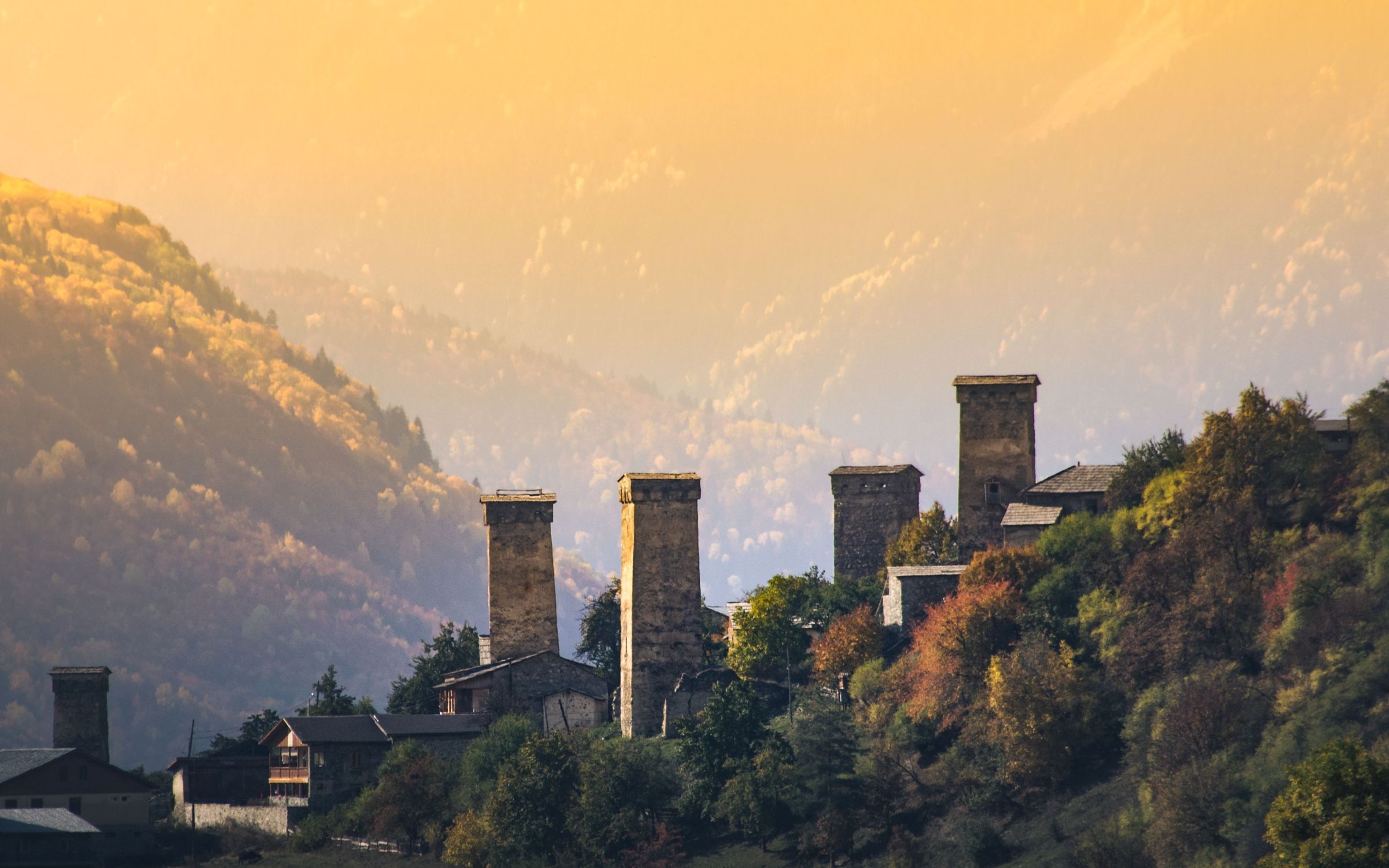
    Ushguli isn't a museum reconstruction — it's four hamlets strung along the Enguri River where Svan families still live inside the same defensive stone towers their ancestors raised between the 9th and 12th centuries, sheltering during blood feuds and Mongol raids. At 2,100–2,200 metres it's among Europe's highest permanently inhabited settlements, and Mount Shkhara's 5,000-plus-metre wall fills the horizon behind the 12th-century Lamaria Church, where pagan sacred stones sit beneath Christian frescoes. Walk on to Chazhashi, where roughly two hundred towers still stand largely intact, some still storing family provisions in their upper levels exactly as they always have. Getting there costs real effort: a rough 40-kilometre, 2.5-to-3-hour 4WD track from Mestia, impassable from November through April. That friction is precisely why the towers were never flattened for parking or rebuilt for tour buses. Basic guesthouses run year-round, but full services — and easy access — belong to June through September, so plan the visit around that window rather than around a fixed itinerary date.

    Svaneti

  3. Juta Valley & the Chaukhi Massif

    Best for a dramatic day hike without committing to a multi-day trek

    Juta sits at 2,200 metres beneath Chaukhi, the jagged granite massif Georgians nickname 'the Dolomites,' its three spires rising to over 2,300 metres above the valley floor. Until the 1980s no road reached this seasonal hamlet, and it still feels like the edge of somewhere — Khevsurs once considered these peaks the boundary of the known world. From Juta, day hikers can reach the Chaukhi Lakes at 3,300 metres or push on to the three glacially coloured Abudelauri Lakes (Green, Blue, White), a roughly 15-kilometre round trip through wildflower meadows and abandoned shepherd settlements. The valley is reached via an 18-kilometre unpaved road from Stepantsminda (about two hours by 4WD) or a five-to-six-hour walk. This is the pick for travellers who want Svaneti-grade scenery without leaving the Kazbegi side of the mountains or booking multiple nights away from Tbilisi, and it pairs easily with a same-trip visit to Gergeti Trinity Church.

    Kazbegi & the Military Road

  4. The Mestia–Ushguli Trek

    Best for serious trekkers who want days of immersion, not one viewpoint

    This is the classic Svaneti trek and the clearest reason to choose Svaneti over Kazbegi if hiking is the whole point of the trip. The route typically runs four days from Mestia to Ushguli, crossing high passes and staying in family guesthouses along the way, with Adishi — a village of roughly forty people at 2,040 metres, its stone towers overlooked by a visible glacier tongue — as a common second-night stop. Unlike a Kazbegi day hike that returns you to a hotel bed by evening, this route puts you inside the Svan highlands for the better part of a week if you add rest days, river crossings, and side trips to villages like Adishi's neighbours. Guesthouses have no formal booking platforms in the smaller villages, so arranging beds ahead of arrival matters. June through September is the only realistic window; snow and river levels make the route unreliable outside it.

    Svaneti

  5. Gudauri

    Best for skiing and winter mountain sports

    If winter sports are the deciding factor, Kazbegi's side of the mountains wins on scale and access. Gudauri sits at 2,196 metres directly on the Georgian Military Highway, roughly two hours from Tbilisi on the E117 — a genuinely simple drive compared with reaching any Svaneti ski base. Over 70 kilometres of groomed runs spread across five linked sectors, the Sadzele lift climbs to 3,279 metres for watershed views with Kazbek visible on clear days, and the Kudebi off-piste bowl draws heli-ski operators. Svaneti answers with Hatsvali and the higher, newer Tetnuldi resort above Mestia — quieter, more scenic, and worth choosing if you're already spending a week in Svaneti for other reasons — but neither matches Gudauri's size or its easy highway access from the capital. Best December through March; the highway itself can close temporarily during heavy snowfall, so build in a buffer day either side.

    Gudauri (on the road to Kazbegi)

  6. Mount Ushba & Mazeri

    Best for staring at one of the Caucasus's most dramatic peaks without a technical climb

    Ushba's twin pyramidal summits — 4,710 metres of sheer granite rising straight out of the Enguri valley — have been the iconic silhouette of the Caucasus since British alpinists first climbed it in 1888; the south summit held out until 1903 and the peak remains one of Europe's hardest technical climbs. You don't need to touch a rope to feel its presence. Mazeri, a scattered Svan community at the end of a rough valley road in Becho, puts the north face directly in front of you at breakfast, with medieval towers still standing among the cow pastures. A three-to-four-hour hike leads to the 40-metre Shdugra waterfall through old-growth beech forest, and dawn photographs from the bridge over the Dolra River catch the peak mirrored in still water before the day's thermals stir. Reach Mazeri by 4WD from Mestia (about two hours) or on foot from Becho; the last stretch needs a high-clearance vehicle.

    Svaneti (Becho community)

  7. Truso Valley

    Best for solitude, mineral springs, and an untouched borderland landscape

    Most visitors to Kazbegi never get here, which is exactly the appeal. Truso is a 15-kilometre glacial corridor cut by the Terek River, with Mount Kazbek looming to the south and the closed frontier of South Ossetia just beyond the ridgeline. The valley holds the abandoned stone towers of Keterisi village, evacuated during the 2008 war and now used only seasonally by shepherds, alongside multicoloured mineral springs and travertine terraces formed by carbonated groundwater — a genuinely unusual sight in a country better known for its wine springs than its ice-cold mineral ones. The valley ends at a moraine viewpoint over the Abano Glacier at roughly 2,800 metres. Access is a rough 4WD track from Ketrisi village, May through October only, with the final approach requiring local transport or hiking. Stay on marked paths near the border zone; this is a place to visit with a guide who knows the terrain.

    Kazbegi

Best for every traveller

  • First-timers with 2–3 days from Tbilisi: Kazbegi — Everything sits on a paved highway roughly three hours from the capital, so you get Gergeti Trinity Church, Gudauri, and the Military Highway's fortresses without ever needing a multi-night detour.
  • Serious trekkers with a week to spare: Svaneti — The Mestia–Ushguli trail network and the villages strung along it reward multiple days on foot in a way a Kazbegi day trip simply can't match.
  • Families or travellers who'd rather avoid long 4WD tracks: Kazbegi — Stepantsminda and Gudauri are reachable by ordinary road transport; Svaneti's best villages, especially Ushguli, demand hours of rough 4WD driving.
  • Architecture, culture, and history-focused travellers: Svaneti — The Svan tower-house tradition is a living, inhabited medieval architecture found nowhere else in Georgia, with UNESCO recognition to match its rarity.
  • Skiers: Kazbegi's Gudauri — A far larger, more established piste network with easier access from Tbilisi than Svaneti's smaller, higher-altitude Hatsvali and Tetnuldi resorts.

How to choose

The honest way to decide is to ask how much time and how much rough road you're willing to trade for how much depth. Kazbegi delivers an outsized view — arguably Georgia's single most photographed scene — for a half-day's effort on paved roads from Tbilisi, plus a scatter of quieter valleys like Juta and Truso for those who want to go further without going for longer. Svaneti asks for more: a longer journey in, 4WD tracks that close for half the year, and guesthouses booked ahead of arrival, but it repays that effort with an entire inhabited medieval landscape and days of trekking rather than a single vantage point. Neither is the objectively better region; they solve different trip-planning problems.

Methodology — how we ranked

This comparison weighs the two regions against the factors that actually decide a trip: how much time and driving each destination demands, how rough the roads and trails are, the scale and rarity of what's there to see, the depth of cultural and architectural weight, how the scenery photographs and compares side by side, and how sustainable the visit is for small mountain communities that depend on careful, spread-out tourism rather than a single overcrowded viewpoint. Every place named below appears in our Georgia destination atlas; nothing here is invented, and neither region is declared a flat winner because the right choice depends entirely on the traveller.

Know before you go

Practical notes, without the noise

Kazbegi is reached from Tbilisi by marshrutka, private transfer, or self-drive along the Georgian Military Highway, typically under three hours each way, making it a realistic day trip or one-night stay. Svaneti is reached via Mestia, either by daily flights from Tbilisi, a long road transfer from Tbilisi (around nine to ten hours), or a shorter drive from Zugdidi (three to four hours) on a road fully paved since 2010; Ushguli itself still requires a further 4WD leg from Mestia. Both regions run on the same core season — June through September for hiking and sightseeing, with roads and trails becoming unreliable or closed outside it — while Gudauri and Svaneti's ski bases operate December through March or April in the opposite direction. Pack for sudden weather changes at altitude in either region, and budget more transfer time and cost for anywhere off the Kazbegi highway or the paved Mestia road.

Can I visit both Kazbegi and Svaneti on the same trip?

Yes, but treat them as two separate legs rather than a loop. Kazbegi works as a day trip or overnight from Tbilisi; Svaneti needs its own multi-day block reached by flying or driving to Mestia, typically bookended by Tbilisi or Kutaisi rather than connected directly to Kazbegi.

Which region is better for photography?

They photograph differently rather than one being 'better.' Kazbegi offers a single unmatched composition — Gergeti Trinity Church against Mount Kazbek — while Svaneti offers layered shots combining inhabited stone towers with high peaks like Ushba and Shkhara in the same frame.

Do I need a 4WD for both regions?

Stepantsminda itself and Gudauri are reachable by ordinary car. A 4WD (or a long hike) is only needed for the final climb to Gergeti Trinity Church and for side valleys like Truso and Juta. In Svaneti, a 4WD is effectively required to reach Ushguli and most villages beyond Mestia.

Is Svaneti accessible year-round?

Mestia is accessible year-round by flight and by road. Ushguli and the higher villages are typically cut off by snow from November through April, when the 40-kilometre track from Mestia becomes impassable for most vehicles.

Which is better for skiing, Kazbegi or Svaneti?

Gudauri, on the Kazbegi road, has by far the larger piste network and the easiest access from Tbilisi. Svaneti's Hatsvali and Tetnuldi resorts near Mestia are smaller and higher-altitude, better suited to travellers already spending time in Svaneti than as a dedicated ski trip.

We re-check: seasonal road and 4WD track closures on the Ushguli and Truso approaches; ski lift and cable car operating dates at Gudauri, Hatsvali, and Tetnuldi; flight schedules between Tbilisi and Mestia; guesthouse availability and names in smaller villages.
Last reviewed 25 August 2026 · biannual

Every booking removes 1 tonne of CO₂ — no surcharge.