Ushguli
Best for the essential Svaneti night
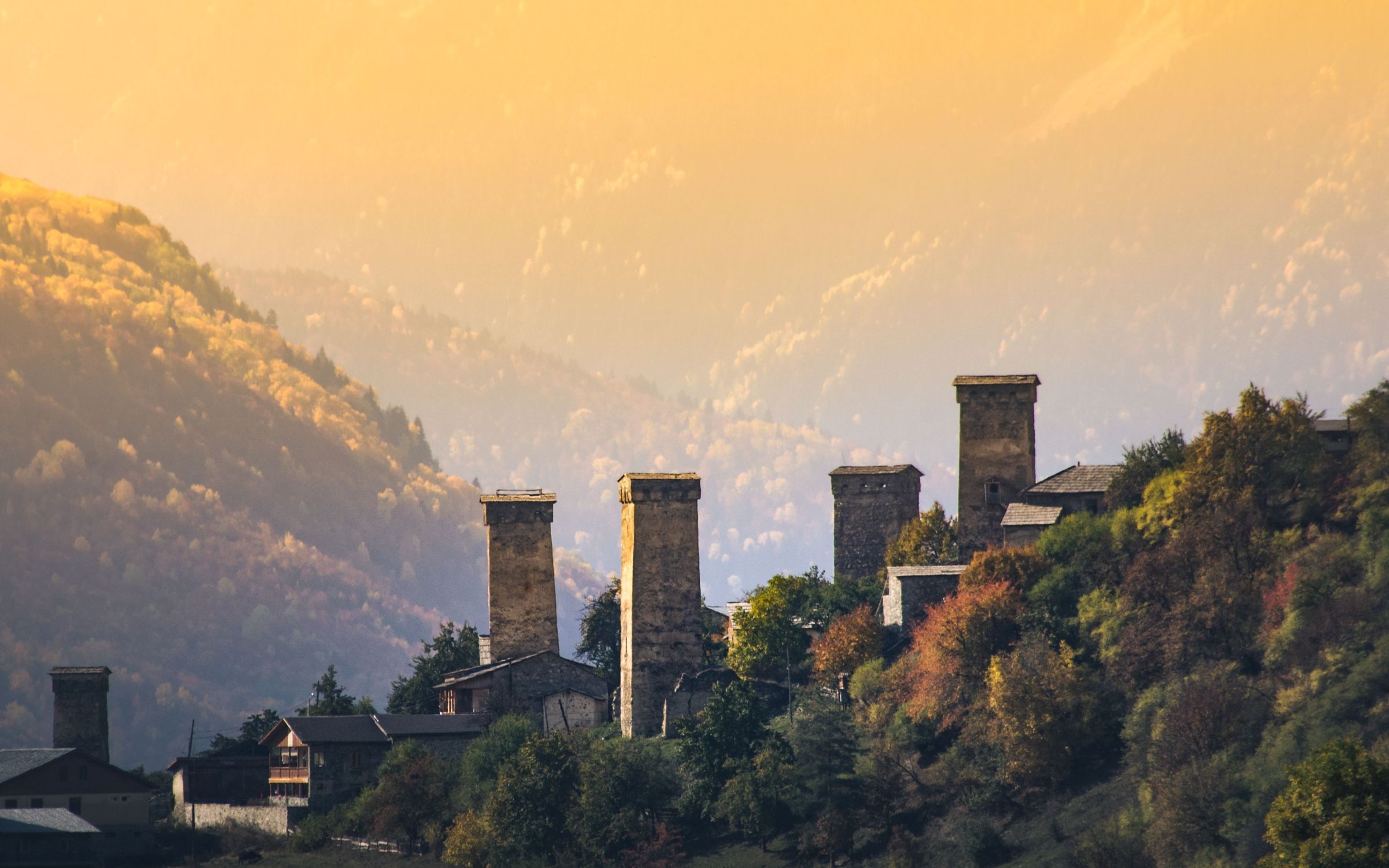
Ushguli is four hamlets strung along the Enguri River beneath Shkhara's 5,193-metre glacier, its 9th-to-12th-century Svan towers still inhabited rather than preserved behind rope lines. At 2,100–2,200 metres it is among Europe's highest permanently settled places, and the UNESCO listing recognises exactly what you come to sleep inside: families who still store provisions in the upper machub levels of towers built for defense during clan blood feuds. In Zhibiani, the Lamaria Church of the Assumption holds 12th-century frescoes beside pre-Christian sacred stones — walk up in the evening once the day-trip crowds from Mestia have driven back out. A guesthouse night here means cows in the lane at dusk, grandmothers baking kubdari in outdoor ovens, and Shkhara catching the last light through your window. Getting in is the price of admission: 40 kilometres of rough 4WD track from Mestia, 2.5–3 hours, impassable November through April. Guesthouses run year-round but are fullest and best-equipped June to September.
Adishi
Best for total wilderness immersion
Adishi holds perhaps forty people at 2,040 metres, where the Adishischala River meets the Enguri beneath a glacier tongue visible from the village itself. Its stone towers, dated to the 8th–10th centuries, are the real reason to stay: some still inhabited, others quietly collapsing, none of it staged for visitors. This is the second night's stop on the classic four-day Mestia–Ushguli trek, and the village earns that role — you sleep in a family guesthouse with cows wandering past the window, then in the morning cross the glacier's moraine-fed river barefoot or on horseback, one of the more genuine adventure moments left in European trekking. There are no formal hotels, so guesthouse beds must be arranged in advance, usually through contacts in Mestia. Come June through September; outside that window the trail and the crossing itself become unreliable. If you want a night that feels like the frontier rather than a heritage site, this is it.
Kala
Best for pilgrimage atmosphere
Kala sits at 1,400 metres on the unpaved spine between Mestia and Ushguli, a village of maybe two dozen households whose real weight lies above it: Lagurka, a 12th-century fortress-church on a steep hill holding the Kvirikoba icon of St. George, credited with healing powers and carried into battle by Svan clans for centuries. Every 28 July, thousands make the ascent for the Kvirikoba festival — polyphonic song, communal feasting, ritual traditions that predate the church itself — and a night in Kala puts you at the centre of it. Outside festival season the village returns to near-total silence, its church locked but its presence unmistakable; September and October bring clear light and empty trails. Reach it by 4WD or on foot, 4–5 hours from Mestia or 3 hours from Ushguli. Choose Kala over the bigger names if what you want from the night is not architecture but the sense of standing somewhere Svans have gathered, unbroken, for a thousand years.
Iprari
Best for unscripted hospitality
Iprari was never built as a destination — it exists because trekkers on the two-day walk from Mestia to Ushguli need somewhere to stop. Its handful of towers, raised between the 9th and 12th centuries, rise from terraced fields with none of the polish of a heritage circuit: the 12th-century Danelia family tower, with its intact stone staircases and defensive machicolations, can be climbed with permission from whoever's home. What makes a night here worthwhile is the total absence of a script. There is no formal booking system; you arrange a bed through a Mestia guesthouse contact or simply arrive and ask, and dinner is often whatever the household is already cooking — kubdari meat bread, tashmijabi cheese-and-potato — served because you're a guest, not a customer. It's reached only on foot, 6–8 hours from Mestia or a shorter walk from Zhabeshi, which keeps it firmly for travellers already committed to the trek rather than a detour from a car.
Latali
Best for towers paired with Byzantine frescoes
Latali sits on a forested ridge a short 4WD ride from Mestia, which makes it the most practical of these villages for anyone who wants a genuine tower-village night without committing to a multi-day trek. Its towers stand alongside a real artistic draw: the Matskhvarishi Church of the Savior, a 12th–13th-century structure whose interior holds a fresco cycle of the Last Judgment and donor portraits in Svan dress, work commissioned when Svaneti sheltered Christian art through Georgia's more turbulent centuries. The smaller Church of St George adds a second stop, and an old ox-track connects Latali on foot to neighbouring Chazhashi and Zhabeshi past inhabited medieval towers. Reach Latali by 4WD in about 45 minutes from Mestia, or hike the marked trail in 3–4 hours; either way you avoid the roughest tracks that gate Ushguli and Adishi. It rewards travellers with limited time, families, or anyone who wants the tower-village atmosphere without the logistics.
Mazeri
Best for waking up under Ushba
Mazeri sits at the dead end of the Becho valley, a working settlement of perhaps two dozen families where medieval defensive towers still punctuate cow pastures — but the real reason to stay is what fills the window. Ushba's north face, a 1,200-metre wall of ice and rotten granite considered one of the Caucasus's most dangerous climbs, dominates the village from breakfast table to bedtime. This isn't the Mestia corridor's polished version of Svaneti; it's a small, unpretentious community that has hosted mountaineers since Soviet alpinists first probed these walls in the 1930s. A 3–4 hour hike reaches the Shdugra waterfall with the massif filling the frame, and the bridge over the Dolra River gives the classic dawn photograph of Ushba reflected in still water. The last 8 kilometres from Becho village demand a high-clearance vehicle or arranged transport, and guesthouses operate only in season — winter here is for ski mountaineers with avalanche training, not overnight travellers.
Zhabeshi
Best for pairing a tower-village night with skiing
Zhabeshi sits at 1,500 metres where the Mulakhi Valley opens toward the Caucasus wall, a Svan village of stone towers and hay meadows whose character shifted when the Tetnuldi ski resort opened nearby in 2016. It's the one village on this list with a genuine winter economy: families still drive cattle through the lanes each morning while skiers gather along the upper road for the shuttle to Tetnuldi's lift-served terrain, glacier visible above. The Gabiani family tower, one of roughly a dozen medieval defensive structures scattered through the upper village, sits a short walk from where the ski minibuses load. A night here means waking to church bells and cowbells rather than hotel corridors, with a clear sightline to Ushba's twin horns from the village edge. Best December through March if skiing is the point, though a 4WD is essential for the final 3 kilometres in snow — book ahead, since Zhabeshi's guesthouse beds are limited and fill quickly in peak season.