Best for a first-time visitor's base
Tbilisi's old quarter still follows the bend in the Mtkvari River where the city was founded in the 5th century around a hot spring, and it wears its layered history openly: Persian-influenced balconied houses lean over cobbled lanes, the brick domes of the Abanotubani sulfur bathhouses steam year-round, and Narikala Fortress watches over all of it from the ridge above, reachable by cable car or a steep footpath. Anchiskhati Basilica, the city's oldest surviving church, sits a few streets from Rustaveli Avenue's theatres and museums, and the Bridge of Peace makes a clean modern counterpoint at night. It works as a base rather than a single stop — Mtskheta's Jvari Monastery and Svetitskhoveli Cathedral are a half-hour away, and every other region on this list is reachable from here by marshrutka or car. Spring and early autumn are kindest; the cobblestones turn punishing in summer heat and winter ice, and small churches close for services without posted hours.
Tbilisi
Svaneti (Mestia & Ushguli)
Best for Svan tower villages and glacier views
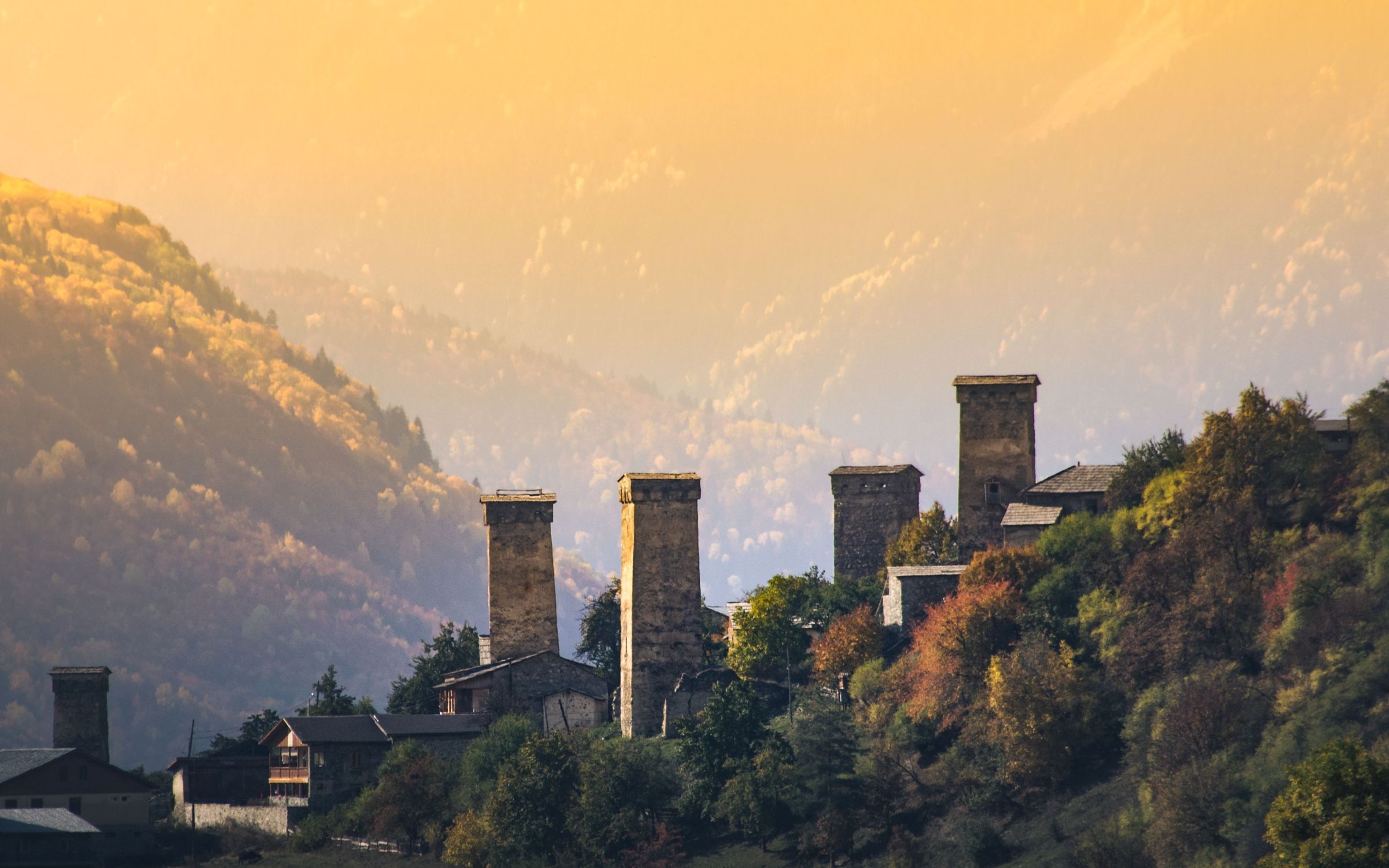
Svaneti is where Georgia's mountain identity is most visible: stone defensive towers, built between the 9th and 13th centuries by families who needed to survive blood feuds and avalanches alike, still stand — and are still lived in — across the valley. Mestia is the practical base, with a cable car up to Hatsvali for views of Mount Ushba and trailheads toward the Koruldi Lakes. Ushguli, a UNESCO-listed cluster of four hamlets beneath the 5,193m Shkhara glacier, is the payoff: a genuinely medieval settlement, not a reconstruction, four kilometres' walk from the ice itself. Getting there is the honest cost of the reward — a rough 4WD track from Mestia takes two and a half to three hours and closes with snow from November to April. Come June through September for hiking, or December to April for skiing lower down; this is not a place to rush.
Svaneti
Sighnaghi & the Kakheti Valley
Best for wine and gentle countryside
Kakheti is Georgia's wine country in the literal, 8,000-year-old sense — qvevri clay vessels still ferment grapes underground the way they did before the pyramids were built. Sighnaghi is the valley's showpiece town: an 18th-century fortified hill town with a fully walkable 4km wall and 23 towers, looking out over the Alazani Valley to the Caucasus. Family wineries such as Pheasant's Tears and Okro's Wines pour tastings and lay on courtyard supra feasts, and Bodbe Monastery, two kilometres downhill, holds the tomb of Saint Nino, who brought Christianity to Georgia in the 4th century. It pairs naturally with a detour to David Gareja's desert monastery complex on the way back to Tbilisi. Best visited March to November; a marshrutka from Tbilisi's Samgori station takes about ninety minutes, making this an easy add-on rather than a detour.
Kakheti
Kazbegi & Gergeti Trinity Church
Best single-day mountain pilgrimage
No image sells Georgia's mountains harder than Gergeti Trinity Church, a 14th-century stone chapel standing alone at 2,170 metres with the glaciated face of Mount Kazbek filling the sky behind it — built with no village around it, only wind and a view. The drive up the Georgian Military Highway to Stepantsminda is itself one of the country's great routes, climbing through the Aragvi valley past Ananuri Fortress before the terrain turns properly alpine. From Stepantsminda, a 4WD taxi or a steep walk reaches the church; more ambitious travellers push on to Juta village and the jagged Chaukhi Massif, nicknamed Georgia's Dolomites, or attempt the multi-day Kazbek summit trek with a registered guide. It is doable as a long day trip from Tbilisi (about three hours each way) but rewards an overnight. Best June to September; the highway itself can close after heavy snow.
Kazbegi
Best for layered medieval history
In 1185, Queen Tamar ordered a fortress-monastery carved into a cliff above the Mtkvari River as a refuge from Mongol invasion, and what her masons produced was thirteen storeys of hand-hewn rock: wine presses, a bakery, a forge, an irrigation tunnel, and the Church of the Dormition, whose fresco of Tamar herself is the only portrait made from life of Georgia's greatest ruler. At its peak the complex sheltered as many as 50,000 people; earthquakes and time have exposed much of it to the open air, which only makes the scale easier to read. It sits 30km from Akhaltsikhe, itself worth a stop for the restored Rabati Castle, and combines well with the spa town of Borjomi on the return route. Visit May to October, wear sturdy shoes for the uneven stone stairs, and expect the climb to be more strenuous than the drive suggests.
Samtskhe-Javakheti
Batumi & the Adjara Coast
Best for beach time and nightlife
Batumi is Georgia's answer to a Black Sea holiday, and it commits to the role: a seven-kilometre boulevard, laid out in 1884 for the port city's elite and expanded through Soviet and post-Soviet decades, runs past Dancing Fountains synchronised nightly to music from May through October and the slow-moving ‘Ali and Nino’ sculpture, two aluminium figures that merge and separate on a ten-minute cycle. The subtropical climate, casinos, and late restaurants give it a different pace from anywhere else on this list — useful as a contrast after several days in the mountains, and a straightforward flight or overnight train from Tbilisi. Walking the full boulevard takes about ninety minutes, or rent a bicycle from stations along the path. Come May to October for the fountains and beach clubs; the promenade itself is pleasant year-round for a shorter visit.
Adjara
Best for skiing and high-altitude adventure
Gudauri sits at 2,196 metres on the Georgian Military Highway at the foot of the Cross Pass, a Soviet-era resort that has become the most developed winter destination in the Caucasus, with Mount Kazbek visible from the lift lines on clear days. Over 70km of piste is only part of the draw: the Kudebi off-piste bowl is served by A-star helicopters for heli-skiing, and the Sadzele lift climbs to 3,279 metres for one of the longest vertical descents in the Eastern Caucasus, back down to the base village. In summer the same slopes turn into paragliding launch sites with the same views, minus the crowds. It's a straightforward add-on for anyone already driving the Military Highway toward Kazbegi. Best December through March for snow; the highway is the only access road and closes intermittently in heavy weather, so build in a buffer day.
Mtskheta-Mtianeti
Martvili & Okatse Canyons
Best for canyon adventure near Kutaisi
West Georgia's limestone canyons make an efficient, high-payoff day out from Kutaisi. Martvili Canyon, a 700-metre gorge carved by the Abasha River and sacred to pre-Christian inhabitants before a 7th-century monastery claimed its pools for baptisms, is toured by a short guided boat ride through walls just metres apart, with a walking trail to the 30-metre Dadiani Waterfall. Okatse Canyon, nearby, is walked rather than boated, along a cantilevered metal walkway bolted to the cliff face above the gorge floor. Both sit within reach of Prometheus Cave's illuminated limestone chambers, letting an ambitious day combine three very different landscapes without changing base. Best May through October, when river levels allow the Martvili boat tours to run; each site charges its own small entrance fee, with boat tickets bought separately on-site.
Samegrelo
Best for frontier desert landscape
Founded in the 6th century by St. David Garejeli, one of the Thirteen Assyrian Fathers credited with shaping Georgian Christianity, David Gareja is a string of rock-hewn monasteries strung along a bare semi-desert ridge that the modern border with Azerbaijan now cuts through. The Lavra Monastery is still inhabited by monks living in cave cells beside a 6th-century church; a steep hour-long climb from there reaches the Udabno caves, where 10th-to-13th-century frescoes — including a striking royal portrait—survive in abandoned cells with views running to the horizon in both directions. It is the starkest landscape on this list, a genuine change of register from the Caucasus peaks and green valleys elsewhere in the country, and works well as a long half-day trip from Tbilisi or a stop on the way to Kakheti. Visit April to June or September to October; summer heat is severe and the final 10km of unpaved road often calls for a 4WD.
Kakheti
How to choose
Start from how much driving you're willing to do. Tbilisi, Kakheti, and David Gareja form a tight, easy triangle within two hours of each other and of the airport — a realistic base for a short trip. Svaneti, Kazbegi, and Gudauri each demand a dedicated overnight or two in the mountains, on roads that can close with weather, so treat them as separate legs of the trip rather than day trips from the capital. Batumi and the west Georgia canyons form their own pocket, best reached by the Tbilisi-Kutaisi or Tbilisi-Batumi train rather than tacked onto a mountain itinerary. Few travellers manage all nine in one visit; picking one from the capital cluster, one mountain region, and Batumi or the canyons if time allows gives a trip that feels complete rather than rushed.
Methodology — how we ranked
We ranked places on seven criteria: the strength and rarity of the experience itself, how distinct it is from everything else on this list (no two entries compete for the same trip), how realistically a traveller can reach and visit it, value for the time and money it asks, the scenery or craft on display, its weight in Georgian history and culture, and whether visiting it supports the place rather than straining it. A site had to clear all seven to make the cut — that is why this list runs to nine rather than a round ten, and why several well-known monasteries and towns that are merely pleasant, not distinctive, were left off.