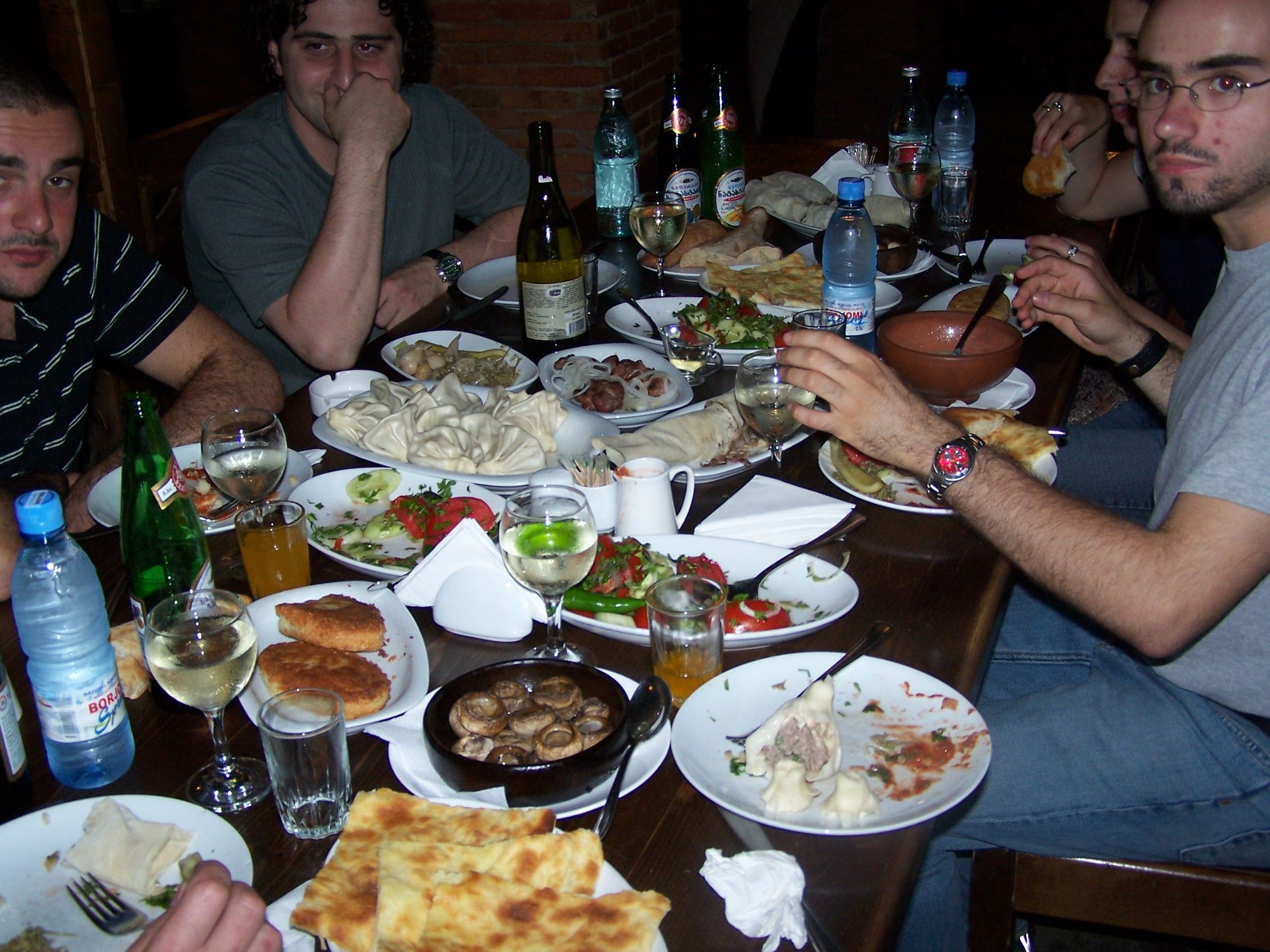
Khachapuri
Best for understanding Georgian food in one bite
Khachapuri is cheese-filled bread, but that description undersells a dish with at least half a dozen distinct regional forms. Imeretian khachapuri is a round, low loaf with cheese baked into the dough itself, the everyday version found on nearly every menu. Adjaruli khachapuri, from the Black Sea coast, is the boat-shaped showpiece: a canoe of bread filled with cheese, topped with a raw egg and a knob of butter that you stir in tableside so the yolk and cheese turn into a molten sauce, then tear pieces of the crust to dip. Megruli khachapuri adds a second layer of cheese on top. None of these are interchangeable, and a good bakery or restaurant will tell you which region's version you are getting. Order the Imeretian style as a snack and the Adjaruli boat as a meal in its own right — it is genuinely filling.
Nationwide, with Adjaruli style rooted in Adjara
Khinkali
Best for a hands-on introduction to Georgian dining etiquette
These are large, hand-pleated dumplings, usually filled with spiced minced meat and a savoury broth that forms as they steam. They come with a strict etiquette: pick one up by its topknot, take a small bite from the side, sip the broth out, then eat the rest — the twisted knob of dough on top is traditionally left on the plate, not eaten, and a pile of discarded knobs is how a Georgian waiter tallies how many you had. Meat versions (kalakuri, spiced with cumin) are the classic order; mountain regions also make khinkali with potato, mushroom, or cheese fillings, especially useful for vegetarians. They are eaten with the hands, without cutlery, and pair naturally with the pepper grinder rather than any sauce.
Nationwide, with mountain versions strongest in Khevsureti, Pshavi and Kazbegi
Mtsvadi (Georgian Barbecue)
Best for a supra centrepiece
Mtsvadi is skewered, open-fire grilled meat — most often pork, sometimes beef, lamb, or chicken — marinated simply, usually just with onion, and cooked over vine cuttings or oak coals rather than charcoal briquettes, which gives it a distinct smokiness. It is the dish that anchors a proper outdoor supra: skewers are often served straight off the fire onto flatbread, with a plate of raw onion rings and tkemali (sour plum sauce) alongside. In wine country especially, mtsvadi and a first pour of new wine are treated as a single ritual marking the start of a meal, not just a dish. Roadside and countryside restaurants that grill to order, rather than reheating, are worth seeking out over central Tbilisi tourist rooms.
Nationwide, especially strong in Kakheti and rural supra settings
Qvevri Wine
Best for tasting an 8,000-year-old winemaking method
Georgia is where wine fermentation in buried clay vessels called qvevri began, a method UNESCO has recognised as intangible cultural heritage, and Kakheti is its heartland. Qvevri wine, especially the amber (orange) whites made by fermenting white grapes on their skins for months, tastes genuinely different from anything produced in stainless steel — tannic, savoury, and structured rather than fruit-forward. Rtveli, the autumn grape harvest, is the best time to see the process, but family cellars around Telavi and Sighnaghi open for tastings year-round, often paired with home-cooked food rather than a formal flight. This is worth doing at a working cellar rather than only ordering the bottle in a Tbilisi restaurant.
Kakheti, centred on Telavi, Sighnaghi and Kvareli
Racha's Smoked Pork and Khvanchkara Wine
Best for a mountain region's own food identity
Racha, in the mountains between Kutaisi and the high Caucasus passes, has a food identity distinct enough to be worth a detour for. Its cured and smoked pork, jonjoli (pickled bladdernut flower shoots), and Racha-style khachapuri (made with a richer, more buttery dough than the Imeretian version) reflect a colder, more insular highland larder. It is also the source of Khvanchkara, Georgia's best-known semi-sweet red, made from Aleksandrouli and Mujuretuli grapes grown around Ambrolauri, historically associated with Stalin's table and still one of the few semi-sweet reds taken seriously by wine drinkers rather than dismissed as a tourist pour. Trying the food and the wine together, in Ambrolauri itself, is a different experience than either found separately in the capital.
Racha, around Ambrolauri
Churchkhela
Best for an edible souvenir that is actually good
Churchkhela is walnut or hazelnut halves threaded on a string, dipped repeatedly in thickened grape must (tatara) until they build up into a firm, chewy, candle-shaped sweet, then air-dried. It is sometimes called Georgian Snickers by guides, which undersells how central it is to Georgian food culture — traditionally made at the same time as the grape harvest and given as a portable, non-perishable source of energy. Colours and grape varieties vary by region. Buy it from market stalls or roadside vendors in wine country rather than shrink-wrapped airport versions, and check that it feels slightly soft and fresh rather than rock-hard, which means it has been sitting too long.
Nationwide, best sourced fresh in Kakheti markets
Lobio and Mchadi
Best for an inexpensive, deeply comforting everyday meal
Lobio is a slow-cooked kidney bean stew, seasoned with coriander, marigold, and sometimes walnut, often served bubbling in its own small clay pot. It is a staple of Georgian fasting cuisine (built around Orthodox fasting days when meat and dairy are avoided) and one of the most reliably good vegetarian dishes in the country regardless of the occasion. It is classically eaten with mchadi, a dense, slightly sweet cornbread that replaces wheat bread at many rural tables, particularly in western Georgia where maize historically outcompeted wheat. Together they are the cheapest genuinely excellent meal available almost anywhere, and a useful counterpoint to the meat-heavy image most visitors arrive with.
Nationwide, strongest in Imereti and Samegrelo
Adjika and Suluguni Cheese
Best for understanding Georgian flavour building blocks
These two are less a single dish than the pantry items that make everything else taste distinctly Georgian. Adjika is a fermented, walnut-and-spice-thickened chilli paste from Abkhazia and Samegrelo, used as a condiment and a cooking base — sharper, more aromatic, and far more complex than a simple hot sauce. Suluguni is a brined, semi-hard, slightly stretchy cheese from Samegrelo, eaten fresh, grilled, smoked, or melted into khachapuri; it is one of the two or three cheeses that define Georgian cooking. Buying both at a working market, where vendors will let you taste before you choose, is a better introduction than any restaurant plate, and both travel well if you want to bring a taste of the trip home.
Samegrelo, sold in markets nationwide