Mtskheta
Best for a Historic Send-Off
Before the road climbs into the Caucasus, it passes Georgia's ancient capital, and skipping it would mean starting the journey a thousand years too late. Mtskheta sits at the confluence of the Mtkvari and Aragvi rivers, its skyline anchored by Svetitskhoveli Cathedral, the 11th-century church said to hold Christ's robe, and by Jvari Monastery on the hilltop above—the vantage point that gives the road's summit its name. This is where Georgia's conversion to Christianity in the 4th century is written into stone: cross-in-square architecture, royal burial vaults, and a UNESCO World Heritage listing that covers the whole historic core. Most drivers spend an hour here before turning north; that's enough to see both churches but not to linger over the Old Town's smaller chapels. Treat it as the overture, not a full concert—the road's real drama starts about 20km further on, once the valley narrows and the fortresses begin.
Ananuri Fortress & Zhinvali Reservoir
Best Overall Stop
About 70km north of Tbilisi, the road delivers its first genuine showstopper: a 17th-century fortress complex belonging to the Dukes of Aragvi, rising directly above the jade-green Zhinvali Reservoir. The Church of the Assumption, completed in 1689, carries some of Georgia's finest surviving stone carving—vine-scrolls, beasts, and a hunting frieze attributed to master mason Tazari Jughayisdze—while the fortress walls above still hold their crenellations. The reservoir itself was created in 1986 by damming the Aragvi to supply Tbilisi, and in dry years the submerged remains of old Zhinvali village briefly resurface near the shore. The combination of fortified stone, carved churches, and still water framed by mountains is the single most photographed scene on the entire route, and it costs nothing to walk the grounds. Arrive in the morning if possible—tour buses from Tbilisi cluster here by early afternoon, and the light on the water is best before then anyway.
Pasanauri
Best for a Khinkali Break
Pasanauri sits where the White Aragvi and Black Aragvi rivers meet without mixing—their mineral content keeps the two currents visibly distinct from the town's old Soviet-era bridge, a small natural curiosity worth two minutes' pause. The bigger reason to stop, though, is on the plate: Pasanauri is where highland Georgians say khinkali, the pleated, broth-filled dumpling, was invented, and family-run restaurants here serve it hand-folded and eaten by hand, never with a fork or knife. It's the natural halfway point and lunch stop for anyone driving the road in a day, before the climb toward Gudauri gets serious. Rafting operators also launch Class III–IV trips on the Aragvi from town in warmer months, for travelers with an extra half-day to spare. There's no reason to linger overnight this far south with Gudauri and Kazbegi still ahead, but no one should drive past Pasanauri hungry, and it's a sensible place to top up on fuel and snacks before the road starts climbing in earnest.
Gudauri
Best for Adrenaline and Altitude
At 2,196 meters, Gudauri is a Soviet-era resort reborn as Georgia's most developed mountain destination, sitting directly on the highway just below the Jvari Pass. In winter it's the country's premier ski town: over 70km of groomed runs across five linked sectors, a lift running to 3,279 meters, and heli-ski access to the wide, north-facing Kudebi bowl for those chasing off-piste terrain. The rest of the year the same slopes host paragliding launches, with tandem flights running May through October over the Aragvi valley and Kazbek's glacier on clear days. Even travelers with no interest in skiing or flying should slow down through Gudauri—the Greater Caucasus wall rises straight from the road here, and it's the last proper town with real infrastructure (fuel, food, accommodation) before the high pass and the descent toward Kazbegi. The Tbilisi–Gudauri highway is the only access road and can close intermittently in heavy snow, so winter drivers should check conditions before setting out.
Jvari Pass & the Russia–Georgia Friendship Monument
Best Panoramic Viewpoint
The road's literal high point, Jvari Pass (Cross Pass) sits around 2,379 meters and marks the watershed between the Black and Caspian Sea drainage basins—everything flows south from here, then everything flows north. A short distance below the summit stands the Russia–Georgia Friendship Monument, a 1983 Soviet concrete arc commissioned for the 200th anniversary of the Treaty of Georgievsk, its interior covered in vivid mosaic panels by Georgian artist Zurab Tsereteli depicting eighteen scenes from both nations' shared and contested history. The irony of a friendship monument on a road built for imperial and military purposes is not lost on most visitors, but the view is unimpeachable: Mount Kazbek and Mount Shani dominate the northern horizon, and the Aragvi valley unfurls below in one uninterrupted sweep. There's no entry fee and a small café operates on-site. This is a five-minute stop that produces the road trip's best photograph—budget for the crowds that know it too.
Kobi and the Truso Valley
Best for Off-Road Adventure
Just past the pass, at Kobi, the paved highway effectively surrenders and a rough side track breaks west into the Truso Valley—a 15km glacial corridor along the Terek River that most drivers never see because it demands a 4WD and a full extra day. The payoff is Georgia's strangest highland landscape: multicolored mineral springs and travertine terraces staining the riverbed orange and white, and the abandoned Ossetian village of Keterisi, whose 18th-century stone towers were evacuated during the 2008 war and now stand empty except for seasonal shepherds. The valley runs close to the administrative line with Russian-occupied South Ossetia, so travelers should stay on marked tracks and expect the final kilometers to require hiking or a local driver rather than a rental car. This is a stop for travelers with time, a sturdy vehicle, and genuine curiosity about the region's harder history—not a highway pull-off.
Dariali Gorge & Gveleti Waterfalls
Best for a Short, Dramatic Hike
North of Kobi the valley closes into the Dariali Gorge, a granite cleft so narrow that for millennia it was the only viable route between the Black and Caspian Seas—the ancient Darial Pass, the 'Gate of the Alans,' fought over by Persian, Roman, Mongol, and Russian armies in turn. A ruined 12th-century watchtower, sometimes called Tamar's Fortress, still clings to a cliff above the road. A short detour from the highway leads to the twin Gveleti Waterfalls: the lower fall drops about 25 meters and is reachable via a stepping-stone scramble roughly ten minutes from the parking area, while the upper fall requires another twenty minutes through birch forest. It's an easy, high-reward stop for anyone stretching their legs after hours in the car. Note that the final approach to the actual Russian border checkpoint beyond here requires a permit from Stepantsminda police, and foreign travelers are not permitted past the last checkpoint regardless.
Stepantsminda & Gergeti Trinity Church
Best Iconic Finale
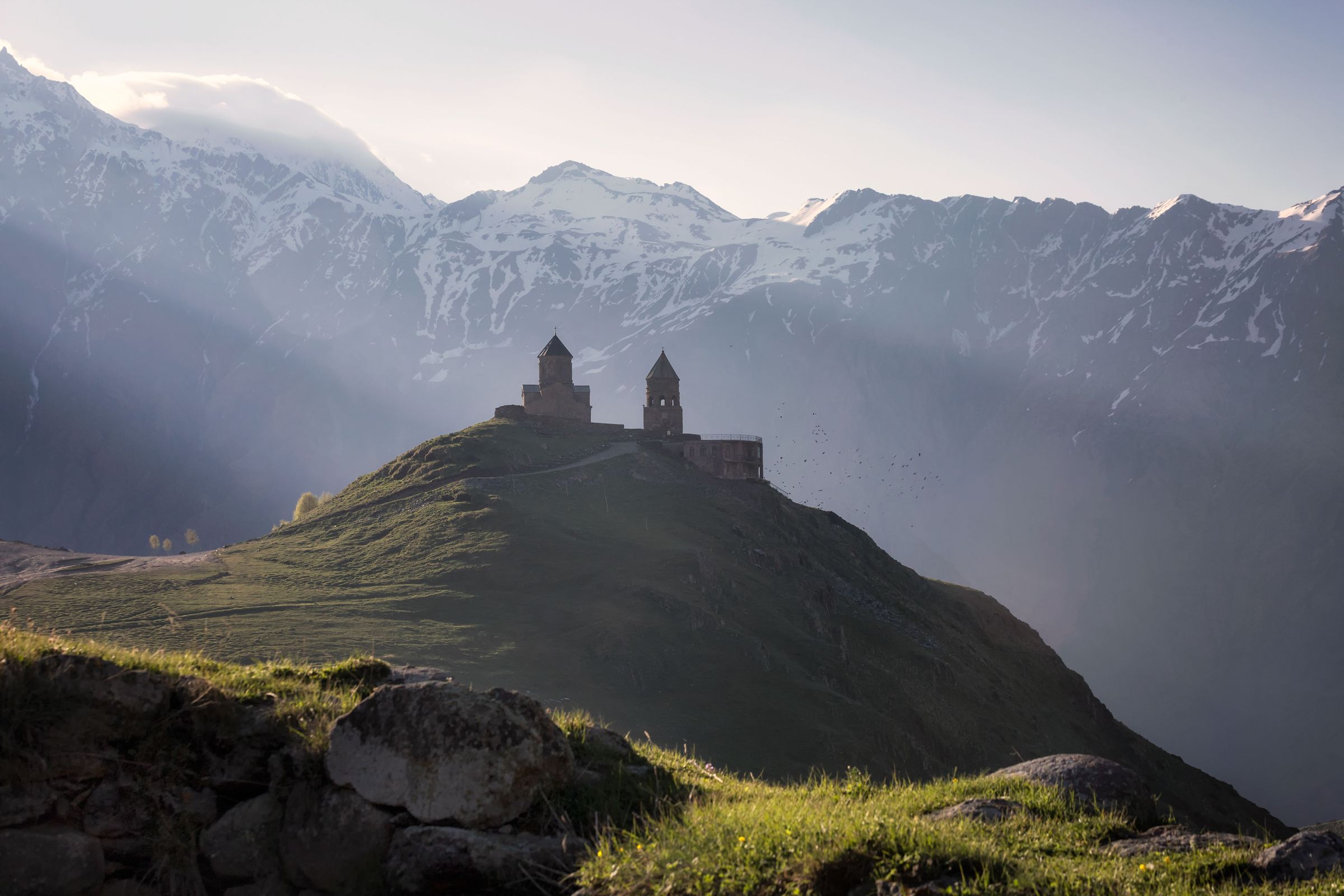
Stepantsminda (still widely called Kazbegi) is the road's natural endpoint for almost every traveler: a modest town of guesthouses at 1,740 meters, sitting directly beneath Mount Kazbek's 5,047-meter dormant volcanic cone—the peak where Greek myth chained Prometheus. From here, the 14th-century Gergeti Trinity Church is reachable by a 6km trail (3–4 hours on foot) or a rough 4WD track, climbing to 2,170 meters on a bare ridge with no village, no trees, and Kazbek's glacier rising directly behind the apse. The image of that small stone church against the mountain is Georgia's single most recognizable postcard, and it earns the reputation: the churchyard viewpoint fifty meters northwest frames bell tower and summit in one shot. Plan to stay overnight in town rather than rushing the hike after a long drive—early morning light on the church, before the day's 4WD taxis arrive, is worth the extra night alone.
Juta Valley via Sno
Best for Serious Trekkers
For travelers with an extra day and proper hiking legs, a turnoff near the village of Sno—itself worth a brief stop for its Svanidze clan defensive towers—leads up an 18km unpaved road to Juta, the last settlement before the wilderness of Khevsureti. Juta sits at 2,200 meters beneath Chaukhi, a jagged limestone massif locally nicknamed the 'Georgian Dolomites,' and serves as the trailhead for two of the region's best treks: a full-day hike to the turquoise Chaukhi Lakes at 3,300 meters, and the longer route to the three distinctly colored Abudelauri Lakes. This is not a highway pull-off but a genuine detour, reachable only by 4WD or a five-to-six-hour walk, and it rewards travelers who want the Military Road's mountains without the crowds gathered at Gergeti. Guesthouses in the valley offer overnight stays for those tackling the passes toward Roshka rather than a there-and-back day trip.