Tbilisi or Batumi: Which Should You Visit?

Best of Georgia · Head to head

Tbilisi or Batumi: Which Should You Visit?

How to read this ranking

Ordered for how you travel, not for spectacle.

Each place below is scored for character, welcome, access across seasons, and the feeling it leaves — never for inventory. Use the traveller-type notes when two names pull equally.

The quick answer

If you have to pick one, choose Tbilisi: it holds Georgia's deepest history, its best food and wine culture, and the easiest access to the mountains and Kakheti's vineyards. Choose Batumi instead if a Black Sea beach holiday, a modern seafront boulevard, and warm-weather nightlife matter more to you than churches and canyons. With five days or more, the honest answer is both — a direct train links them in under six hours.

Top picks

  • Best Overall First Visit: Tbilisi
  • Best for a Beach-and-Boulevard Break: Batumi
  • Best If You Have 5+ Days: Tbilisi and Batumi Together
  1. Tbilisi

    Best for layered history and old-town wandering

    No other Georgian city compresses this much history into a walkable footprint. Tbilisi Old Town follows the riverbend where the city was founded in the 5th century over hot springs, and its carved wooden balconies sit within sight of Narikala Fortress, a Persian-founded citadel expanded by Arabs, Mongols, and Georgians across roughly 1,700 years. Below the fortress, the domed bathhouses of Abanotubani still pipe 40°C sulfur water into private rooms, much as they did for Pushkin. Cross the glowing glass span of the Bridge of Peace into Rustaveli Avenue, and you move from medieval alleys to the neoclassical facades and the Georgian National Museum's Treasury of Colchis gold in under fifteen minutes on foot. Batumi has nothing built before the 19th century at this scale. If what you want from Georgia is the sense of standing where empires overlapped — Persian, Ottoman, Russian, Soviet — Tbilisi delivers it in a single afternoon's walk, and keeps delivering it for days.

    Tbilisi & Mtskheta

  2. Batumi

    Best for a seafront boulevard and modern skyline

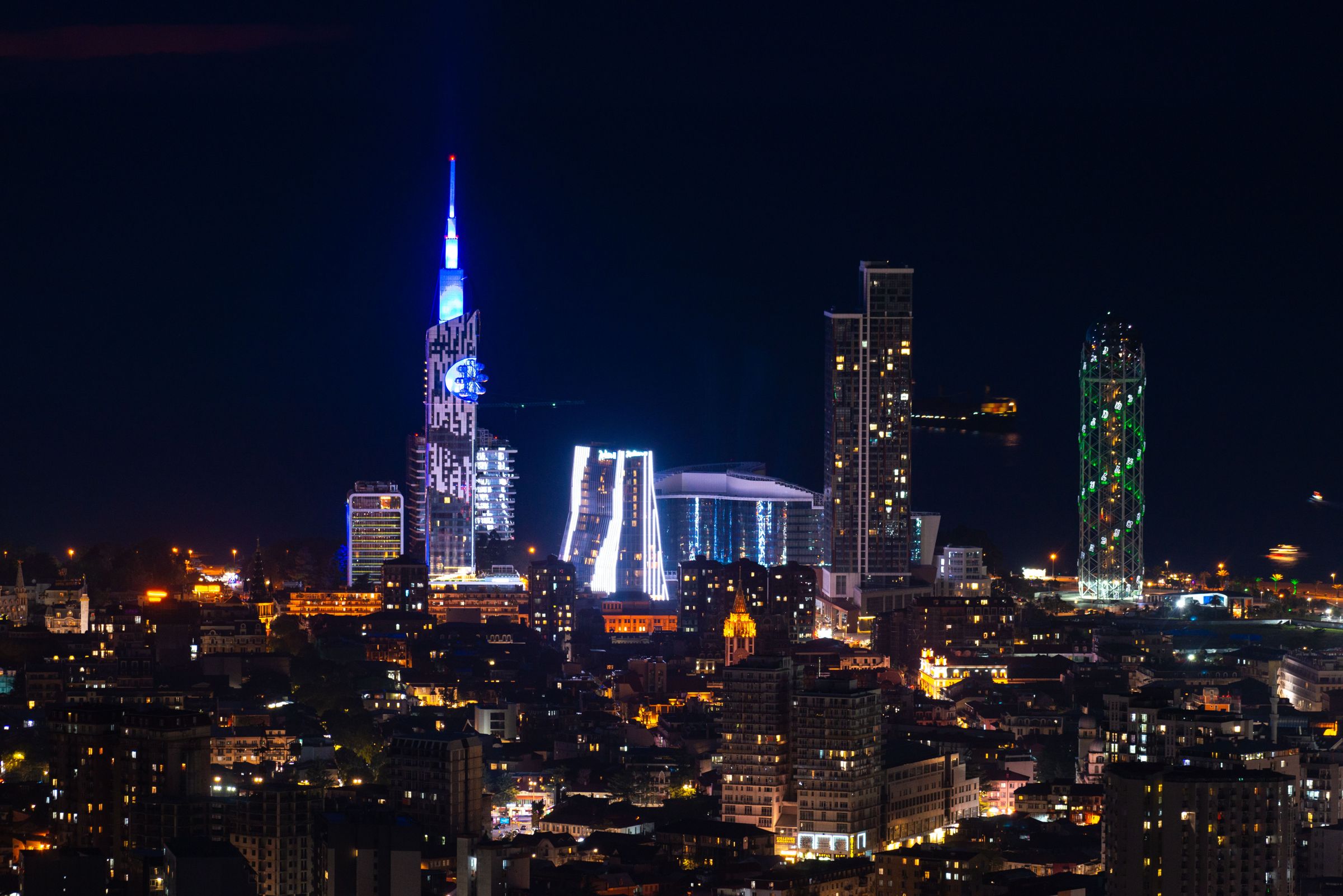
    Batumi's identity is entirely different from Tbilisi's, and that's the point. Its seven-kilometer Boulevard, first laid out in 1884 for Russian officers, has been rebuilt since 2010 into one of the most ambitious seafront promenades in the Caucasus — palm-lined, fountain-lit, and busy with Georgian families at sunset in a way no Tbilisi street quite matches. The skyline behind it mixes Soviet-era sanatoriums with genuine architectural swagger: the 130-metre Alphabet Tower spirals 33 steel letters of the Mkhedruli script into the sky, and on the waterfront the Ali and Nino sculpture — two steel figures gliding past and through each other every ten minutes — has become the most photographed public artwork in the country. Add the Piazza's Italianate mosaics and astronomical clock, and Batumi reads less like a Georgian city and more like a Black Sea resort that happens to be in Georgia. For skyline photography and an evening stroll with a drink in hand, it beats Tbilisi outright.

    Adjara & the Black Sea

  3. Tbilisi

    Best for wine culture and easy day trips to Kakheti

    Tbilisi's restaurant scene runs deeper and wider than Batumi's, but its real advantage is geography. Georgia's most important wine region, Kakheti, is under two hours away by road, meaning a Tbilisi base lets you drink at a working qvevri cellar and be back in the city for dinner. Closer still, Mtskheta — with Jvari Monastery and Svetitskhoveli Cathedral — sits twenty minutes from the capital, so a single day can cover a UNESCO World Heritage core plus a vineyard lunch. Within the city itself, the wine bars and modern Georgian kitchens clustered around Fabrika, the reclaimed 19th-century textile factory now full of natural-wine bars and creative studios, give Tbilisi a food identity Batumi hasn't built. Batumi's dining leans toward fresh Black Sea seafood and Adjarian khachapuri, which is genuinely excellent, but it's a narrower cuisine and there's no comparable wine region on Adjara's doorstep. If food and wine are part of why you're visiting Georgia at all, base yourself in Tbilisi.

    Tbilisi & Mtskheta

  4. Batumi

    Best for a proper Black Sea beach holiday

    Tbilisi has no coastline; this category belongs to Batumi by default, but it earns the win on more than geography. The city anchors a genuine variety of Adjaran beaches within a short drive: Kvariati's clear water and 15-metre visibility over smooth stones to the south, the dramatic mountains-meet-sea village of Sarpi at the literal edge of the country, and the broader, more developed strands at Makhinjauri, Chakvi, and Kobuleti to the north. All are pebble beaches rather than sand, so water shoes help, but the payoff is water clarity that most Black Sea resorts further north can't match. Batumi Botanical Garden, terraced above the coast across 111 hectares and nine climatic zones, gives a shaded, scenic break from the beach itself. None of this is available from a Tbilisi base without a multi-hour drive each way, which is why travelers building a beach-and-sun itinerary in Georgia should simply start in Batumi rather than day-trip from the capital.

    Adjara & the Black Sea

  5. Tbilisi

    Best for launching into the high Caucasus

    If the mountains are a priority, Tbilisi is the only sensible base. The Georgian Military Road runs north from the capital past Ananuri's fortress and lakeside walls, climbs through the ski town of Gudauri, and ends at Kazbegi (Stepantsminda), where Gergeti Trinity Church sits alone on a ridge beneath Mount Kazbek's glaciers — a full day trip that's genuinely one of the best in the Caucasus, and undoable from Batumi without an overnight. Svaneti's watchtower villages are further out but still route through or near Tbilisi more sensibly than via Adjara. Batumi's own mountain access, the Adjara highlands around Khulo and Goderdzi reached by the historic cable car, is real but smaller in scale — foothills and a ski pass rather than 5,000-metre peaks. For travelers whose main reason to visit Georgia is the high Caucasus scenery that shows up in every photo of the country, Tbilisi's position at the mountains' southern gateway makes the choice straightforward.

    Tbilisi & Mtskheta

  6. Batumi

    Best for after-dark energy and warm-season nightlife

    Batumi built its modern identity around evening entertainment in a way Tbilisi, for all its bars and clubs, hasn't matched on the waterfront itself. The Boulevard becomes a different place after dark: the Ali and Nino sculpture glides under lights, the Alphabet Tower and Ferris wheel illuminate the skyline, and the dancing fountains and beachfront cafes stay busy well past midnight through the warm season. Batumi's casinos, a legacy of tax policy that drew Turkish and regional visitors across the border for a weekend, give the city a Vegas-on-the-Black-Sea flavor that has no Tbilisi equivalent — Tbilisi's nightlife is real but concentrated in techno clubs and wine bars rather than a single glittering strip. The trade-off is seasonality: Batumi's evening energy is built for May through October, and much of it quiets considerably in winter. If you're visiting in summer and want a lively, walkable evening scene by the water, Batumi is the stronger pick.

    Adjara & the Black Sea

  7. Tbilisi

    Best for a trip that works in any season

    Batumi is at its best from May to October; outside that window, the Boulevard empties, seasonal cafes close, and several beach-town attractions reduce their hours or shut entirely. Tbilisi doesn't have this problem. Its museums, sulfur baths, churches, and restaurant scene run year-round, and a light dusting of snow over Narikala Fortress or Mtatsminda Park is arguably more atmospheric than a summer haze. Winter also brings the capital within easy striking distance of Gudauri's ski season, adding an entirely different reason to base there that Batumi can't offer. For travelers whose dates are fixed by flights or work rather than by Georgia's beach season, Tbilisi is simply the safer choice — nothing about the experience depends on hitting a narrow window, and shoulder-season crowds and prices are noticeably lower than a summer visit to either city.

    Tbilisi & Mtskheta

Best for every traveller

  • First-time visitors with limited days: Tbilisi — It carries the deepest concentration of Georgia's history, food, and mountain access within a single walkable base — the fullest introduction to the country in the fewest days.
  • Couples wanting a beach-and-relax break: Batumi — The Boulevard, Black Sea swimming, and a genuinely romantic evening scene around the Ali and Nino sculpture suit a slower, sun-focused trip better than an inland capital can.
  • Families with children: Batumi — Pebble beaches, the Ferris wheel, dolphinarium, and Batumi Botanical Garden give children obvious things to do outdoors; pack water shoes for the beaches.
  • History and architecture enthusiasts: Tbilisi — Narikala Fortress, Abanotubani's bathhouses, and Mtskheta's UNESCO sites nearby outweigh Batumi's mostly 19th- and 21st-century architecture.
  • Travelers with 5 days or more: Both, via the direct train — The Tbilisi–Batumi rail link runs in around five to six hours, making a split itinerary — mountains and old town first, sea and boulevard last — the most complete way to see Georgia.

How to choose

Start from what you actually want out of the trip rather than which city sounds more exciting. If you're drawn to churches, fortresses, wine, and mountain day trips, Tbilisi will keep you busy for four or five days without repeating itself. If you want to lie on a beach, walk a seafront boulevard in the evening, and eat fresh Black Sea seafood, Batumi does that better and Tbilisi can't offer it at all. The seasons matter too: Batumi peaks May through October and thins out considerably outside it, while Tbilisi works year-round. Anyone with more than four or five days should stop treating this as an either-or question — the direct train between them removes most of the friction, and the two cities are different enough that seeing both is more a change of pace than a repeat.

Methodology — how we ranked

We compared the two cities across seven criteria: depth of historical and cultural experience, uniqueness (what you genuinely can't get elsewhere in Georgia), ease of access and onward day trips, value for money, scenery, cultural weight, and how each city holds up outside peak summer. Rather than declare one city an overall winner, we scored each city against the other on the specific things travelers actually go for — old-town wandering, beach time, wine, nightlife, mountain access — and named the stronger city in each. Every place mentioned is drawn from the national atlas of verified Georgian sites, not general reputation.

Know before you go

Practical notes, without the noise

Tbilisi is Georgia's main international gateway, with Tbilisi International Airport serving most long-haul and regional flights; Batumi has its own airport with seasonal direct flights from Istanbul, Kyiv, and a handful of European cities, useful if a beach-only trip is the goal. Between the two, the daily direct train covers roughly 370 km in five to six hours and is the most comfortable option; marshrutka minibuses and shared taxis run more frequently but take longer and are less predictable. Batumi's high season runs May to October, when hotel rates rise and the Boulevard is at its liveliest; outside that window, many beachfront cafes and some attractions reduce hours. Tbilisi has no comparable off-season — spring and autumn are the most pleasant for walking, while summer heat and winter ice both make the Old Town's cobblestones harder going. Both cities are inexpensive relative to Western Europe, though Batumi's seafront hotels and seasonal dining can run higher than equivalent Tbilisi options outside summer.

Can you visit both Tbilisi and Batumi in one trip?

Yes, and it's the most common way to see Georgia properly. A direct train covers the roughly 370 km between them in five to six hours, so a week-long trip can comfortably split into a few days in each city without excessive travel time.

Which city is better for a first-time visitor to Georgia?

Tbilisi, if you can only pick one. It holds the deepest concentration of history, food, wine, and mountain day-trip access, giving the fullest sense of the country in the least time. Batumi is a strong second stop rather than a substitute.

Is Batumi worth visiting outside summer?

It's quieter and cheaper, but many seafront cafes, the cable car, and some beach-town attractions run reduced hours outside May–October. Batumi's Boulevard and city center still function year-round, so it's worth visiting off-season if the beach itself isn't the priority.

Which city is cheaper?

Both are inexpensive by Western European standards, but Batumi's seafront hotels and seasonal dining can cost more than equivalent options in Tbilisi during peak summer months. Outside the high season, prices in both cities are broadly comparable.

Is Tbilisi or Batumi better for families?

Batumi generally suits younger children better, with beaches, a Ferris wheel, dolphinarium, and botanical garden offering easy outdoor activities. Tbilisi works well for families interested in history and culture, but has fewer purpose-built children's attractions.

How far is Batumi from Tbilisi by car?

The drive is roughly six to seven hours depending on the route and traffic through Kutaisi, longer than the direct train. Most travelers without their own vehicle find the train the more comfortable option for this distance.

We re-check: hotel names; prices; seasonal access; train schedules and journey times; flight routes to Batumi International Airport.
Last reviewed 25 August 2026 · biannual

Every booking removes 1 tonne of CO₂ — no surcharge.