Best Places in Georgia for Photography | Georgia Travel

Best of Georgia · Across the country

Best Places in Georgia for Photography

How to read this ranking

Ordered for how you travel, not for spectacle.

Each place below is scored for character, welcome, access across seasons, and the feeling it leaves — never for inventory. Use the traveller-type notes when two names pull equally.

The quick answer

Georgia rewards photographers with an unusual range in a small country: glacier-backed medieval stone towers in Svaneti, a hilltop wine town wrapped in ramparts, cave cities carved into cliffs, and a Black Sea skyline that lights up after dark. Ushguli is the single most photographed scene in the country, but the best trip strings together several of these across the highlands, the wine region, and the coast.

Top picks

  • Best Overall: Ushguli
  • Best for Sunrise: Gergeti Trinity Church
  • Best for Golden Hour: Sighnaghi
  1. Ushguli

    Best for medieval towers against a glacier

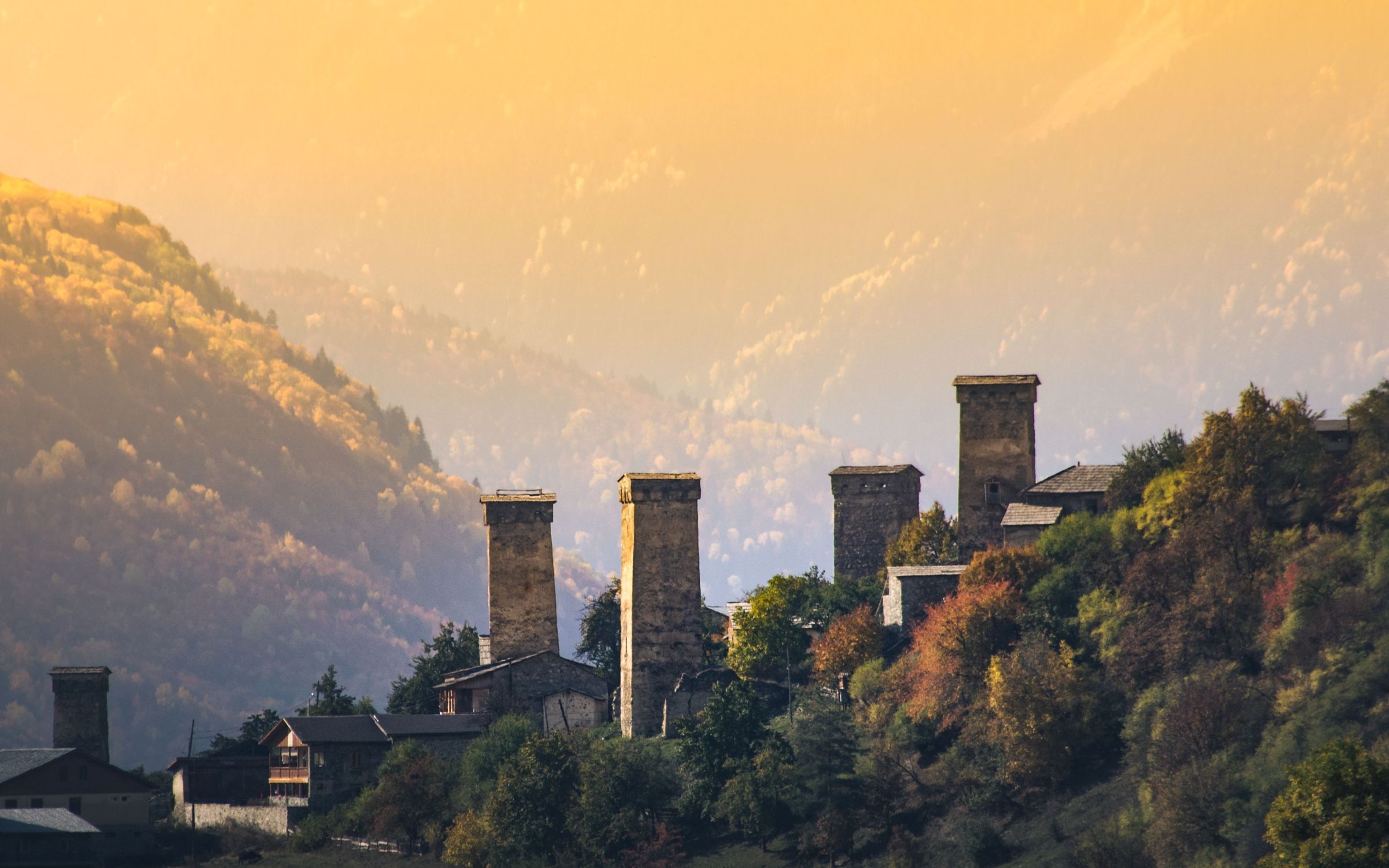
    Ushguli is the reason Svaneti appears in every serious portfolio of Caucasus photography. Four hamlets of Svan defensive towers, some standing since the 9th century, sit on a plateau at roughly 2,100–2,200 metres with the 5,193-metre glacier of Shkhara rising directly behind them — there is no middle distance to soften the scale. The strongest compositions come from the meadow east of Chazhashi, where the densest cluster of thirteen towers reads as a single silhouette against the peak, and from the four-kilometre walk toward the Shkhara glacier tongue, which opens a series of changing angles on the village as you climb. Morning light works best here: cloud tends to build over Shkhara by early afternoon, and the towers themselves face east. Ushguli is reached only by a rough 4WD track from Mestia, roughly 2.5 to 3 hours over 40 kilometres, and is impassable from November to April, so a summer visit is not optional if the glacier backdrop matters to the shot. Guesthouses are basic but open through the season; arriving the evening before gives first light without the drive.

    Upper Svaneti

  2. Gergeti Trinity Church

    Best for a single dramatic mountain-church frame

    This is the most efficient composition in the country: one 14th-century stone church, alone on a treeless ridge at 2,170 metres, with the entire eastern face of Mount Kazbek filling the sky behind it. There is a well-known viewpoint about 50 metres northwest of the church where the bell tower and the summit line up in a single frame, and it is worth reaching before the day's foot and vehicle traffic arrives — Kazbek is a temperamental subject that clouds over readily by mid-morning in July and August. The church can be reached by a rough 4WD track from Stepantsminda or by a three-to-four-hour hike, and both approaches offer their own perspectives on the peak as it comes in and out of view. The window is June through September; outside that the road up is unreliable and the church itself can be difficult to reach safely. For anyone based in Tbilisi with limited time, this is the single best return on a long day trip up the Georgian Military Highway.

    Kazbegi (Stepantsminda)

  3. Sighnaghi

    Best for golden-hour hill-town architecture

    Sighnaghi sits on a ridge above the Alazani Valley with the Greater Caucasus as a distant backdrop, and its 18th-century town walls — 23 towers along a still-walkable four-kilometre circuit — give a photographer height and framing options a flat town cannot. The town's own texture carries the shots that don't need the mountains: balconied houses, cobbled lanes, and a wine-country calm that photographs differently at every hour. Late afternoon light raking across the valley toward the Caucasus is the payoff most people come for, best caught from the wall near the town's southern towers. The Bodbe Monastery two kilometres downhill adds a quieter, garden-set subject if the town itself is crowded. Sighnaghi is an easy 1.5 to 2 hours from Tbilisi by car or marshrutka, which makes it realistic to time a visit for a specific light window rather than accepting whatever the day offers — a rare luxury in this list.

    Kakheti

  4. Ananuri Fortress

    Best for a river-framed fortress composition

    Ananuri earns its place for one specific reason: the fortress sits directly above the turquoise confluence of the Aragvi River and a tributary, and the water colour changes with the season in a way that reworks the same shot every time you return. The 17th-century Church of the Assumption inside the walls carries a rare carved exterior frieze, but the more useful vantage for photography is the climb up the worn keep steps, which puts the whole complex, the river confluence, and the Georgian Military Highway winding north toward Kazbegi into one frame. Spring and autumn give the clearest water colour and noticeably fewer visitors than summer. Because it sits right on the Tbilisi–Kazbegi road, about 70 kilometres and 90 minutes from the capital, Ananuri works well paired with Gudauri or Gergeti on the same day rather than as a standalone trip.

    Mtskheta-Mtianeti

  5. Gudauri Viewpoint

    Best for a 360-degree Caucasus panorama

    This unmarked pull-off on the Georgian Military Highway, at 2,196 metres, gives a full panorama of the Greater Caucasus rather than a single framed subject — Kazbek and Mount Shani both sit on the northern horizon, with the Aragvi valley falling away below. It suits photographers who want breadth over intimacy: wide-angle work and stitched panoramas do more here than a long lens. The Soviet-era Russia–Georgia Friendship Monument, an arched concrete structure with mosaic work, sits 500 metres south and gives foreground interest against the same mountain wall. Visibility is best April through October; winter brings heavy snow and the road itself closes intermittently, which rules out a reliable trip outside the warmer months. It sits directly on the route between Tbilisi and Kazbegi, so it costs nothing extra to add to a Military Highway day trip. Paragliding tandem flights launch from the slope just below the pull-off between May and October, and a wide lens catching a canopy against the same ridgeline adds a scale reference that a bare panorama lacks.

    Mtskheta-Mtianeti

  6. Tusheti (Omalo)

    Best for remote wilderness and stone koshki towers

    Tusheti is the hardest location on this list to reach and the one that rewards the effort most for photographers after landscapes with no crowd in the frame. Omalo, the region's only year-round village, sits at 1,880 metres with cylindrical koshki towers dating from the 16th to 19th centuries rising from a plateau that drops sharply toward the Pirikiti Alazani valley. The paired towers of the upper village and the Keselo cluster give the strongest architectural subjects; beyond the village, the surrounding valleys are largely untouched high pasture where Tush shepherds still move flocks by tradition. Access is the constraint that defines everything else here: the only road in crosses the 2,850-metre Abano Pass, typically open from late June to early October only, and the drive from Alvani takes three to four hours of switchbacks with no fuel or services once inside the park. This is a multi-day trip, not a detour, and it should be planned around that pass being open at all.

    Tusheti

  7. Vardzia Cave Monastery

    Best for cave-city texture and scale

    Vardzia is a different kind of subject entirely: not a landscape but a cliff face carved into thirteen levels of a 12th-century cave city, commissioned by Queen Tamar to shelter tens of thousands. What survives after a 1283 earthquake is still enormous — wine cellars, a bakery, a forge, and the two-storey Church of the Dormition with its fresco of Tamar herself. The photography here is about texture and repetition: rows of dark cave openings pockmarking the cliff face, best shot from across the valley in the low sun of early morning or late afternoon when the shadows in each opening read clearly. Interiors are dim and a tripod earns its keep in the fresco chamber. The 30-kilometre approach from Akhaltsikhe is paved but winding, and the site rewards visiting from May to October when the stone staircases are dry and safe underfoot.

    Samtskhe-Javakheti

  8. Martvili Canyon

    Best for turquoise water and reflections

    Martvili is the one entry on this list built entirely around water colour: the Abasha River has carved a 700-metre limestone gorge whose milky turquoise tone comes from dissolved limestone refracting light, and it changes noticeably through the day as the sun angle shifts over the narrow channel. A short guided boat ride through the tightest section, where the walls close to a few metres apart, gives a water-level perspective unavailable from the trail; the 1.5-kilometre walk to the 30-metre Dadiani Waterfall gives a second, taller subject in the same visit. The 7th-century monastery above the canyon, with its frescoed church and stone bridge, is worth the short extra climb for a wider establishing shot. The canyon only runs at photographable water levels from May through October, and it sits 45 minutes from Kutaisi, making it an easy addition to a west Georgia itinerary rather than a destination in its own right.

    Samegrelo

  9. Batumi

    Best for a lit-up coastal skyline after dark

    Batumi is the counterpoint to the rest of this list: a Black Sea city skyline rather than a mountain or monastery, and the only entry that photographs best well after sunset rather than at either end of the day. The seven-kilometre boulevard along the shore gives a clean foreground of palms and sculpture against a backdrop of illuminated towers, including the 130-metre Alphabetic Tower, and the kinetic statue Ali and Nino makes a reliable moving-subject study as it slowly embraces and separates. Shooting from the beach looking back at the skyline, or from the boulevard looking along the curve of the bay, both work; a slower shutter on the waterline adds motion that a static mountain shot never offers. The season runs May through October for comfortable evening conditions, and Batumi is reachable by direct flight or the five-hour scenic train from Tbilisi, which makes it realistic to close out a longer Georgia trip here rather than fitting it in as a rushed side trip.

    Adjara

Best for every traveller

  • Serious landscape photographers with several days to spend: Ushguli and Upper Svaneti — Nowhere else in Georgia combines this density of distinctive man-made subjects with genuine high-mountain scale, and the remote access means the light and the scene are rarely shared with a crowd.
  • Photographers based in Tbilisi with one day free: Ananuri, Gudauri Viewpoint, and Gergeti Trinity Church — All three sit on the same Georgian Military Highway corridor, so a single day trip covers a river-framed fortress, a full Caucasus panorama, and the country's most iconic mountain-church shot without doubling back.
  • Architecture and golden-hour photographers: Sighnaghi — It is the one location on this list close enough to Tbilisi to plan around a specific evening light forecast rather than accepting whatever the mountains give you that day.
  • Adventure and wilderness photographers comfortable with rough travel: Tusheti (Omalo) — The Abano Pass access filters out casual visitors, so the koshki towers and highland valleys stay uncrowded for the small number of photographers willing to plan around a narrow summer window.
  • Night and urban photographers, or anyone ending a trip on the coast: Batumi — It is the only subject here that needs darkness rather than dawn or dusk, making it a natural way to close out a highlands-and-monasteries itinerary with something completely different.

How to choose

Start from how much rough travel you're willing to take on. Svaneti and Tusheti both demand multi-day trips over unpaved 4WD tracks that close for roughly two-thirds of the year, and they reward that effort with subjects nothing else in the country matches. If time is tighter, the Georgian Military Highway corridor out of Tbilisi — Ananuri, Gudauri, and Gergeti Trinity Church — delivers three strong, very different compositions in a single long day. Wine-country and cave-monastery subjects around Sighnaghi and Vardzia are gentler on logistics and forgiving of a shorter trip. Batumi is worth keeping separate from the rest: it is the only location here that photographs best at night, so it fits naturally at the end of an itinerary rather than being squeezed into the same days as mountain light.

Methodology — how we ranked

We ranked locations against seven criteria: the strength and reliability of the light (does the subject actually look different at dawn, dusk, or under cloud), how distinctive the composition is versus generic Caucasus scenery, how physically accessible the vantage point is for a photographer carrying gear, whether the visit represents good value against the time and effort required, the raw scenic drama of the setting, the cultural or historical weight the subject carries beyond its looks, and whether visiting puts pressure on a fragile site or supports the community that maintains it. A location needed to score well on at least four of the seven to make this list; several well-known viewpoints were left off because they photograph well only in narrow weather windows or add little beyond a postcard shot already covered by a stronger entry nearby.

Know before you go

Practical notes, without the noise

Most of these locations are strongest between May and October; several — the Abano Pass into Tusheti, the Ushguli track, and the Gudauri high road — are seasonally closed and can be impassable without warning outside that window, so check current road conditions before committing to a highland route. Sturdy footwear matters more than camera gear at Vardzia's uneven stone staircases and on the Shkhara glacier trail out of Ushguli. Fuel, cash machines, and phone signal are unreliable or absent once inside Tusheti and on the Ushguli track, so plan accordingly. If flying a drone, check current Georgian registration and no-fly-zone rules before travelling, since these are tightened around monasteries, military roads, and border areas and are subject to change without much notice.

What is the single best photography location in Georgia if I only have time for one?

Ushguli. It is the only place in the country combining medieval stone towers, still inhabited, with a genuine 5,000-metre glacier as a backdrop, and the composition is difficult to replicate anywhere else in the Caucasus.

When is the best season for Caucasus mountain photography in Georgia?

June through September for the high mountain locations — Ushguli, Gergeti Trinity Church, Tusheti — since the access roads are open and the peaks are more likely to be clear of cloud. Shoulder months like May and October can still work at lower-altitude sites such as Sighnaghi, Ananuri, and Martvili Canyon, often with fewer other visitors.

Do I need a 4WD vehicle to reach these locations?

For Ushguli and Tusheti, yes — both are only reachable by rough unpaved tracks that ordinary rental cars are not equipped for, and both routes close seasonally. Ananuri, Gudauri, Sighnaghi, Vardzia, Martvili, and Batumi are all reachable by paved road.

Is early morning or late afternoon better for shooting Mount Kazbek and Gergeti Trinity Church?

Early morning, generally. Cloud tends to build around Kazbek's summit through the day, especially in July and August, so the clearest views of the peak behind the church are usually in the first few hours after sunrise.

Are any of these sites difficult to photograph respectfully because they're still active places of worship or living communities?

Yes — Ushguli's towers are still inhabited family homes, Vardzia and David Gareja remain functioning monasteries with resident monks, and Katskhi Pillar's chapel is a working religious site. Photograph from public viewpoints, ask before photographing people directly, and avoid interiors during services.

We re-check: Abano Pass opening and closing dates into Tusheti; Ushguli 4WD track seasonal passability; Georgian Military Highway winter road closures; drone registration and no-fly-zone rules; guesthouse and hotel availability in Mestia, Omalo, and Sighnaghi; boat ticket pricing at Martvili Canyon.
Last reviewed 25 August 2026 · biannual

Every booking removes 1 tonne of CO₂ — no surcharge.