What a Supra Actually Is
Best for understanding the tradition before you sit down
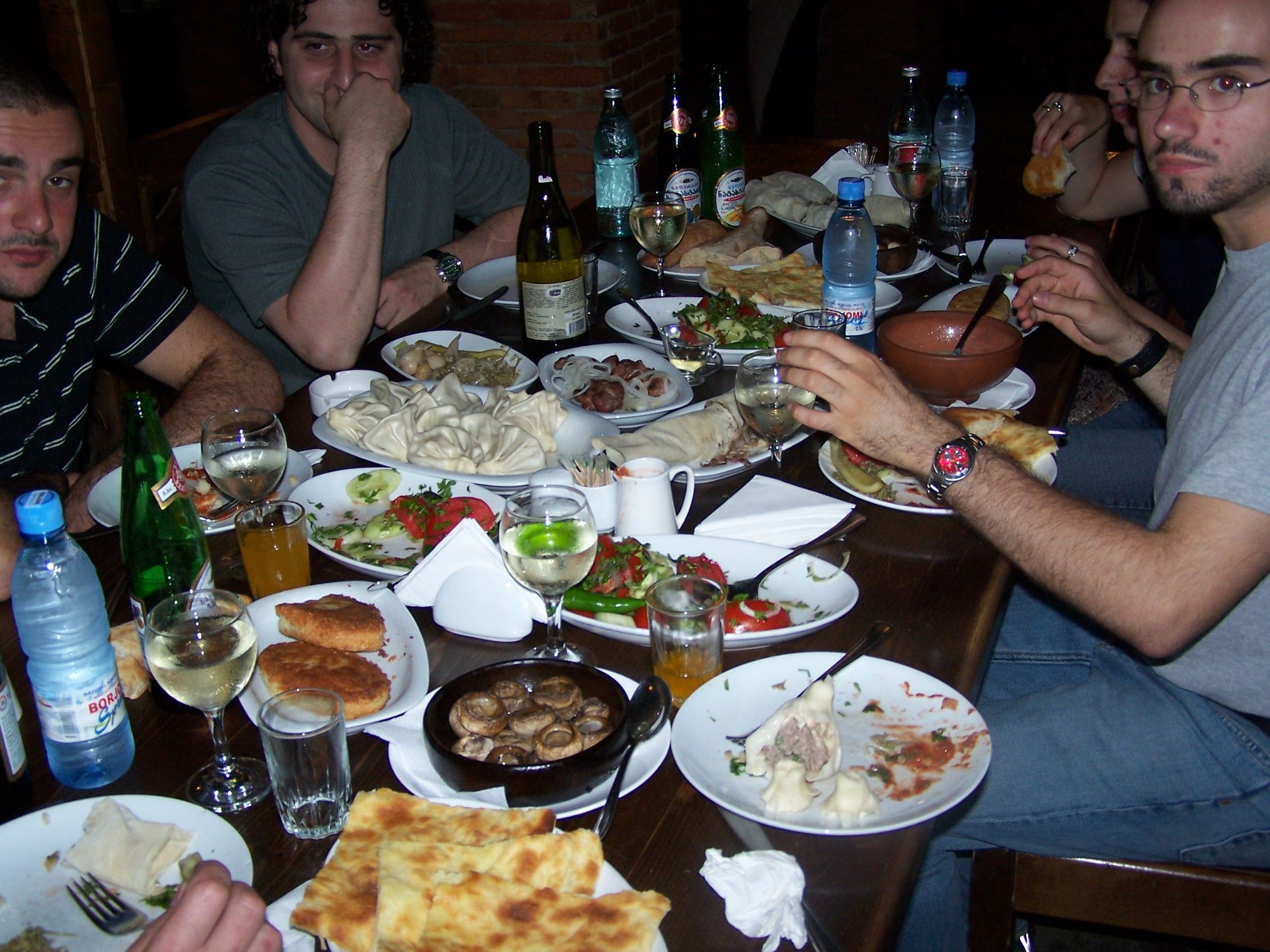
A supra is not simply a dinner party — it is a structured ritual with its own grammar. The table is laid heavy from the start, every dish arriving together rather than in courses, and it stays that way for hours: cold plates like pkhali and badrijani refreshed as they empty, hot dishes like khinkali and mtsvadi brought in waves, bread and wine never allowed to run out. What makes it a supra rather than a large meal is the presence of a tamada, a toastmaster who directs the evening through a fixed sequence of toasts, and the understanding among everyone at the table that conversation, food, and drink all answer to that sequence. Supras mark everything from weddings and funerals to a Tuesday visit from an old friend, and the tone shifts accordingly — a funeral supra (kelekhi) is solemn and specific in its toasts, while a celebratory one can run late and loud. UNESCO recognised the qvevri winemaking method underpinning it as Intangible Cultural Heritage, but the supra itself is the social vessel that gives that wine its purpose.
The Tamada and the Order of Toasts
Best for knowing what is expected of you at the table
The tamada is chosen — usually the host, or the most respected man present, though this is changing — and everyone else drinks in response to what he proposes, never before. The sequence is not improvised: it typically opens with a toast to peace, moves through toasts to the country, to those who have died, to parents, to children, to love, and to the table itself, with the tamada elaborating each into something closer to a short speech than a clink of glasses. Guests may be asked to speak after him, and a skilled tamada reads the room, drawing in a quiet traveller with a personal toast rather than leaving them as spectators. You are not obliged to finish your glass on every toast, and no host will genuinely press a guest who says they don't drink — but you are expected to raise your glass, listen, and never drink out of turn. This is the single most disorienting part of a supra for a first-time visitor and the single most rewarding once it clicks: the toasts are the meal's actual structure, and everything else is set dressing.
Reading the Table: The Dishes You Will See
Best for first-timers who want to recognise everything in front of them
The supra table is built for grazing, not sequence, so knowing a handful of names in advance changes the whole experience. Khinkali, the soup dumplings twisted into a topknot, are eaten by hand and never with a fork — hold the knot, bite the side, drink the broth, discard the knot. Khachapuri, the cheese-filled bread, appears in regional forms; the boat-shaped Adjaruli with a raw egg and butter stirred in is the showpiece but Kakhetian and Imeretian versions are just as common on a Kakheti table. Look for pkhali (walnut-paste vegetable pâtés, usually spinach, beetroot, or bean), badrijani nigvzit (aubergine rolled around walnut paste), mtsvadi (skewered pork or beef grilled over vine cuttings), lobio (bean stew, often in a clay pot), and churchkhela, the strung walnut-and-grape-must candy that ends the meal alongside fruit. Tonis puri, bread baked against the wall of a clay tone oven, is torn by hand and used to mop everything else. None of this arrives in courses; it is refreshed continuously until the tamada calls the final toast.
Qvevri Wine: The Reason Kakheti Exists
Best for wine-focused travellers who want the deeper story
The wine at a supra is not an accompaniment, it is the mechanism — toasts don't function without it. Kakheti's Alazani Valley has fermented grapes in buried clay qvevri since roughly 6,000 BCE, a method that ferments juice together with skins, stems, and seeds for months, producing the deep amber wines that mark Georgian winemaking apart from anything European. Alaverdi Monastery's monks have kept qvevri cellars running for over a millennium, and the practice never fully died even through the Soviet period, when industrial production dominated but family cellars kept working underground — literally. What you're drinking at a Kakhetian supra table, whether a family's own vintage or a bottle from one of the valley's wineries, is a continuous line from that same tradition, and the tamada's toasts are, in a real sense, older than the glass they're poured into.
Pheasant's Tears, Sighnaghi
Best for an intimate, working-winery supra
Pheasant's Tears was founded in Sighnaghi in 2007 by American painter and musician John Wurdeman alongside Georgian winemakers, built around reviving the 8,000-year-old qvevri method rather than modernising past it. The name comes from a Georgian proverb — that only wine worth drinking makes the pheasant weep — and the winery occupies a restored 19th-century house with a marani, the underground cellar where qvevri are sunk into the earth floor. The adjoining restaurant serves seasonal Kakhetian dishes built to accompany the amber and red wines rather than to headline on their own, and the supras here tend to be smaller and more conversational than the coach-tour version, with musicians who sometimes fold live polyphonic singing into the toasts. Book ahead, especially in autumn harvest season, and expect the evening to run long — that's the point.
Twins Wine Cellar, Napareuli
Best for a hands-on harvest-season supra
Run by brothers Gia and Gela Gamtkitsulashvili in the village of Napareuli, Twins Wine Cellar is a genuine multi-generational family operation rather than a built attraction — the qvevri marani sits below a working household, and the attached Museum of Viticulture and Ethnography displays the family's own pressing tools and archive pieces alongside the wine. What sets a visit here apart is participation: during the autumn harvest, visitors can crush grapes by foot in the traditional satsnakheli trough and bake bread against the wall of a tone oven before sitting down to the supra itself. Outside harvest season the tasting and meal still follow the same family rhythm, just without the grape-stained feet. This is the version of Kakheti wine tourism built around a real household rather than a stage set for one.
Tsinandali Estate, Telavi
Best for a refined supra in a historic aristocratic setting
Tsinandali was the 19th-century home of Prince Alexander Chavchavadze, the Georgian literary figure and wine pioneer who introduced European winemaking methods alongside Georgia's own qvevri tradition and effectively created Georgia's first commercial dry wine. The estate holds the country's oldest European-style wine cellar, Georgia's first botanical garden, and a museum of the Chavchavadze family's art and history, and its supras are accordingly more formal than a village cellar's — long tables under the estate's mature trees or inside its restored halls, with wines drawn from a cellar that has been producing continuously since the 1830s. It suits travellers who want the toast tradition delivered with genuine historical weight rather than rustic informality, and it works well as a stop that combines an afternoon of the museum and gardens with an evening supra on site.