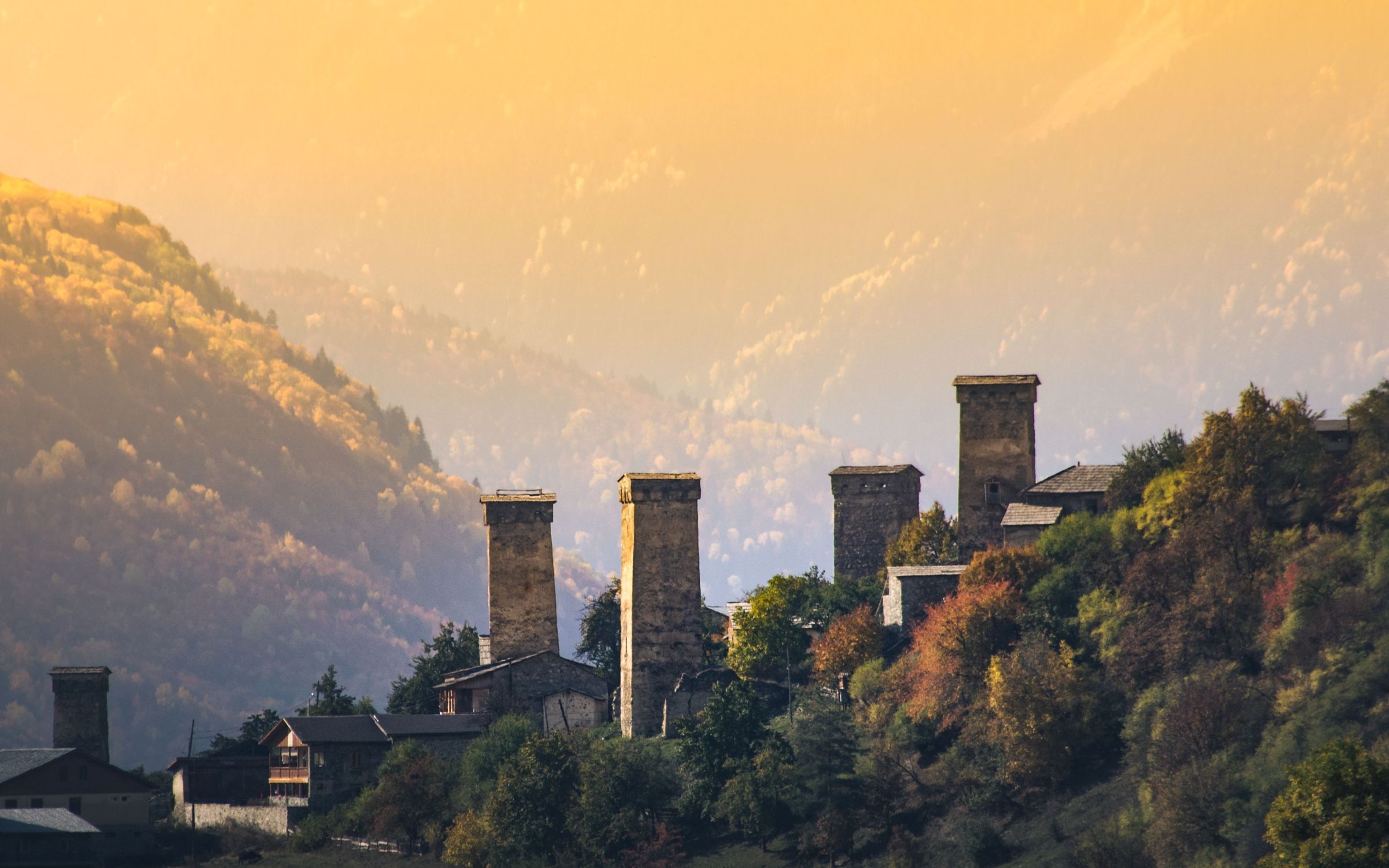
Ushguli & Upper Svaneti
Best for epic mountain scenery
Four hamlets threaded along the Enguri River beneath Shkhara's 5,193-metre glacier, Ushguli is one of the highest permanently inhabited settlements in Europe and the single image most travellers carry home from Georgia: stone Svan towers, raised between the ninth and twelfth centuries as refuges from blood feuds and invasion, still standing shoulder to shoulder with the houses beneath them. UNESCO recognised the wider Upper Svaneti valley — more than 175 of these unmortared limestone towers scattered across Ushguli, Chazhashi and seven other villages — as a masterpiece of mountain adaptation, and nowhere else in the Caucasus lets you walk directly into that history rather than view it behind glass. The approach is part of the experience: a rough 4WD track from Mestia climbs through gorge and pine forest for two and a half to three hours, closed by snow from November to April. Come June through September, when guesthouses are fully open and the high pastures are green, and stay the night if you can — the light on Shkhara at dawn and dusk is the reason people come back.
Svaneti
Best for first-time culture immersion
Tbilisi's Old Town packs the country's whole layered history into a twenty-minute walk: the brick-domed sulphur baths of Abanotubani marking the warm springs that gave the city its name, the Persian-founded Narikala fortress watching over the rooftops from Sololaki Ridge, and lanes of carved wooden balconies that have absorbed Persian, Arab, Mongol, Russian and Soviet rule without losing their own character. It's the right first stop for anyone new to Georgia — the rest of the country makes more sense once you've stood in Abanotubani and felt how central hot water, wine and hospitality are to the national story. Ride the cable car up to Narikala from Rike Park for the skyline view, then descend to soak in one of the bathhouses, most open daily into the night with private rooms bookable by the hour. Spring and early autumn are kindest on the steep cobbles; midsummer heat and winter ice both make the lanes hard going. Give it a full day at minimum, ideally two, before heading out to the regions.
Tbilisi
Best for medieval history
Vardzia isn't a ruin to glance at from a viewpoint — it's a 6,000-dwelling cave city burrowed into the Erusheti Mountains, commissioned by King Giorgi III in the 1180s and expanded into a full monastic town by his daughter, Queen Tamar, at the height of Georgia's medieval golden age. Climbing through the tunnels and stairways, you pass a throne room, wine cellars, bakeries and the two-storey Church of the Dormition, its walls still carrying fragments of the fresco cycle painted for Tamar herself — one of the few surviving contemporary images of Georgia's only reigning queen. Few sites in the country let you inhabit medieval life this physically: you duck through the same doorways monks used eight centuries ago, and the cool cave interior is a relief after the exposed approach. The drive from Akhaltsikhe runs thirty kilometres southeast past the dramatic Khertvisi fortress, best done May to October when the site is fully open and morning light hits the cliff face hardest.
Samtskhe-Javakheti
Kakheti Wine Country
Best for wine and vineyard culture
Georgia claims eight thousand years of continuous winemaking, and Kakheti is where that claim becomes something you taste rather than just hear. Sighnaghi, ringed by eighteenth-century walls built by King Erekle II against Persian and Dagestani raids, sits above the Alazani Valley's vineyard patchwork and makes the best base — cobbled streets, a round-the-clock marriage registry, and cellar doors within walking distance. A short drive away, Tsinandali Estate preserves the nineteenth-century home of Prince Alexander Chavchavadze, the aristocrat-poet who introduced European winemaking methods and built the country's first European-style cellar alongside its first botanical garden; tastings there trace qvevri clay-vessel winemaking straight through to the French techniques he imported. Between the two, a single day trip covers the full arc of Georgian wine history. Come March to November for open cellar doors and clear valley views; harvest in September and October adds working vineyards and festival energy, though small producers fill quickly, so book tastings ahead.
Kakheti
Kazbegi & the Georgian Military Highway
Best for a mountain road trip and day hikes
The drive north from Tbilisi along the Georgian Military Highway is the best way to feel the scale of the Caucasus without technical climbing gear: switchbacks past Ananuri's lakeside fortress, the Jvari Pass crossing above 2,300 metres, and then Mount Kazbek itself, a solitary 5,047-metre volcanic cone that Greek myth cast as Prometheus's prison. From the trailhead in Stepantsminda, a three-to-four-hour hike, or a bumpy 4WD ride, climbs to Gergeti Trinity Church, a lone fourteenth-century stone chapel with nothing around it but wind and Kazbek's glacier filling the sky — arguably the most photographed churchyard in the country, and worth an early start to beat the July and August crowds. It's the trip for travellers who want genuine high-mountain drama in a single manageable day rather than a multi-day trek. Visibility and road conditions are best June through September; outside that window, cloud and snow can erase the payoff, so build in a flexible spare day if the itinerary allows it.
Mtskheta-Mtianeti / Kazbegi
Martvili & Okatse Canyons
Best for canyon and cliffwalk adventure
Imereti's karst landscape hides two very different ways to experience the same milky-turquoise water. At Martvili Canyon, a limestone gorge once sacred to pre-Christian communities and later home to monks who used its pools for baptism, a small wooden boat drifts beneath sheer walls and waterfalls — a slow, cinematic way to see a place that photographs like nowhere else in the country. Twenty minutes away, Okatse Canyon flips the experience entirely: a 780-metre steel walkway, opened only since 2014 on the site of old Soviet hydroelectric works, cantilevers 140 metres above the Okatse River, and the sensation of standing on glass-railed steel over a void is the closest thing Georgia offers to genuine vertigo tourism. Pairing both in one day from Kutaisi — boat first, walkway second — gives a full sense of the region's canyon country without needing technical skills. Both run May through October, weather permitting; Okatse closes in high wind, so check conditions before committing to the drive out.
Imereti / Samegrelo
Best for off-the-beaten-path pilgrimage
David Gareja rewards travellers willing to trade comfort for atmosphere. Founded in the sixth century by the Assyrian monk David Garejeli and his twelve disciples, the complex burrows hundreds of cells, churches and chapels directly into the bare rock of the Gareja ridge, straddling the Azerbaijan border in a semi-desert landscape unlike anywhere else on this list — closer in feel to Cappadocia than to the green valleys most visitors associate with Georgia. The Lavra monastery remains an active religious community; climb past it to the Udabno frescoes for views stretching across the border into the Vashlovani steppe. It's a full day trip from Tbilisi, with the final twenty kilometres on unpaved track, so a driver or organised tour beats a self-drive rental for most visitors. Go April to June or September to October — summer heat on the exposed ridge is severe, and winter can bring snow-blocked roads. Few other Georgian sites deliver this much silence and this much history in a single stop.
Kakheti
Batumi & the Black Sea Coast
Best for a Black Sea city break
Batumi is the counterweight to Georgia's mountains and monasteries — a subtropical port city reinvented from sleepy Soviet harbour into the country's most energetic coastal escape. The seven-kilometre Boulevard, first laid out in 1884 for the city's elite and dramatically expanded after 2010, runs the length of the seafront past fountains, sculpture and the 130-metre Alphabetic Tower celebrating Georgia's unique script; walking it end to end takes about ninety minutes, or rent a bicycle from one of the stations along the way. Beyond the promenade, Batumi's mix of Art Nouveau old town, botanical garden and genuinely good seafood makes it the natural place to unwind after days of hiking or driving mountain passes elsewhere in the country. It's also the most straightforward Georgian city to reach independently, with direct flights from several regional and European hubs, or the scenic five-hour train from Tbilisi. Aim for May through October, when the fountains run and the beach clubs are open; the shoulder months either side are quieter but noticeably cooler.
Adjara
Tusheti
Best for remote wilderness trekking
Tusheti is what's left when you subtract roads, phone signal and crowds from the Caucasus — one of Europe's last genuine wildernesses, protected as a national park where medieval stone towers punctuate emerald valleys and Tushetian shepherds still drive their flocks between summer highland pastures and Kakheti's winter lowlands, a transhumance tradition recognised as intangible heritage. Omalo, the region's only year-round village, sits at 1,880 metres beneath cylindrical koshki towers built by local clans between the sixteenth and nineteenth centuries, and serves as the base for multi-day treks through valleys that see a fraction of the visitors Svaneti does. None of this is easy to reach: the only road in crosses the Abano Pass at 2,850 metres, a genuinely rough 4WD track that typically opens in late June and closes with the first snow in October, with no fuel, banks or medical facilities once you're inside the park. That inaccessibility is the appeal — this is the trip for travellers who have already done Georgia's easier highlights and want the version with nobody else on the trail. Go only in the short July-to-September window and arrange transport in advance.
Tusheti